

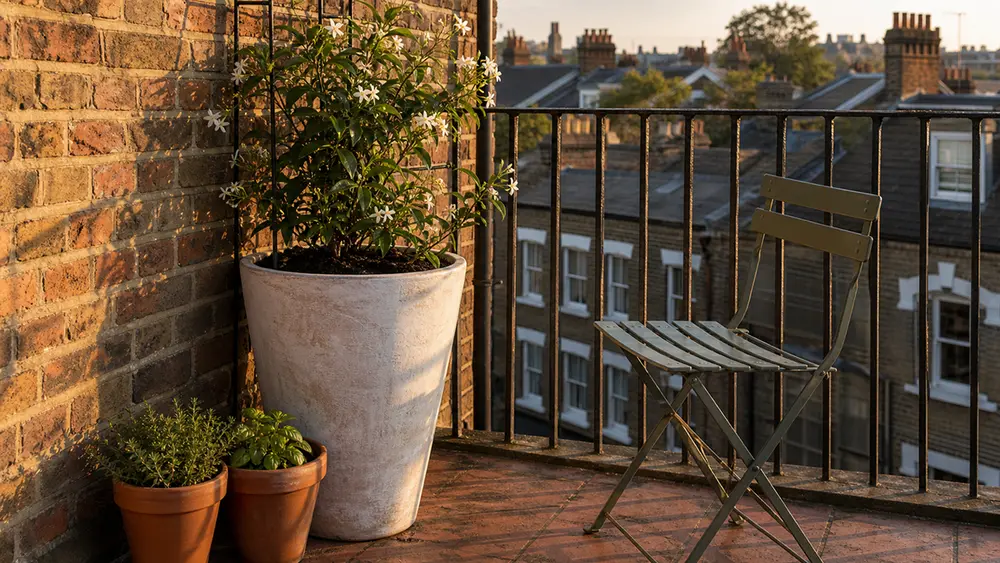
Read Your Balcony First: Aspect, Weight and Wind
The limiting factor on a small balcony is rarely space itself — it is the failure to use that space in three dimensions. Most balconies stay underplanted because the floor gets filled with a handful of pots and nothing else happens. Treat your walls, railings and vertical planes as growing surfaces equal to the floor, and choose plants that address the practical realities of balcony growing: aspect, weight, and wind.
Before choosing plants, establish three things:
- Aspect. A south-facing balcony suits Mediterranean species and sun-loving annuals; a north-facing one needs shade-tolerant plants such as ferns, Hostas and climbing hydrangea.
- Weight limit. Most residential balconies are designed to carry somewhere in the region of 150 to 300 kg per square metre, though this varies by building age and construction — check your lease or ask your building management company for your specific figure. Where floor space is constrained, lightweight poly-resin or fibreglass planters are the practical substitute for heavy terracotta.
- Wind exposure. High-rise balconies need wind-resistant, compact species rather than tall, top-heavy plants that destabilise in gusts. Exposure also affects hardiness: a plant rated for "most of the UK" in a sheltered garden border can struggle in a wind-scoured spot several floors up, so favour a sheltered corner or wall-side position for anything borderline.
Once you've read your balcony this way, you're ready to work through the twelve approaches below.
Quick Tips for Decorating a Balcony With Plants
A small balcony rewards a structured approach: use vertical surfaces as actively as the floor, choose containers suited to your weight limit, and select plants matched to your aspect. In summary, you can:
- Grow climbers vertically on a trellis or wire system
- Fix wall-mounted planters to create vertical planting zones
- Create layered height with staging and plant stands
- Anchor the space with a single structural focal point
- Plant a contained herb garden
- Mount window boxes on the railing for seasonal colour
- Screen for privacy with ornamental grasses or bamboo
- Soften hard edges with trailing and cascading plants
- Plant for evening fragrance
- Grow edibles in containers
- Choose containers for material, weight and aesthetic
- Underplant containers for multi-season interest
Each is covered in full below, with specific plant recommendations, container guidance and practical notes on aspect, weight and maintenance.
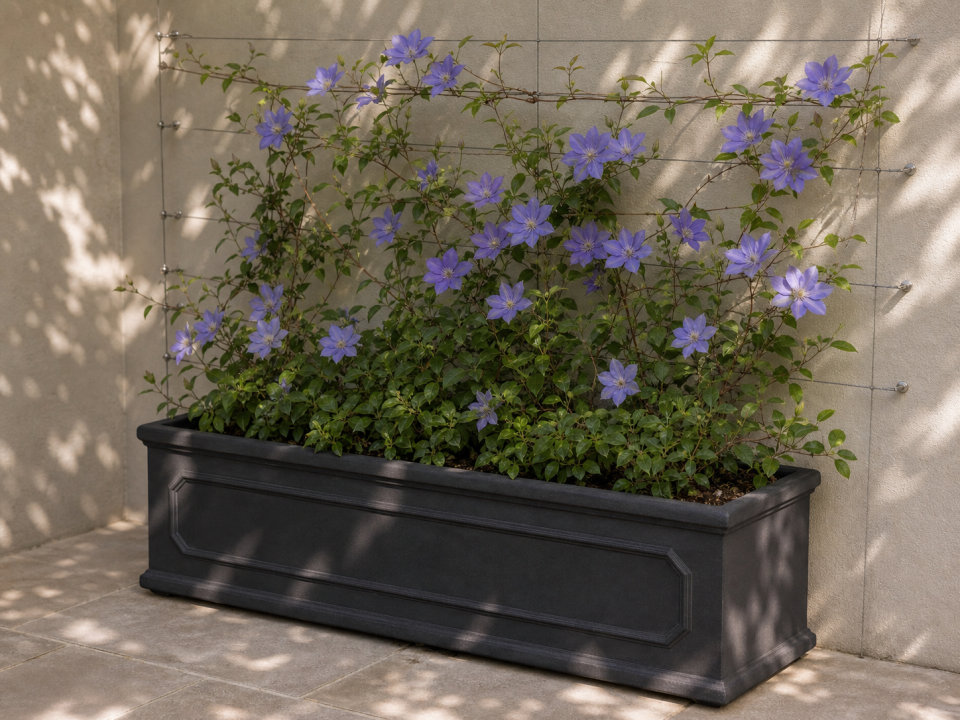
A tensioned wire or trellis system turns a bare wall into 1–2 square metres of growing space.
1. Grow Climbers Vertically on a Trellis or Wire System
Training climbers against your wall space or balcony railing delivers maximum planting impact for minimum floor footprint. A tensioned wire system fixed to the wall at 30 cm intervals, or a freestanding trellis panel, gives a climbing plant the structure it needs to cover 1 to 2 square metres of vertical space.
For a south or west-facing balcony in a reasonably sheltered spot, Trachelospermum jasminoides (star jasmine) is the standout choice: it is RHS-rated H4 — hardy through most of the UK once established — and produces powerfully scented white flowers from July to September, reaching 4 to 6 metres over several years while staying manageable in a large container. It performs best against a warm wall out of the wind; on an exposed high-rise balcony, give it the most sheltered corner you have. Clematis cultivars suited to container growing include Clematis 'Arabella', a non-clinging herbaceous type that flowers repeatedly from June to October and grows to around 1.5 metres, and Clematis montana for rapid coverage. For a north or east-facing aspect, Hydrangea anomala subsp. petiolaris (climbing hydrangea) is one of the few true self-clinging climbers that tolerates deep shade.
Use a container of at least 40 litres and a soil-based compost (John Innes No. 3) for long-term climber plantings. Refresh the top 5cm of compost annually and feed with a slow-release fertiliser each spring.
2. Fix Wall-Mounted Planters to Create Vertical Planting Zones
Wall-mounted planters occupy no floor space and turn a bare rendered wall into a vertical garden. Modular systems in terracotta-finish resin, galvanised steel, or felt pockets all perform well, provided fixings are secured into masonry rather than render.
Sempervivum and Sedum species suit wall planters well because they tolerate drought and survive in shallow compost depths of 8 to 10cm. For a more decorative display, plant trailing Lobularia maritima (sweet alyssum) or Bacopa (Sutera cordata) in the upper rows and let them cascade down. Herbs work equally well: a column of wall planters with Thymus vulgaris, Salvia officinalis and Mentha — grown in its own contained pocket to control spread — creates a productive kitchen garden at eye level.
If you're fixing planters to a shared balcony wall in a managed building, confirm with your building management company or freeholder that wall fixings are permitted before you drill.
3. Create Layered Height With Staging and Plant Stands
A flat arrangement of pots at ground level produces no visual depth. Three-tier staging or a stepped plant stand creates the layered effect of a planted border, with taller plants at the rear and trailing varieties at the front edge.
Position the tallest plant at the back: a structural upright such as Libertia grandiflora, Miscanthus sinensis 'Morning Light', or a standard clipped Laurus nobilis (bay) sets the height. At mid-level, plant bushy seasonal colour: Pelargonium, Argyranthemum frutescens, or Fuchsia. At the front edge, use trailing plants to cascade down: Calibrachoa, Dichondra 'Silver Falls', or trailing Lobelia erinus 'Cascade'.
Aluminium or powder-coated steel staging is the better choice on weight grounds; avoid heavy wooden staging unless you've confirmed the load-bearing capacity of your balcony floor.
4. Anchor the Space With a Single Structural Focal Point
One well-chosen architectural plant does more visual work than five competing ones. A structural focal point gives the eye somewhere to land and turns a collection of pots into a composed planting.
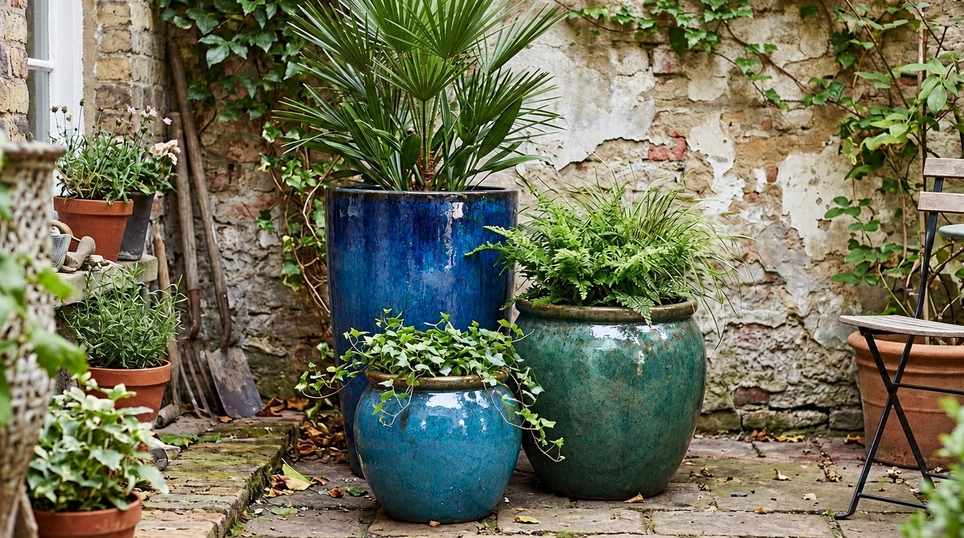
For a south-facing balcony, Trachycarpus fortunei (Chusan palm) is reliably hardy in London — RHS-rated H5, hardy even in most severe UK winters — grows slowly enough to remain manageable in a large container for several years, and brings unmistakable subtropical structure. Cordyline australis cultivars such as 'Torbay Red' or 'Red Star' provide bold strap-shaped foliage in dark burgundy or green-bronze, though container-grown specimens are more exposed to cold than plants in open ground and benefit from fleece wrapping in a hard frost. For a more contemporary look, Agave americana in a glazed ceramic container delivers structural drama with minimal maintenance, though it needs protection from prolonged frost.
Choose a container proportional to the plant's eventual size: a 50- to 60-litre pot is the minimum for a mature Trachycarpus or Cordyline. Use a loam-based John Innes No. 3 compost with 20% added horticultural grit for drainage.
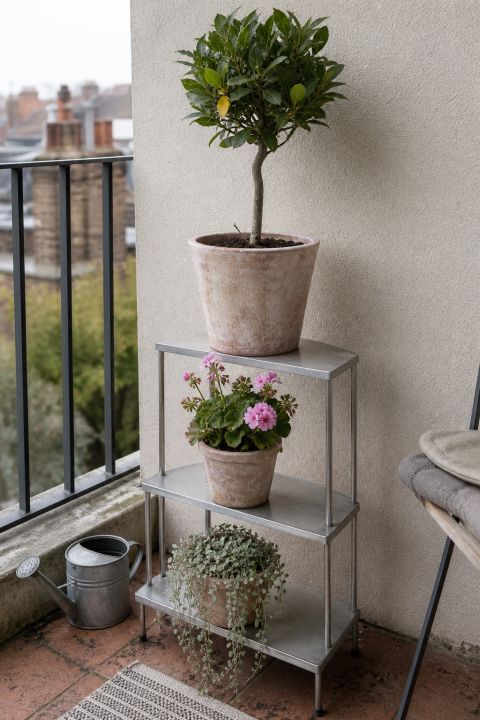
Staging and plant stands create the depth of a planted border in a fraction of the floor space.
5. Plant a Contained Herb Garden
Herbs reward small-space gardening in direct proportion to their value: daily harvest, fragrance, structural interest and pollinator support from a single container.
A deep window box (at least 25cm deep) or a 30-litre container planted with Rosmarinus officinalis, Thymus vulgaris, Salvia officinalis 'Purpurascens', and Origanum vulgare creates a compact but productive Mediterranean planting. All four need full sun and free-draining compost — mix John Innes No. 2 with 25% horticultural grit. Add Allium schoenoprasum (chives) and flat-leaf Petroselinum crispum (parsley) for cooler-season coverage.
Ocimum basilicum (basil) performs best in the warmest, most sheltered position on the balcony and needs replacing each year as a tender annual. Mentha species are productive but invasive; always grow mint in its own pot to stop it overwhelming its neighbours.
6. Mount Window Boxes on the Railing for Seasonal Colour
Railing-mounted window boxes extend your planting area beyond the balcony floor by using the vertical plane of the railing itself. They work particularly well for seasonal succession planting, letting you rotate spring, summer and autumn displays without any permanent floor commitment.
For spring, plant compact Tulipa cultivars such as 'Ballerina' (apricot, lily-flowered) or 'Negrita' (deep purple) alongside Narcissus 'Tête-à-Tête' and Muscari armeniacum. For summer, Pelargonium 'Tomcat', Petunia 'Cascadia Rim Magenta', and trailing Verbena bonariensis create a long-season display. Move into autumn with Cyclamen persicum and ornamental Brassica for colour into November.
Make sure railing-mounted brackets are rated for the weight of a saturated container — a standard 60cm window box filled with compost weighs 8 to 12kg once wet, and brackets need to be secured to the railing structure rather than clipped loosely. Self-watering boxes with a reservoir base reduce how often you need to water in summer.
7. Screen for Privacy With Ornamental Grasses or Bamboo
Privacy is one of the most practical goals of balcony planting, and tall ornamental grasses and bamboo both achieve it while adding movement, sound and seasonal texture.
Phyllostachys nigra (black bamboo) is the most architectural choice: it grows to 3 to 5 metres, produces striking ebony-black canes in its second year, and responds well to container growing. Because bamboo is vigorously rhizomatous, plant it in a robust, well-draining container — the drainage holes lined with a root-barrier fabric or fine mesh — rather than one with open drainage; the roots will otherwise find their way out through the holes and continue spreading. A sturdy metal or well-built wooden planter works better here than plastic, which running bamboo roots can eventually break through. For a north-facing or partially shaded balcony, Fargesia murielae (umbrella bamboo) is a clumping, non-invasive alternative that tolerates shade and is fully hardy.
For a more naturalistic effect, Miscanthus sinensis 'Morning Light' grows to 1.5 metres in a container, produces pale feathery plumes from August to October, and catches evening light beautifully. Calamagrostis x acutiflora 'Karl Foerster' offers a more upright, formal habit, reaching 1.8 metres with minimal spread.
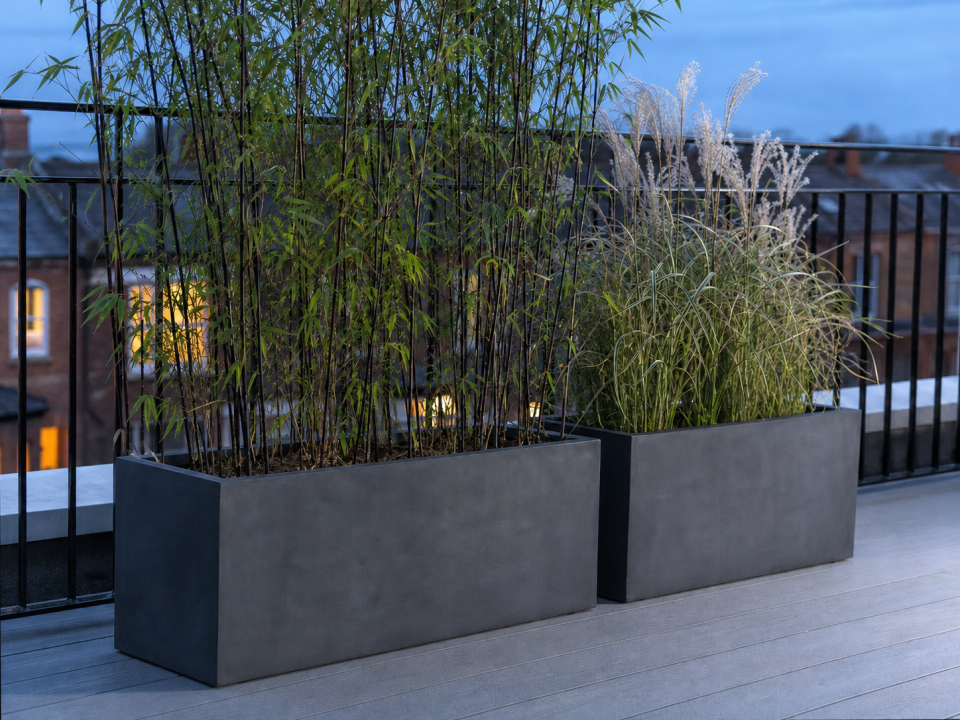
Tall grasses and clumping bamboo add privacy along with movement and seasonal texture.
8. Soften Hard Edges With Trailing and Cascading Plants
Concrete balcony floors, metal railings and rendered walls read as harsh without plant material to interrupt them. Trailing and cascading plants placed at the front edge of containers, in railing boxes, or at the base of staging blur the boundary between hard and soft.
Dichondra 'Silver Falls' is one of the most effective trailing balcony plants: its kidney-shaped silver-grey leaves cascade to 1.2 metres in a season and it thrives in full sun with infrequent watering. For shadier balconies, trailing Fuchsia cultivars such as 'Swingtime' or 'Dark Eyes' deliver a long display of pendant flowers from June to October. Bacopa (Sutera cordata) is a compact, self-cleaning trailer suited to mixed containers, while trailing Lobelia erinus 'Cascade Series' gives an intense cobalt-blue at the front of summer boxes.
Add trailing plants at the outermost edge of any tiered arrangement to reinforce the layered effect and connect the planting visually to the space below.
9. Plant for Evening Fragrance
Balconies are used most intensively in the evening, and scented plants repay that timing with particular generosity.
Trachelospermum jasminoides produces some of the most powerful summer fragrance of any hardy climber, its vanilla-scented white flowers intensifying in warmth from July to September. Nicotiana sylvestris (tobacco plant) grows to 1.2 metres in a container, produces tall white tubular flowers, and releases its fragrance most strongly after dusk. Matthiola incana (stock) is best used as a cool-season annual, planted in autumn or early spring for fragrance from March to June.
Lavandula angustifolia 'Hidcote' is a compact sun-loving lavender (45cm) with deep violet flowers and strong aromatic foliage that draws pollinators through the summer. For a shadier balcony, Convallaria majalis (lily of the valley) grown in a shaded container delivers exceptional fragrance in May from a species that needs no direct sun.
10. Grow Edibles in Containers
Container-grown edibles are among the most productive uses of a small balcony, and several food crops are bred specifically for restricted growing spaces.
Tomato 'Tumbling Tom Red' and 'Tumbling Tom Yellow' are trailing varieties that produce cherry tomatoes from a 25cm hanging basket or railing-mounted pot. Strawberry 'Elsanta' (Fragaria x ananassa) grows well in a tiered strawberry planter — plant 20 to 25cm apart and switch to a low-nitrogen fertiliser once flowers appear. For soft fruit with a longer season, Vaccinium corymbosum (highbush blueberry) grows to 1.2 metres in a 30-litre pot of ericaceous compost; plant two cultivars such as 'Bluecrop' and 'Duke' for cross-pollination and a better yield.
Dwarf French beans (Phaseolus vulgaris 'Annabel') and compact courgette varieties such as Cucurbita pepo 'Patio Star' both perform well in containers of 30 litres or more. Water consistently — both crops are sensitive to irregular moisture and produce poorly under drought stress.
11. Choose Containers for Material, Weight and Aesthetic
Container choice defines the visual identity of a balcony planting as much as the plants themselves. Material affects weight, moisture retention, root temperature and longevity — all of which influence plant health.
| Material | Weight (empty, 40L) | Water Retention | Best Suited To | Notes |
|---|---|---|---|---|
| Terracotta | 8–12 kg | Low (porous) | Mediterranean herbs, Agave, Cordyline | Heavy — avoid on weight-restricted balconies |
| Fibreglass / poly-resin | 2–3 kg | Moderate | Any species; ideal where weight is constrained | Best default choice for load-limited balconies |
| Glazed ceramic | 6–10 kg | High | Hostas, ferns, moisture-loving perennials | Water-retentive; heavy |
| Galvanised steel | 3–5 kg | Low (drains fast) | Grasses, herbs, drought-tolerant species | Drill adequate drainage holes |
For balconies with confirmed weight constraints, fibreglass and poly-resin containers are the practical default: a 40-litre fibreglass pot weighs roughly 2 to 3kg empty, against 8 to 12kg for an equivalent terracotta pot. Avoid dark plastic containers in south-facing positions — direct summer sun raises root-zone temperatures to levels that damage tender roots and accelerate moisture loss.
For aesthetic coherence, limit yourself to two container materials across the whole balcony. A pairing of terracotta and galvanised metal, or glazed ceramic and lightweight poly-resin in a stone finish, reads as intentional; five different materials can read as an accumulation rather than a scheme.
12. Underplant Containers for Multi-Season Interest
Single-species containers exhaust their interest quickly. Underplanting uses the vertical layers within a single container to produce multi-season interest: a structural element at height, with lower-growing companions occupying the undercanopy.
A standard Rosa 'Ballerina', a cluster-flowered shrub rose reaching 1.2 metres in a container, underplanted with Viola cornuta gives flower colour from April to November — the viola performing best in spring and autumn, the rose covering the main summer flush. A structural Miscanthus sinensis underplanted with Narcissus 'Tête-à-Tête' bulbs produces early spring colour before the grass breaks dormancy and establishes its summer height, so there's no gap in interest.
Use a deep container (at least 40cm) to accommodate the root systems of both the structural and underplanting species. A layer of bulb fibre at 15 to 20cm depth, followed by John Innes No. 2 to the surface, accommodates spring bulbs beneath a perennial structural plant without root competition.
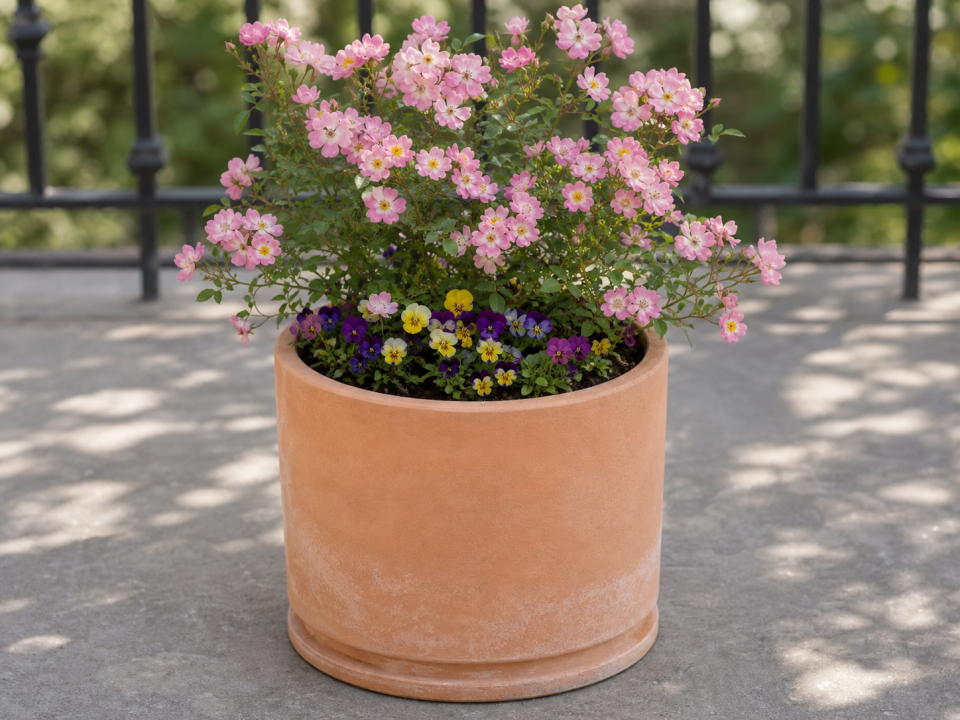
Underplanting a structural centrepiece with seasonal bulbs or bedding keeps a single container interesting for longer.
Our team at Boma can advise on plant selection, container choice and growing media for your specific aspect, weight constraints and aesthetic goals. We also offer a bespoke Courtyard & Roof Terrace Container Planting service for balconies, roof terraces and courtyards within 5 miles of Kentish Town. Visit us at 51–53 Islip Street, NW5 2DL to see our current range of balcony-suitable plants, containers and specialist composts, or browse the range online.
Choosing Plants by Aspect: A Quick Reference
The direction your balcony faces is the single biggest factor in species selection. Use the table below as a starting point, then adjust for how sheltered or exposed your particular spot is.
| Aspect | Light Level | Suitable Species | Avoid |
|---|---|---|---|
| South-facing | Full sun (6+ hrs) | Trachycarpus, Agave, Mediterranean herbs, Pelargonium, Trachelospermum | Hosta, ferns, Hydrangea |
| West-facing | Afternoon sun (4–6 hrs) | Clematis, roses, Lavandula, most annuals, Libertia | Deep-shade species |
| East-facing | Morning sun (3–4 hrs) | Fuchsia, Camellia, Astilbe, Clematis montana, Hydrangea | Full-sun Mediterranean species |
| North-facing | Shade / indirect | Hosta, Dryopteris, Fargesia, Convallaria, climbing Hydrangea | Herbs, tomatoes, Agave, Pelargonium |
Frequently Asked Questions
What Plants Grow Best on a Shaded Balcony?
Shaded balconies support Hosta, ferns (Dryopteris filix-mas or Polystichum setiferum), Hydrangea anomala subsp. petiolaris, Fargesia bamboos, and trailing Fuchsia. Avoid Mediterranean species, sun-loving herbs and tomatoes, which all need at least 4 to 6 hours of direct sunlight to perform.
How Much Weight Can a Balcony Hold?
Most residential balconies carry somewhere between 150 and 300kg per square metre, though this varies by building age, construction method and local building regulations. If in doubt, ask your building management company or architect for the structural specification. Substitute fibreglass or poly-resin planters for terracotta when weight is a constraint, and use lightweight peat-free compost rather than soil-based mixes for large plantings.
How Do I Stop Pots Drying Out on a Windy Balcony?
Wind accelerates moisture loss from both containers and foliage. Use larger containers (minimum 30 litres for perennial plantings), water-retaining granules in the compost mix, and self-watering containers with a reservoir base where practical. Grouping containers together also raises humidity around the foliage, which helps reduce how quickly individual pots dry out.
Can I Grow a Tree on a Small Balcony?
Several slow-growing trees and large shrubs perform well in containers on a balcony. Laurus nobilis (bay) clipped as a standard, Prunus 'Amanogawa' (a narrow upright ornamental cherry), and Betula utilis var. jacquemontii in a 50-litre container all stay manageable for 5 to 10 years. Repot when root-bound rather than continually increasing container size — root pruning at repotting keeps large specimens in check.
Boma stocks a curated range of balcony-suitable plants, containers and specialist composts at our Kentish Town garden centre, with knowledgeable staff on hand to advise on aspect, weight and species selection. Whether you're starting from scratch or adding to an existing planting, our team — and our Courtyard & Roof Terrace Container Planting service — can help you make the most of every square metre.
Book a Consultation Visit Us Check Delivery