

The RHS advises checking containers daily in warm or windy weather and twice daily in hot weather — small containers dry out fastest of all. The layouts below are written for anyone working with a London courtyard, roof terrace, balcony or small patio who wants the container garden to work as hard as the planting.
Five Principles for Arranging Pots in a Small Garden
Arranging pots in a small garden comes down to five principles: scale up, group tightly, step the heights, repeat materials and keep the route clear.
- Scale up the containers. Use one to three large containers as anchors rather than a dozen small pots.
- Group pots tightly. Cluster them in threes or fives so the foliage overlaps and shades the compost.
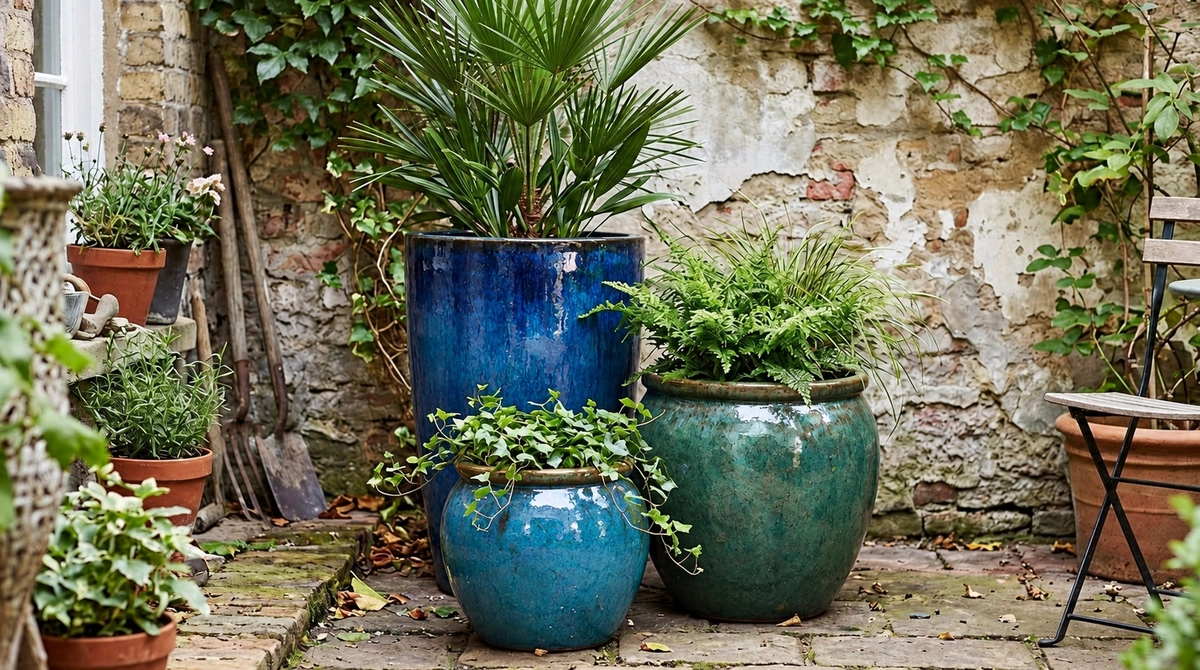
- Step the heights. Put the tallest pot at the back against a wall or fence, mid-height pots in the middle, and low or trailing plants at the front.
- Repeat one material and colour. One material for all your pots, or two at most, holds a small space together.
- Keep the route clear. Leave the path, the centre of the floor and the seating areas open, and push groups to the edges or a single focal point.
A group of three large pots reads as one deliberate feature; twelve small pots spread around the edges read as clutter. More compost also buffers plant roots against the swings in temperature and moisture that stress plants in shallow containers standing on hot paving.
Scale matters visually too. One substantial pot, 50cm or more across, planted with a multi-stemmed shrub or small tree, gives a courtyard height and depth that a row of 20cm pots cannot. Big pots used this way create focal points and frame the view from the house, which makes a small space feel planned rather than filled.
Choose the right plants before the pot, and size the container for the plant's mature spread, not its nursery-pot size: larger plants need big pots from the start. For anchors, choose evergreen structure that holds its shape year-round: Fatsia japonica in shade, Pittosporum tobira 'Nanum' or Olea europaea for a sunny, sheltered spot, or Acer palmatum in a sheltered corner where its leaves won't scorch. When a plant outgrows its pot, move it into one slightly larger rather than jumping several sizes, which leaves cold, wet compost around the roots.
Container size has practical minimums too. Most plants need a container at least 30cm (12in) wide, and edibles need depth: one tomato plant needs at least 19 litres (5 gallons) of compost, and most vegetables need around 30cm (12in) of compost depth. Containers dry out faster than garden beds because of their limited soil volume, so every step up in size buys time between waterings.
Use Odd Numbers and Stepped Heights
Odd-numbered groups of three or five pots look settled because the eye reads them as one composition rather than as pairs. Set the tallest container and plant at the back, against a wall or trellis, then step down to mid-height pots and finally low or trailing plants at the front, to create a layered bank of foliage and flowers.
One London courtyard of around 7m by 9m, holding close to 100 pots, uses the same theatre-set approach: taller pots and plants at the back, shorter ones in front. Where floor space is tight, raise the back row on a sturdy plant stand or a low wall rather than buying ever-taller pots. Within a single large pot, the same layering gives the same effect in one footprint: one upright plant, a mounding plant around it and a trailing plant over the rim.
Repeat One Material and One Colour
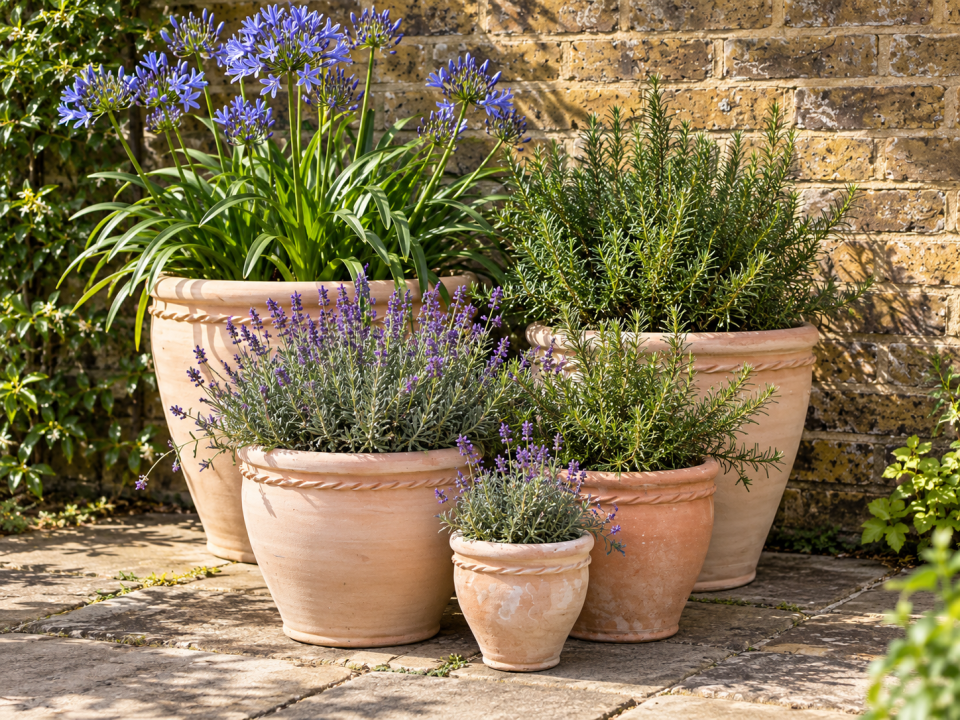
Repeating a single pot material is the quickest way to make a small garden look designed. A cluster of terracotta pots in three sizes, or a run of glazed pots in one glaze, ties the group together even when the planting varies.
Repeat plant colour the same way: plant at least two, and ideally four, pots of each variety, keep to one plant variety per pot so each pot peaks at once, and space matching pots through the display so the eye travels across it. Limiting the number of varieties keeps the group from looking jarring, and generous green foliage between flowers in different colours stops a small display from reading as busy. Mix long-flowering plants with coloured foliage, and pair evergreens with seasonal flowers for year-round interest.
Group Pots by Light and Water Needs
Group container plants with the same light and water requirements so one watering routine suits the whole cluster. Mediterranean plants such as Lavandula angustifolia, Salvia rosmarinus (rosemary) and Agapanthus belong together in full sun, with herbs such as thyme alongside. Shade-tolerant foliage such as Hakonechloa macra, Hosta and the soft shield fern Polystichum setiferum belongs together in the shadow of a wall. Mixing the two in one group means overwatering one half or underwatering the other, so plant choice and position have to be decided together.
Space-Saving Pot Layouts for Five Small Garden Shapes
The right pot layout for a small garden depends on its shape, where the light falls and how you move through it. The table matches common small spaces to an arrangement that keeps the floor usable. In every case, one tight cluster in an otherwise unused corner does more than pots dotted along every edge.
| Space | Main constraint | Arrangement | Pot choice | Plants that suit |
|---|---|---|---|---|
| North-facing courtyard | Low light; slow drying | One large anchor plus a group of three in the brightest corner | Glazed or stone pots, which retain water | Fatsia japonica, Polystichum setiferum, Hosta |
| South-facing patio | Heat; fast drying | Tight groups of three to five against the house wall for shared shade | Large glazed or stone pots; avoid small unglazed terracotta | Olea europaea, Lavandula angustifolia, Agapanthus |
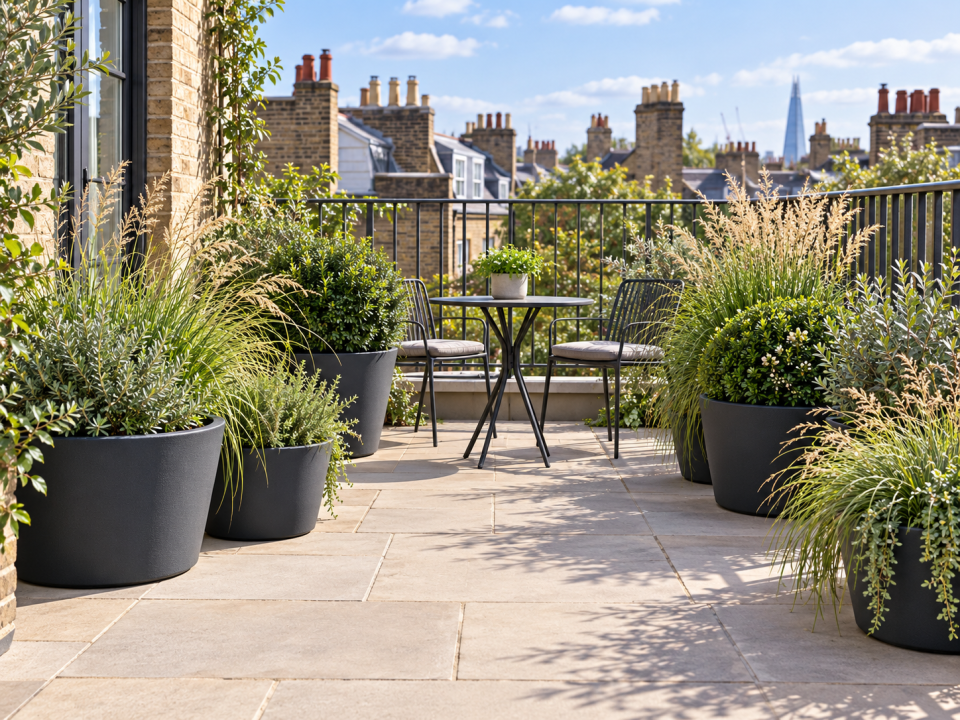
| Roof terrace or balcony | Wind; weight | Low, wide pots at exposed edges; taller pots in the lee of a wall | Lightweight polystone, fibreclay or plastic | Pittosporum tobira 'Nanum', Salvia rosmarinus, grasses |
| Front steps and doorway | Access; symmetry | Matching pair either side of the door, or graduated pots one side of the steps | Two or three pots in one material | Ilex crenata clipped into domes, seasonal bulbs |
Roof Terraces and Balconies: Weight and Wind
Roof terraces and balconies need lightweight containers and a structural check before heavy planting goes in. Wet compost is heavy, so confirm the load capacity with a structural engineer or the building's managing agent before installing larger planters. Tall, narrow pots blow over in exposed positions; the RHS recommends adding bricks or stones to the base and placing them somewhere sheltered. Polystone planters and plastic containers cut the weight, and plastic doesn't dry out as quickly as unglazed clay pots — which matters in a windy, sunny position.
Narrow Side Returns: Plant Along One Wall
Narrow side returns work best with all the pots along one wall, which keeps the route to bins and the back door clear. Rectangular troughs use the width more efficiently than round pots, and a climber trained up the wall above them adds planting without adding floor area.
Using Vertical Space in a Small Container Garden
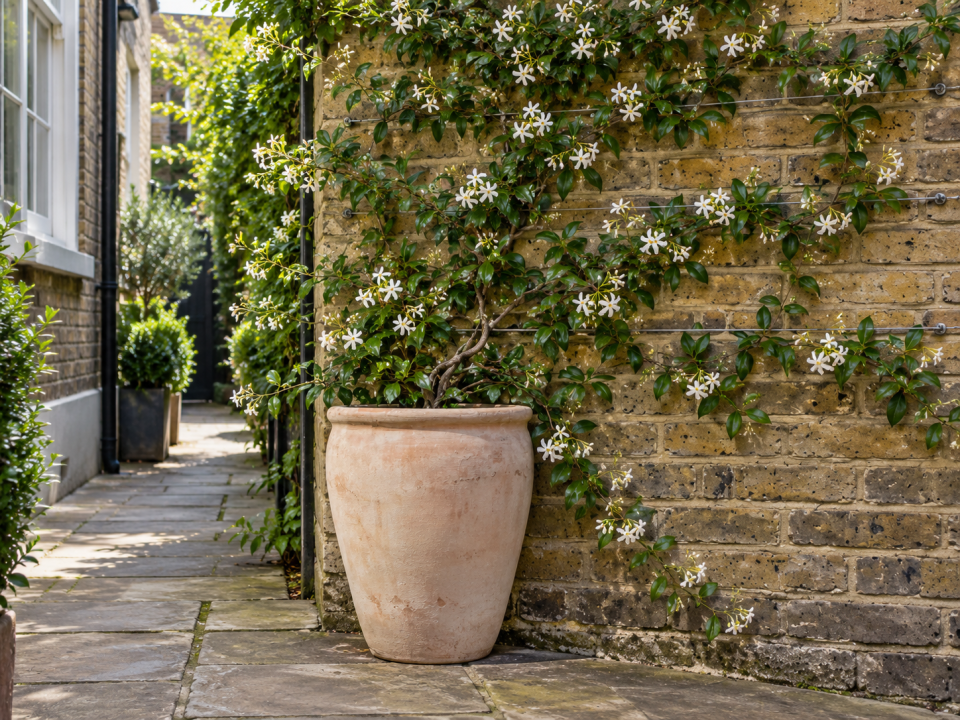
Vertical planting adds plants to a small garden without taking floor space, and drawing the eye upwards makes the garden feel larger. Train an evergreen climber such as Trachelospermum jasminoides from a large container up horizontal wires on a boundary wall: it holds its leaves all year, carries scented white flowers in summer and tolerates part shade.
Choosing Pot Materials for a Small Garden
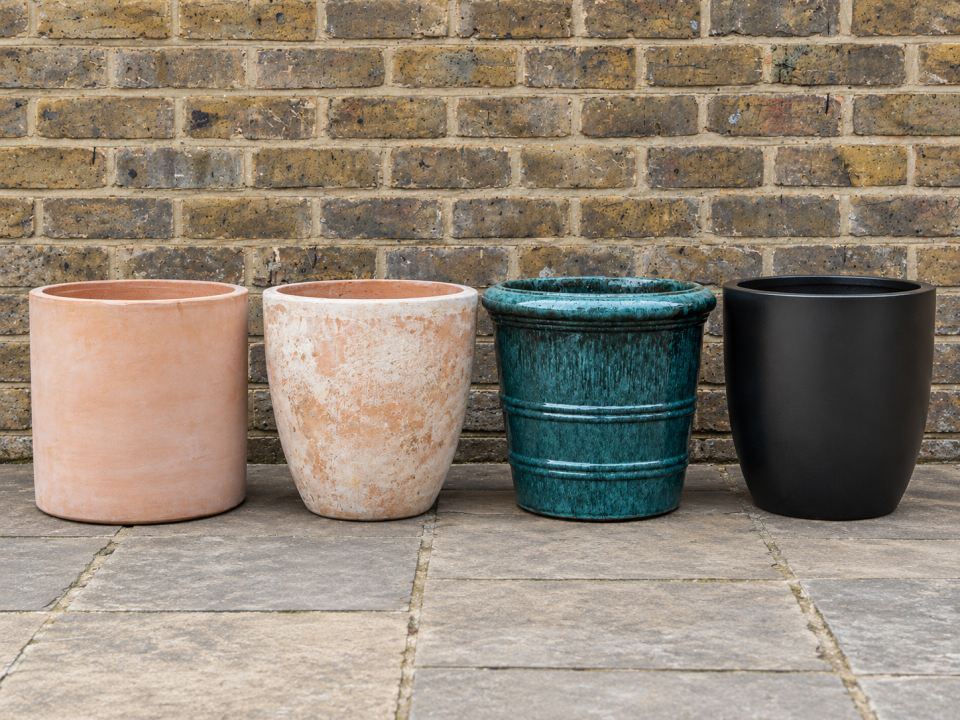
Pot material affects weight, water retention and frost resistance as well as appearance, so choose it for the position first and the style second.
| Material | Weight | Water retention | Frost | Best position |
|---|---|---|---|---|
| Unglazed terracotta | Heavy | Low: porous, so it dries quickly | Buy frost-proof pots; cheaper terracotta can crack in winter | Sun, Mediterranean plants and herbs |
| Glazed ceramic | Heavy | High | Good when sold as frost-resistant; raised pot feet help | Shade or part shade; statement anchors |
| Polystone, fibreclay and plastic | Light | Medium to high; dries more slowly than clay | Generally good; check the maker's rating | Roof terraces, balconies, pots you move seasonally |
| Wood | Medium | Medium; rots over time unless lined | Good | Wooden troughs along boundaries |
Sources for porosity, frost and weight points: RHS.
Terracotta, glazed pots, stone planters and metal containers all run through Boma's range — terracotta, glazed, stone and metal — so a single material can run through the whole garden.
Drainage, Compost and Feeding for Container Plants
Every pot in a small garden needs drainage holes, compost matched to how long the plant will stay, and a feeding plan, because growing plants in containers depends entirely on what you give them.
Drainage Holes and Pot Feet
Drainage holes are essential, and the RHS recommends raising pots on bricks or pot feet to keep the holes clear. Raising pots also lets excess water run away instead of pooling and staining the paving.
Crocks do less than tradition suggests: in a Which? Gardening trial of 40 pots, half with crocks and half without, crocks made no difference to how well plants grew.
Water only moves from fine compost into coarse material once the compost above is saturated, so a deep layer of crocks holds wet compost above it. A single crock or a square of mesh over the hole stops compost washing out, and nothing more is needed for proper drainage. Remove saucers before winter to prevent root rot in pots left standing in water.
Compost: Match It to the Plant's Lifespan
Long-term plants need a soil-based compost such as John Innes No. 3, while short-term bedding, bulbs and herbs grow well in peat-free multi-purpose compost (RHS). Don't fill pots with garden soil on its own: London clay in particular compacts in a container, drains badly and starves plant roots of air. Use ericaceous compost for acid-loving plants such as Camellia and Rhododendron. Whatever compost you choose, leave about 2.5cm (1in) between the compost and the rim so water collects and soaks in rather than running off.
Feeding Container Plants
Feed container plants with a slow-release fertiliser at planting for a steady supply of nutrients, then top up with a liquid feed through the growing season for hungry flowering plants — containers have no reserve of nutrients beyond what the compost and feed provide.
How to Water Container Plants in Grouped Pots
Grouped pots need less water than the same pots spread apart, because neighbouring foliage shades the compost and raises the humidity around them (RHS). Even so, check moisture daily in warm or windy weather and up to twice a day in hot weather, by pushing a finger into the compost rather than the leaves, until water runs from the drainage holes, and use a can with a long spout or a watering lance to reach the back row without lifting pots.
For a container garden with more than a handful of pots, a drip irrigation system on a timer keeps containers evenly moist when you are away and saves the daily round in summer.
Rearranging Your Container Garden Through the Seasons
A container garden can be rearranged to follow seasonal changes, which is its main advantage over garden beds. The best planting time for permanent plants is early spring, and tender summer plants go out in late May or early June once the risk of frost has passed (RHS).
From early spring, bring flowering pots forward into the sightline from the house and move plants past their best to the back. In winter, the RHS recommends grouping containers close together near a house wall to protect roots from cold. Heavier grades of horticultural fleece give about 2°C of frost protection — enough to see tender plants such as Agapanthus through a light frost.
Plant directly into the display pot for permanent plants; for seasonal flowers and bulbs, plant into plastic liner pots that sit inside the decorative pot, so a tired display can be swapped in minutes. For spring bulbs, plant at least 25 bulbs in two layers in a 30cm to 35cm pot for a full display. If you plan to move a large pot, set it on pot feet or a wheeled plant caddy before you plant it: a filled 60cm pot isn't something to lift by hand.
Common Mistakes When Arranging Pots in a Small Garden
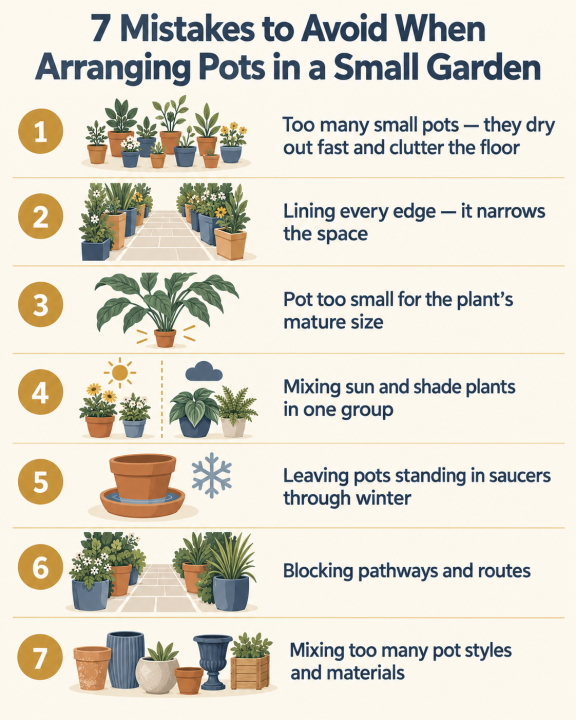
The most common mistake when arranging pots in a small garden is using too many small pots, which dry out quickly and clutter the floor. Six others recur:
- Lining every edge with pots, which narrows the space; group them instead.
- Choosing a pot too small for the plant's mature size, so it becomes root-bound and needs watering twice a day.
- Mixing sun and shade plants in one group, so no watering routine suits the whole cluster.
- Leaving pots standing in saucers through winter, which leaves roots wet and cold.
- Blocking pathways and routes with pots instead of keeping them clear.
- Mixing too many pot styles and materials, so the group reads as clutter rather than a collection.
Container Planting Advice From Boma
Boma's planting team designs container schemes for small gardens, courtyards and roof terraces, assessing light, exposure and microclimate before choosing plants and pots. For courtyards, roof terraces and balconies, Courtyard & Roof Terrace Container Planting covers site assessment, planting suited to the site's microclimate, troughs and planters, irrigation and aftercare advice on seasonal replanting.
For established gardens with patios, beds and borders, the Garden Planting Service runs from consultation and site assessment through a planting scheme presented as mood boards, a costed proposal, and supply and installation of planters, plants and irrigation.
Frequently Asked Questions
How Do You Arrange Garden Pots in Groups?
Arrange garden pots in groups of three or five, with the tallest pot at the back, mid-height pots in the middle and low or trailing plants at the front. Keep to one or two pot materials, and group plants with the same light and water needs.
How Many Pots Should a Small Garden Have?
A small garden usually works best with one to three large containers as anchors and a handful of smaller containers grouped at their feet, which also keeps the garden low maintenance. The real limit is watering: plant only as many pots as you can water daily in a hot spell.
Do Garden Pots Need Pot Feet?
Garden pots on paving or decking benefit from pot feet, because raising the pot keeps the drainage holes clear and stops water pooling beneath. The RHS recommends raising containers on pot feet or bricks, which matters most in wet winters.
Can I Use Garden Soil in Containers?
Garden soil used on its own is a poor choice for containers because it compacts, drains badly and can carry weed seeds and pests. Use a peat-free, soil-based potting mix such as John Innes No. 3 for permanent plants, or peat-free multi-purpose compost for seasonal planting.
What Are the Best Plants for Pots in a Small, Shady Garden?
The best plants for pots in a small, shady garden are shade-tolerant foliage plants such as Fatsia japonica, Hakonechloa macra, Hosta and ferns including Polystichum setiferum and Asplenium scolopendrium. Glazed or stone pots suit them because they retain moisture well.
Start by marking the floor you need to keep clear, then build the framework of your container garden: choose one anchor pot and build a group of three around it before adding anything else. Explore our current range of pots and planters online or in store at 51–53 Islip Street, Kentish Town NW5 2DL, or book Boma's Courtyard & Roof Terrace Container Planting service to have a scheme designed for your space. We deliver pots, planters and container plants to all M25 postcodes, with charges zoned by postcode from £10.
Shop Pots & Planters Check Delivery Courtyard & Roof Terrace Planting