

What Sets the Japanese Garden Apart?
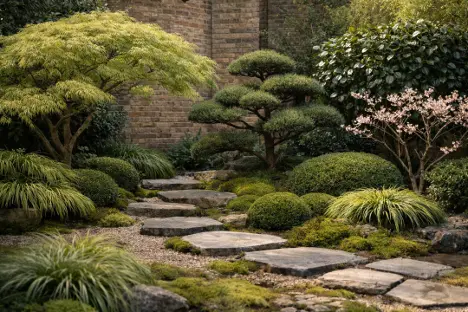
The Japanese garden tradition prioritises negative space as actively as it does planting. The Japanese term ma (間) describes the intentional void: the deliberate emptiness that gives meaning to what surrounds it. In practice, this means expanses of raked gravel or smooth stone, bounded by restrained planting, with each plant positioned for its individual sculptural quality rather than for collective mass. Where a cottage or naturalistic garden fills every gap, a Japanese garden makes the gaps central to the composition.
Three structural elements recur across Japanese garden traditions: stone, representing permanence; water, or its symbolic equivalent in raked gravel or a single ceramic bowl; and plants chosen for year-round architectural form. Feature stones are placed to represent mountains and islands within the composition, a practice rooted in Japanese culture and the long philosophical tradition connecting garden design to the natural landscape.
Larger, traditional versions of the style extend this programme to bridges spanning ornamental ponds, waterfalls feeding into koi pools, and tea houses positioned to frame borrowed views. Japanese rock gardens and the zen garden reduce this to essentials: raked gravel representing water, feature stones representing landforms, and a restrained plant frame at the perimeter.
In a small urban space, reducing the water feature to a galvanised trough, a bamboo fountain, or a glazed bowl removes significant maintenance without compromising the aesthetic logic of the garden. A koi pond typically needs a depth of three to four feet or more to give the fish room to overwinter safely, which puts it out of reach for most London courtyard plots; a drilled stone monolith feeding into a stone basin is a far more proportionate water feature for a small garden, carrying the same symbolic weight at a fraction of the construction cost and none of the depth requirement.
London's typical rear plot of five to eight metres by four to six metres provides exactly the constraint that makes this compositional economy most effective — close to the tsubo-niwa courtyard tradition the style was originally developed for, where a tsubo (roughly 3.3 square metres) sets the working unit and gardens of three to six tsubo are common. Where abundance-focused styles become crowded and lose coherence at these dimensions, five to eight species positioned against a clean ground plane hold their logic at every scale. The planting palette is restricted by design: repetition and precision carry more authority than variety.
The Japanese garden is one of several planting styles Boma works with across London gardens. For a full overview of different approaches, see Boma's garden styles page.
Starting With Structure: Form Before Plants
The ground plane of a Japanese garden is designed before any plant is chosen. Raked gravel, stepping stones, or decomposed granite define the primary surface; planting interrupts and articulates that surface rather than dominating it. In a garden of 20 to 30 square metres, a single gravel panel of four to six square metres reads as deliberate and considered rather than sparse.
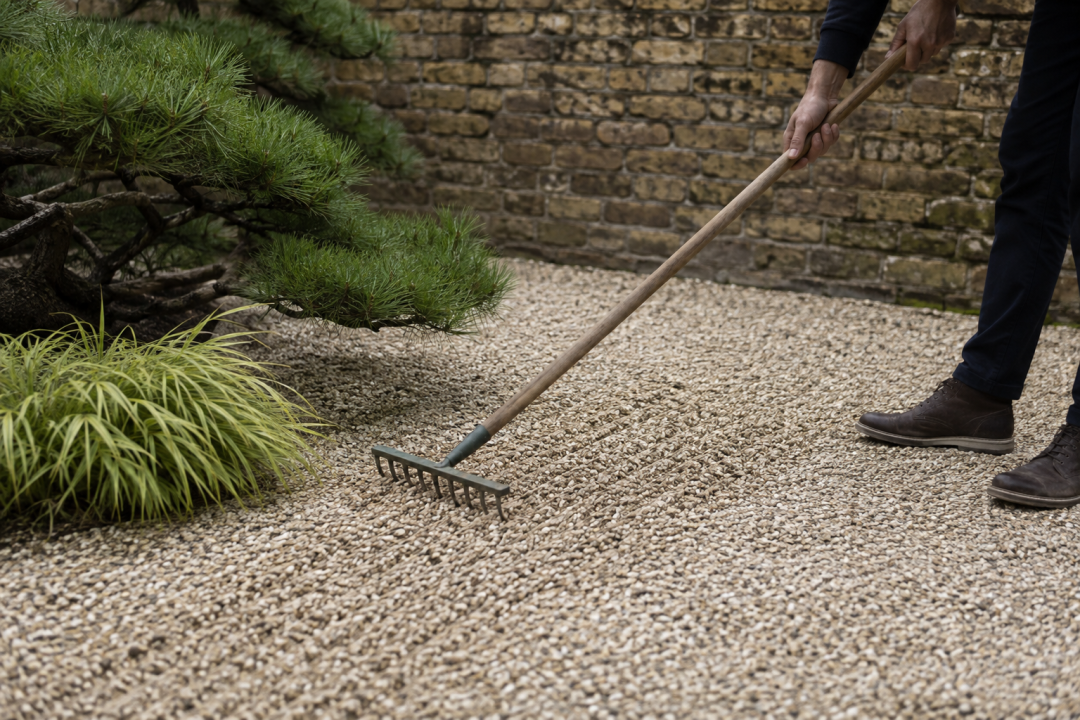
For a raked gravel panel, 6 to 10mm angular limestone or granite chippings hold rake marks more cleanly than rounded pea gravel: the angular faces grip each other and maintain the raked line between maintenance sessions. Pale Cotswold limestone reads warmer and ages naturally against London stock brick; grey Scottish granite chippings provide a cooler contrast that suits rendered or painted walls. Specify the grade as 'angular 6–10mm' rather than 'decorative gravel', which is typically too rounded to hold a pattern.
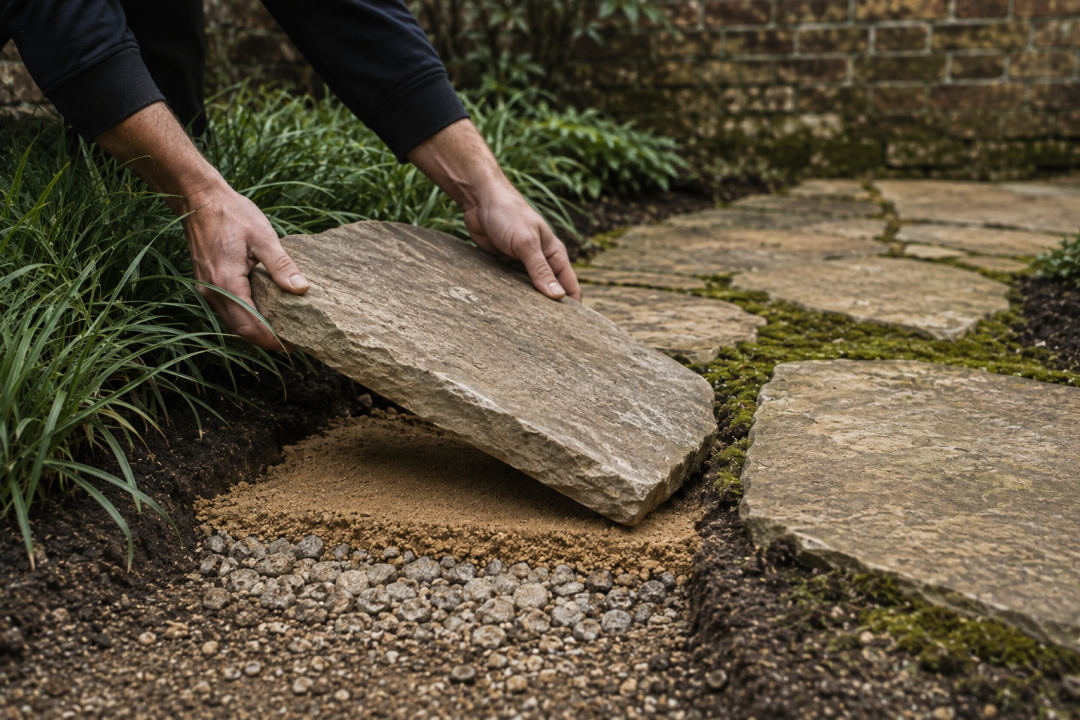
Stepping stones should be a minimum of 50mm thick and 450 to 600mm at their longest dimension, to provide stable footing without a trip hazard. In Japanese garden design, stones are deliberately placed to slow movement through the space, directing attention to particular views and planted features as visitors progress. Set each stone on a 150mm compacted hardcore base plus a 50mm sharp sand bed; this depth prevents sinking and frost heave over successive London winters, where freeze-thaw movement in clay subsoil is the primary cause of stepping stone displacement. Irregular sandstone or reclaimed limestone, flanked by Sagina subulata or moss between the stones, reinforces the naturalistic quality the style requires.
Feature stones placed within or at the edge of the gravel panel reinforce the miniature landscape quality of the small Japanese garden. Select basalt, granite, or weathered sandstone pieces that show natural surface texture; groups of three or five stones, positioned asymmetrically, represent mountains or rocky outcrops within the symbolic composition. Source pieces from specialist stone suppliers rather than general builders' merchants, where the material is rarely chosen with this in mind.
Modest elevation change deepens a flat rectangular plot considerably. A raised moss mound of 30 to 40 centimetres positioned in the rear third of the garden, planted with a single specimen Acer palmatum, creates a focal point and introduces the illusion of topography without construction-scale groundwork.
Does a Japanese Garden Work Against a Brick Wall?
Yes: London stock brick provides an effective backdrop for Japanese garden planting. The warm yellow-grey tone reads as neutral against the dark foliage of Acer palmatum cultivars and the fine texture of cloud-pruned evergreens, and its height creates the enclosure that the Japanese garden tradition treats as an asset rather than a constraint. In exposed sites, the wall also provides shelter that benefits Acer palmatum against late spring frosts and desiccating east winds.
The Plant Palette: Four Pillars of the Japanese Garden
Acer palmatum (Japanese Maple)
Acer palmatum is the structural anchor of the Japanese garden, delivering year-round form, reliable autumn colour, and fine foliage texture within a single specimen. The species is deciduous, most cultivars reaching two to four metres over ten to twenty years in sheltered urban conditions, and its slow growth rate makes it suitable for both open ground and large containers of 45 litres or more. Spring growth emerges in copper or lime depending on the cultivar; autumn foliage progresses from yellow through orange to crimson across a four to six week period from October, giving the garden its defining seasonal display.
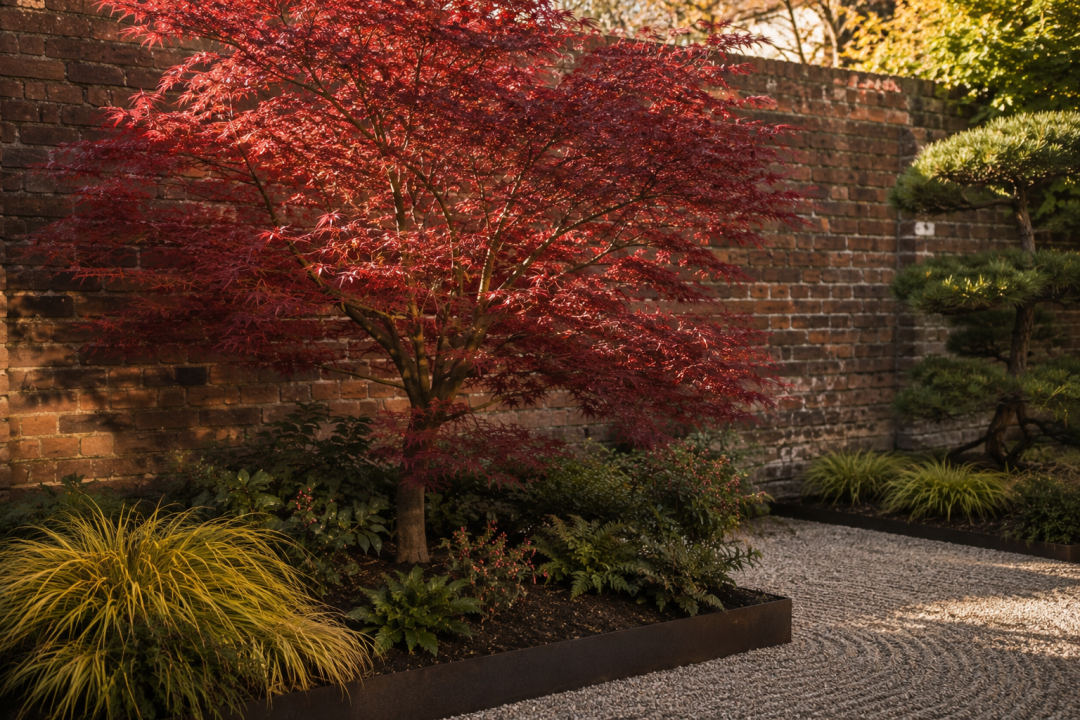
For small city gardens, the dissectum group (finely divided, weeping habit) provides a lower, more horizontal form suited to placement at path edges or around water features. A potted Acer dissectum in a frost-resistant container is available from Boma and provides immediate placement on terraces or in courtyard settings.
For an upright specimen to anchor the rear of the garden, Bloodgood (deep burgundy foliage from spring through to leaf-fall) and Deshojo (vivid red spring growth that softens to bronze-green in summer) are two of the most reliable cultivars for London's climate. Both tolerate urban shade and are broadly hardy across the city.
Acer palmatum needs shelter from late spring frosts and desiccating east winds, both of which scorch emerging growth. A sheltered walled location addresses both risks. In open or exposed plots, a windbreak of clipped evergreen at the north or east boundary acts as a buffer.
Hakonechloa macra: Flowing Japanese Grasses
Hakonechloa macra, Japanese forest grass, brings softness and movement to the composition without the spreading vigour of more robust ornamental grasses. It reaches 40 to 50 centimetres in height and spread and produces fine, arching leaves that catch available light at the garden's edge. The species is deciduous, cutting back in winter and re-emerging in spring as lime-green growth that matures to a deeper green through summer.
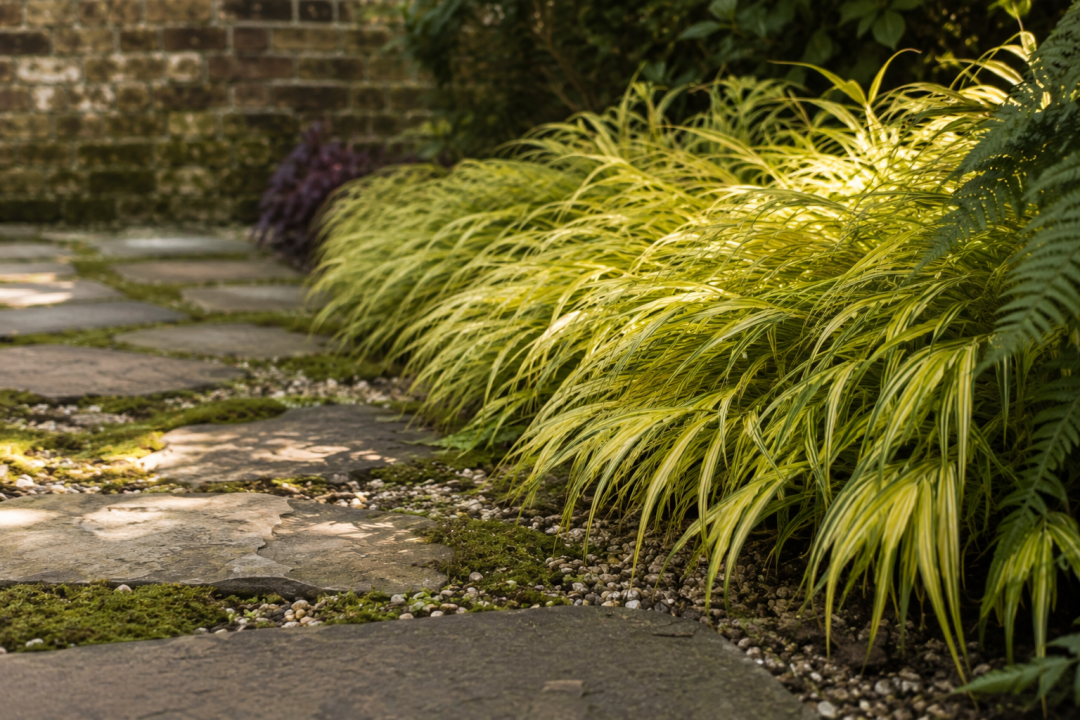
Hakonechloa macra performs well in sun through to partial and full shade, making it directly suited to the shaded edges of urban walled gardens where Stipa, Pennisetum, or Calamagrostis would fail for want of light — though leaf colour is usually brighter with some sun. It requires consistent moisture during dry periods and benefits from an annual spring cut to remove the previous season's growth before new shoots emerge. It is slow to spread and rarely needs dividing for several years, and its well-behaved clumping habit means it never encroaches on the gravel panel.
The variegated form, Hakonechloa macra 'Aureola', introduces golden-yellow striping and brightens positions receiving limited direct sun. Boma stocks Hakonechloa macra in 17cm pots, suitable for immediate planting at path edges or beneath specimen trees.
Prunus incisa: Ornamental Cherry for Seasonal Rhythm
Prunus incisa provides the Japanese garden's defining seasonal moment: a concentrated cherry blossom display in early spring that punctuates the composition with pale pink flowers before any leaf has emerged. The cultivar to use in a small city garden is 'Kojo-no-mai', a compact, slow-growing form of ornamental cherry reaching one and a half to two and a half metres over five to ten years. The branches are distinctly angled, growing in a characteristic zig-zag habit that carries strong architectural quality in both leaf and bare seasons. Autumn colour in orange and red is a secondary, reliable asset.
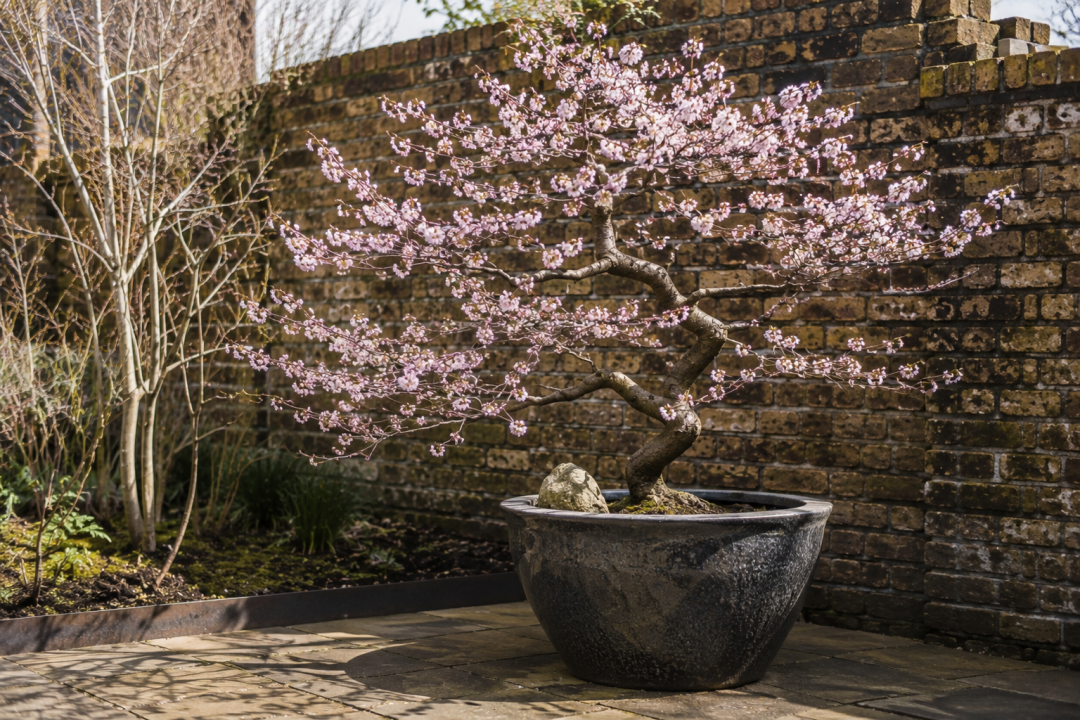
Prunus incisa 'Kojo-no-mai' performs in full sun in moist, well-drained soil and tolerates London's climate without specialist shelter requirements, and holds an RHS Award of Garden Merit for consistent performance across UK conditions. Its compact form suits container planting as well as open ground, making it a practical option where soil depth or quality limits in-ground planting.
Note: stock is seasonal. Please check current availability and register for restock notification if it is currently out.
Pines and Clipped Evergreens: Year-Round Architecture
Cloud-pruned evergreens hold the Japanese garden together through winter, when the deciduous elements are bare. In the Niwaki tradition, Pinus thunbergii (Japanese black pine) and Pinus sylvestris are trained over time to develop horizontal, cloud-like branching that defines the most architecturally distinctive form in the Japanese garden palette. Training begins with selection and wiring of the primary branch scaffold in year three to five of growth; the horizontal cloud forms that characterise a mature specimen take eight to fifteen years of annual spring candling and selective pinching to develop fully.
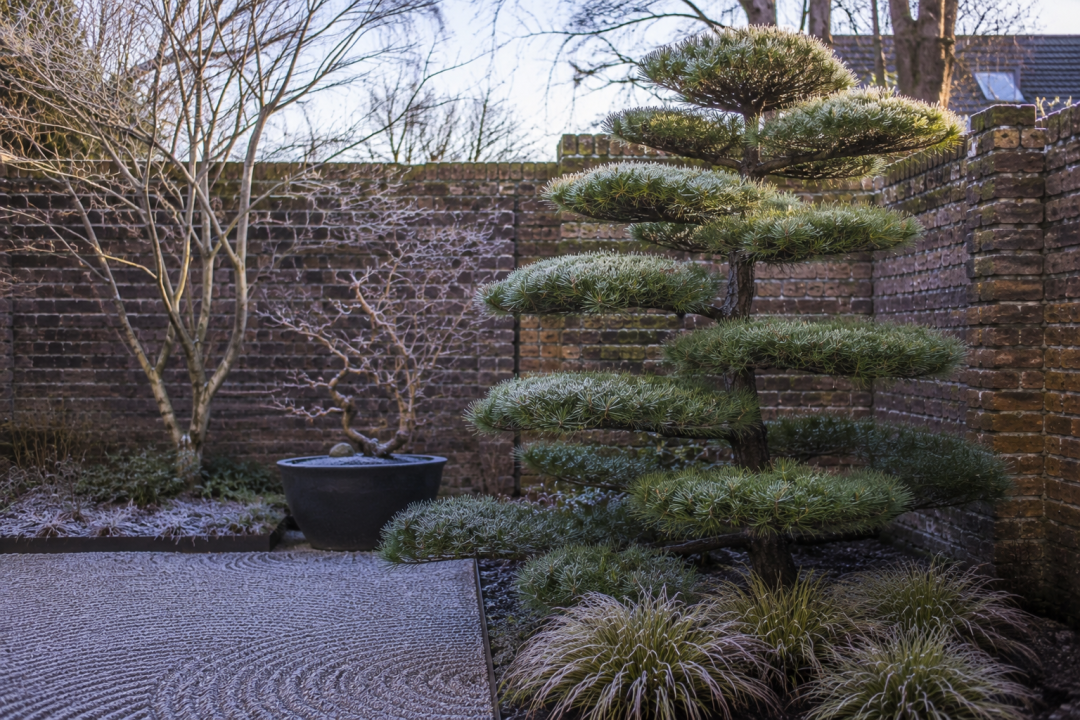
Partially-trained specimens from UK specialist Niwaki nurseries, typically two to four years into their training programme, provide immediate visual presence while annual continuation of the work proceeds. In a small garden, a single specimen of 1.2 to 1.5 metres with two or three defined cloud layers anchors the planting without overwhelming the surrounding composition. Ask in store for current pricing, which varies with height and existing branch structure.
Where cloud-pruning Ilex crenata rather than pine, the cultivar 'Dark Green' is the most reliable choice for UK conditions: it produces dense, small-leafed growth that responds well to hard clipping and holds its form between cuts. The clip timing for London gardens is late July to mid-August, after the main flush of new growth has hardened off but before autumn cold slows recovery. Ilex crenata is increasingly preferred over Buxus sempervirens following the spread of box moth (Cydalima perspectalis); its fine leaf texture reads closely enough that the substitution holds visually in a Japanese garden composition.
Additional Plants for the Small Japanese Style Garden
Beyond the four structural species, a small Japanese garden benefits from a restrained supporting cast that reinforces the style without disrupting the composition. Fargesia murielae 'Bimbo', a compact clump-forming bamboo reaching around a metre in height, is well suited to small gardens and patio containers: it stays dense and non-invasive without the running spread of Phyllostachys bamboo species. A single specimen planted in a rear corner softens the wall boundary and introduces gentle movement.
Dwarf azaleas, especially evergreen Japanese varieties clipped into rounded mounds, contribute late spring flowering interest in white or soft pink tones while reinforcing the cloud-pruning aesthetic across the composition. Planted in groups of three, azaleas add colour without departing from the restrained palette.
Magnolia stellata, the star magnolia, is an excellent small tree for gardens with space for an additional specimen: the species is slow-growing and rarely exceeds three metres, flowers from late winter into early spring in white star-shaped blooms, and is among the most reliable small trees for UK conditions. Adding moss to bare ground areas, to the base of feature stones, and between stepping stones is one of the simplest techniques for completing the small Japanese garden composition and creating a sense of established age quickly.
Plant Palette at a Glance
| Species | Role in the Design | Size (10 Years) | Light |
|---|---|---|---|
| Acer palmatum | Structural anchor; year-round form and autumn colour | 2–4m (10–20 years) | Partial shade, sheltered |
| Hakonechloa macra | Softening movement at path edges and beneath specimens | 40–50cm | Sun to full shade |
| Prunus incisa 'Kojo-no-mai' | Concentrated early spring blossom moment | 1.5–2.5m (5–10 years) | Full sun |
| Pinus thunbergii (cloud-pruned) | Winter architecture and evergreen structure | 1.2–1.5m trained specimen | Full sun to partial shade |
| Ilex crenata 'Dark Green' | Cloud-pruning alternative to box, resistant to box moth | Clipped to size | Sun or shade |
| Fargesia murielae 'Bimbo' | Vertical texture and movement at boundaries | ~1m, non-invasive clump | Sun to partial shade |
Does London Clay Suit Japanese Garden Plants?
London clay presents specific challenges for Japanese garden planting, but all four key species in this palette are manageable within it with targeted preparation. The clay layer across much of North London sits close to the surface, compacting in dry summers and waterlogging in wet winters. Acer palmatum is sensitive to winter waterlogging, which causes root anaerobiosis; incorporate 30 percent horticultural grit into the planting backfill and raise the root zone two to five centimetres above the surrounding soil level to encourage surface drainage.
Of the four key species, only Acer palmatum and Prunus incisa need this amendment. Hakonechloa macra and cloud-pruned evergreens are both reasonably tolerant of London clay provided drainage is not completely impeded. Prioritise drainage preparation around the Acer palmatum first; it is the species most likely to struggle in the first few winters without it.
Gravel panels over clay need a permeable geotextile membrane and a minimum 10-centimetre depth of angular gravel over a 5-centimetre sand drainage layer to prevent clay migrating upward through the surface. Without this preparation, the gravel panel compacts and discolours within a couple of seasons as clay particles work up through the aggregate.
Is a Japanese Garden High Maintenance?
A Japanese garden asks for less seasonal maintenance than a cottage border or naturalistic planting scheme, but the maintenance it does require is precise rather than forgiving.
Cloud-pruned evergreens need clipping once or twice annually to hold their form; Acer palmatum needs no routine pruning beyond the removal of crossing or damaged stems in late winter. The principal task is the gravel panel, which needs raking after leaf fall in October and November and periodic replenishment as the surface settles over successive winters. Taken together, this is meaningfully less work across the year than a perennial border of equivalent size, where seasonal cutting back, division, staking and deadheading dominate the maintenance calendar.
Japanese Garden Design With Expert Guidance
Boma's planting services cover Japanese garden projects at every scale. Our Garden Planting Service applies to established gardens with beds and borders, beginning with a site consultation that assesses light, aspect, and microclimate before producing a detailed planting scheme.
For complete projects incorporating hard landscaping, gravel installation, and specimen tree placement, the Garden Design and Landscaping Service coordinates the design and planting scheme from concept to completion, working with a recommended hard landscaping contractor for the gravel panel and stepping stone installation, which we oversee for quality and consistency with the overall design. Courtyard and roof terrace projects are handled through Boma's dedicated container planting service.
All three planting services operate by appointment within a five-mile radius of Kentish Town NW5 — covering Camden, Islington, Hampstead, Highgate and the surrounding boroughs. Projects beyond that radius are considered on an exceptional basis for larger-scale work. Request a consultation or call 020 7284 4999.
Frequently Asked Questions
What Is a Japanese Garden?
A Japanese garden is a designed landscape tradition characterised by the deliberate use of negative space (ma), a restricted plant palette, and the representation of natural landscape forms in compressed scale. Key elements include feature stones representing mountains and islands, water features or their symbolic equivalent, and specimen plants selected for year-round structural quality rather than seasonal flower display alone.
Can a Small London Garden Be Designed in a Japanese Style?
Yes. The tsubo-niwa courtyard garden tradition was developed for enclosed urban spaces of three to twelve square metres, and a typical London Victorian terrace rear garden provides sufficient space for a coherent composition using three to five key species and a considered ground plane. Japanese style gardens suited to the UK have been showcased at the RHS Chelsea Flower Show and Tatton Park, offering practical design ideas for small gardens.
What Gravel Is Used in a Japanese Garden?
Raked gravel panels use 6 to 10mm angular limestone or granite chippings in neutral tones, typically white, grey, or pale gold. Angular gravel holds rake marks more cleanly than rounded pea gravel. Pale Cotswold limestone reads warmer against brick; grey Scottish granite provides a cooler contrast. Cobbles of 40 to 80mm in a contrasting tone can be positioned within the panel to represent islands or rocks.
How Long Does a Japanese Garden Take to Establish?
A Japanese garden planted with semi-mature specimens reads as established within two full growing seasons. Acer palmatum in 10 to 25L containers, Hakonechloa macra, and cloud-pruned evergreens all provide immediate structural presence from installation. The gravel panel and stepping stones are effective from day one.
What Trees Work Best in a Japanese City Garden?
Acer palmatum cultivars and Prunus incisa 'Kojo-no-mai' are the most effective small trees for a Japanese city garden in London. Both are slow-growing, structurally interesting across all seasons, and well-suited to the sheltered, partially shaded conditions common in urban walled plots. Magnolia stellata is worth considering for early spring blossom and its restrained habit. Acer palmatum is broadly available in multiple pot sizes from Boma; Prunus incisa 'Kojo-no-mai' is seasonal stock.
Explore Boma's range of Japanese garden plants in store and online at 51–53 Islip Street, Kentish Town, London NW5 2DL. For further inspiration, see the full Boma garden styles collection, from architectural and woodland to cottage and contemporary urban.
Book a Consultation Explore Landscaping