

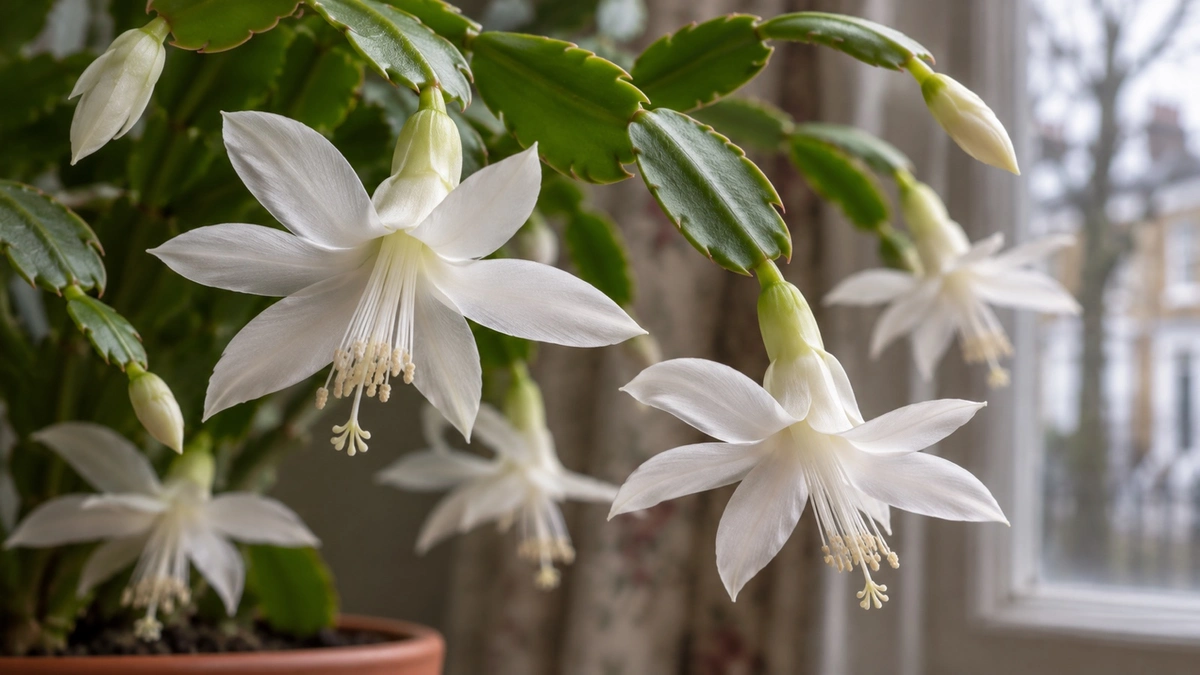
A Christmas cactus (Schlumbergera) is a rainforest plant, not a desert one. Give it bright light out of direct sun, water it when the top of the compost feels dry, and leave it in one steady spot while it flowers in December. For flowers again next year, give it a cool, dark rest from mid-September. It suits a London flat well and is safe around cats and dogs.
- How To Look After a Christmas Cactus in Flower
- Christmas Cactus or Thanksgiving Cactus?
- Christmas Cactus Care Through the Year
- How To Water a Christmas Cactus
- Feeding and Compost for a Christmas Cactus
- When To Repot a Christmas Cactus
- How To Propagate a Christmas Cactus
- Why a Christmas Cactus Drops Buds or Leaves
- Christmas Cactus Care in London Homes
- Frequently Asked Questions
In the wild, Schlumbergera grows on trees in the humid coastal forests of Brazil. That one fact explains most of its care. It likes moisture and filtered light, and it sets its flower buds when the nights lengthen and cool. Boma sells Schlumbergera × buckleyi, which holds the RHS Award of Garden Merit, in red and pink.
How To Look After a Christmas Cactus in Flower
A Christmas cactus in bud or in flower wants things to stay the same. Put it somewhere bright but out of direct sun, at a steady 18 to 20°C, and leave it there until the last flower fades. Water when the top of the compost feels dry, and do not feed it while it is flowering.
- Keep it wrapped on the way home. A cold draught between the shop and your front door can make buds drop.
- Choose its spot once. Moving or turning the plant after buds have formed is the most common reason they fall.
- Keep it away from radiators, open fires and draughty doors.
- Pinch off flowers as they fade to keep the plant tidy.
Christmas Cactus or Thanksgiving Cactus?
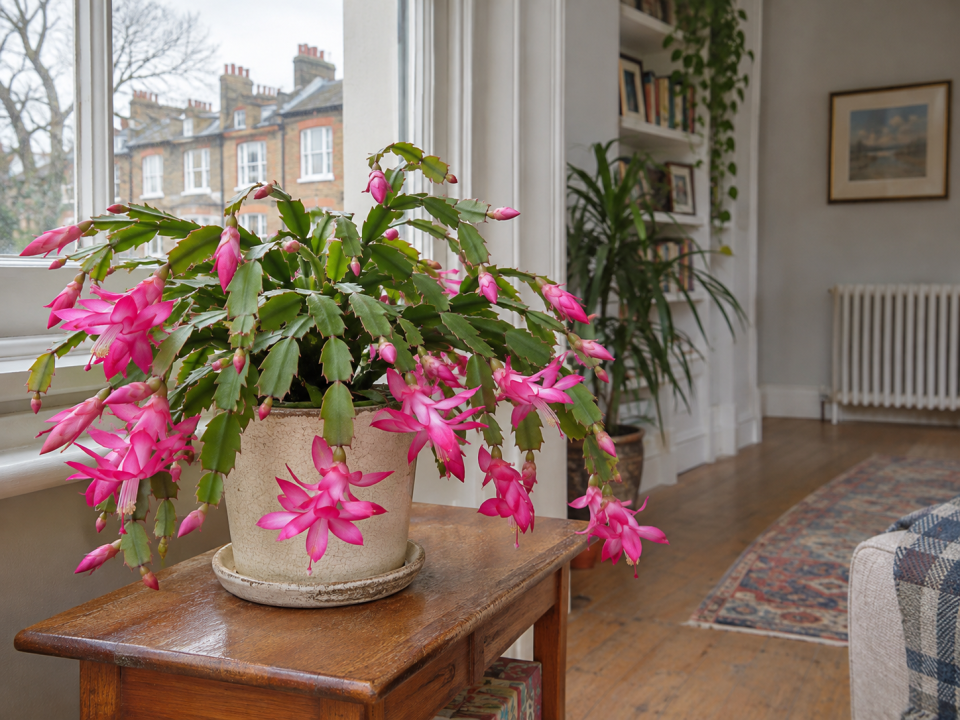
Plants sold as Christmas cactus are one of three closely related holiday cacti, and the stem segments tell them apart. A true Christmas cactus has rounded, scalloped edges. A Thanksgiving cactus has pointed, claw-like teeth and flowers a few weeks earlier. The care is the same for all three.
| Type | Latin Name | Stem Segments | Flowers | Usual Flowering |
|---|---|---|---|---|
| Thanksgiving cactus | Schlumbergera truncata | Two to four pointed teeth on each edge | Held horizontally, with yellow anthers | Late autumn |
| Christmas cactus | Schlumbergera × buckleyi | Scalloped, rounded edges | Drooping, with purplish-brown anthers | Midwinter, around December |
| Easter cactus | Schlumbergera gaertneri (formerly Hatiora) | Rounded segments | Flat and star-shaped | Spring |
Christmas Cactus Care Through the Year
Christmas cactus care follows four stages. Grow it warm and moist from April to mid-September. Rest it cool and a little drier until buds appear. Keep it steady while it flowers. Then rest it again from late January to the end of March.
| Period | Stage | Temperature | Watering and Feeding |
|---|---|---|---|
| April to mid-September | Growing | 18 to 20°C | Water regularly. Feed every two weeks |
| Mid-September until buds show | Autumn rest | 12 to 15°C | Water less often. Stop feeding |
| Buds showing until flowers fade, about late November to January | Flowering | 18 to 20°C, kept steady | Water regularly. No feed |
| Late January to end of March | Second rest | 12 to 15°C | Water lightly. Never bone dry |
| End of March | Repot if needed | Room temperature | Water in lightly |
| May | Take cuttings | Warm room | Water cuttings sparingly |
How To Get a Christmas Cactus To Flower Again
To get a Christmas cactus to flower again, give it a cool, dark rest from mid-September until you see buds. Keep it at 12 to 15°C and water less often. It also needs long nights. Penn State Extension advises at least 12 hours of uninterrupted darkness, so a lamp, a television or a streetlight through the window can be enough to stop buds forming.
An unheated spare room or a cool landing works well, as long as nobody switches the light on in the evening. Once buds show, move the plant to where you want it to flower and leave it there.
How To Water a Christmas Cactus
Water a Christmas cactus when the top few centimetres of compost feel dry. Water thoroughly, let it drain and empty the saucer afterwards. Water less during the two rest periods, but never let the compost dry out completely. A desert cactus can go weeks without water. A Christmas cactus cannot.
It also likes a little humidity. Mist the stems now and then, especially when the heating is on.
What Does an Overwatered Christmas Cactus Look Like?
An overwatered Christmas cactus has limp, soft or translucent segments, stems that darken at the base and compost that stays wet and smells sour. Let it dry out, then check the roots as described below.
Feeding and Compost for a Christmas Cactus
Feed a Christmas cactus every two weeks from April to September and stop when the autumn rest begins. A liquid feed such as Cactus and Succulent Focus is mixed into the watering can. For compost, use a free-draining mix. Cactus & Succulent Focus Peat Free Repotting Mix comes in a 3 litre bag, which is plenty for one or two plants.
When To Repot a Christmas Cactus
Repot a Christmas cactus at the end of March, after its second rest, and only when the roots fill the pot. That is usually every couple of years. Move up one pot size at most. It flowers best when its roots are snug, and a pot that is too large holds water around them.
Choose a pot with drainage holes that is wider than it is deep. The roots are shallow, and the trailing stems need a steady base.
How To Propagate a Christmas Cactus
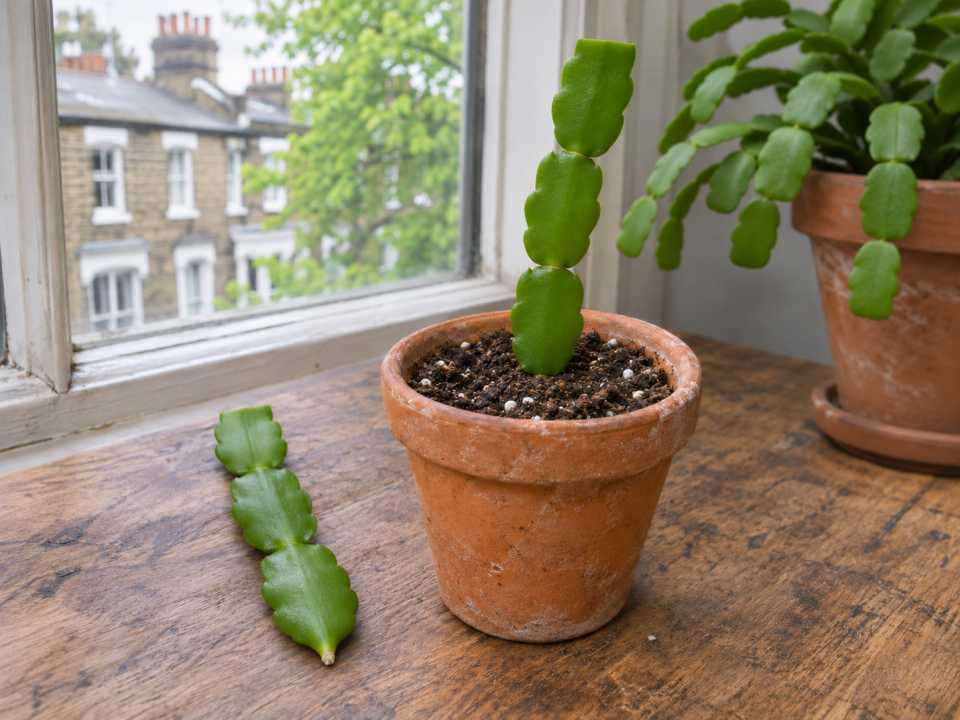
Propagate a Christmas cactus in May from stem cuttings of two or three segments. It is one of the easiest houseplants to share, and a rooted cutting makes a good present by Christmas.
- Twist off a healthy stem tip at a joint, taking two or three segments.
- Leave the cutting somewhere dry and shaded for a day or two, so the end seals.
- Fill a small pot with cactus compost and mix in a handful of perlite for extra drainage.
- Push the cutting in about 1cm deep, just enough for it to stand up.
- Keep it warm, in bright light out of direct sun, and water very sparingly.
- When new segments appear at the tips, it has rooted. Pot it on and treat it as a grown plant.
You can also root a cutting in a glass of water, with only the base under the surface, and pot it up once roots have formed. Penn State Extension describes the same method.
Why a Christmas Cactus Drops Buds or Leaves
A Christmas cactus drops buds when something changes suddenly, such as temperature, position or watering. It drops its leaves, which are really flattened stem segments, when the roots are too wet, too dry or too hot. Most problems are easy to put right once you know the cause.
| What You See | Likely Cause | What To Do |
|---|---|---|
| Buds drop before opening | A draught, a change of temperature or moving the plant | Keep it at a steady 18 to 20°C and leave it in one place |
| Limp segments falling off | Too much water | Let it dry, check the roots and repot if they are soft |
| Wrinkled segments | Too little water, or too much heat | Water thoroughly and move it away from the radiator |
| Red or bleached stems | Direct sun | Move it to bright light out of the sun |
| No flowers | No cool rest in autumn, or light in the evenings | Give it a cool, dark rest from mid-September |
| White, woolly patches | Mealybug | Wipe them off and check the plant each week |
To revive a plant that has collapsed, ease it out of its pot and look at the roots. Firm, pale roots mean it has been too dry or too hot. Stand the pot in water for 20 minutes, drain it and water regularly from then on. Soft, brown roots mean rot. Cut them away, repot into fresh cactus compost in a small pot and water sparingly for a month. If the plant is past saving, take a few healthy segments as cuttings and start again.
Christmas Cactus Care in London Homes
In a London terrace or flat, the radiator often sits under the window, so the sill with the best light is also the hottest, driest place in the room. A table beside the window is better. London tap water is hard, and rainwater or filtered water will stop lime building up on the compost.
You will find Christmas cacti among the houseplants at Boma Garden Centre, 51–53 Islip Street, Kentish Town, London NW5 2DL, in 10.5cm pots at £7.99 and 13cm pots at £11.99. Tell us where you would like to put it, and we will help you choose a pot to go with it.
Bring One Home for Christmas
See our Christmas cacti and other flowering houseplants in Kentish Town, or order online for delivery within the M25.
Shop Christmas Cactus See Christmas PlantsFrequently Asked Questions
Is a Christmas Cactus Toxic to Cats and Dogs?
No. The ASPCA lists Christmas cactus as non-toxic to cats and dogs, which makes it a good flowering houseplant for a home with pets.
How Long Does a Christmas Cactus Live?
A very long time. Penn State Extension notes that a well cared for plant can live for more than a hundred years, and many are handed down through families as cuttings.
Why Are the Flowers on My Christmas Cactus Pink and Not Red?
Flower colour depends on the variety. Red, pink, white, orange and purple forms are all grown, and a plant keeps its colour from year to year. Cool temperatures while the buds form can give pale varieties a pink tint.
Do Coffee Grounds Help a Christmas Cactus?
No. Coffee grounds on the compost hold moisture and encourage mould. A measured liquid feed every two weeks from April to September does the job properly.
Written by the Boma team, Kentish Town. Published November 2026.