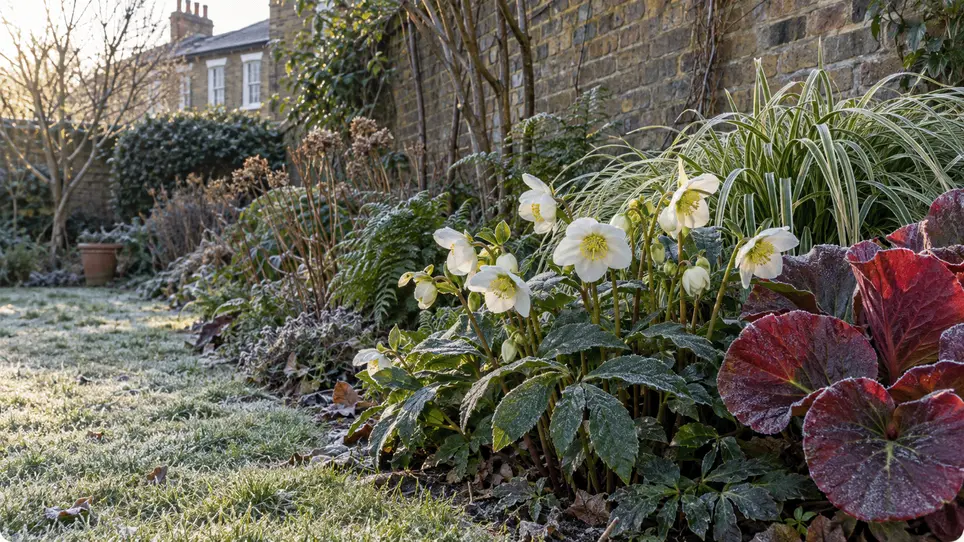


Mature plants that have filled a corner for years are the ones you least want to lose, and the Royal Horticultural Society notes that plants established for more than five years are much less likely to survive a move than younger ones. On heavy London clay the margin is narrower again, because the soil you dig into in February is often too wet to work without damaging it.
When Is the Best Time to Move Plants in the UK?
The best time to move plants in the UK is when they are dormant or growing slowly and the soil is moist but workable, which for most gardens means October and November, then again from late February to March. Dormant plants lose little water through their leaves, so cut roots have time to regrow before spring growth.
The table below sets out the best time to move plants in the garden by type, drawn from RHS guidance and adjusted for clay.
| Plant Type | Best Window | Avoid | Notes for Clay Soils |
|---|---|---|---|
| Deciduous shrubs and trees | Late October to mid March | Frozen or waterlogged ground | Aim for October and November, before winter rain saturates the soil |
| Evergreen shrubs | October, or late March | Midwinter, when cold wind dries the foliage | Late March suits clay better than a wet November |
| Roses | November to February, fully dormant | Replanting into an old rose bed | Change the soil if roses grew there before |
| Herbaceous perennials | September to November, or March to May | Hot, dry spells | Choose spring if autumn turns wet |
| Spring-flowering perennials | After flowering, June to August | Moving in bud | Water well, as summer soil dries fast |
| Herbaceous peonies | Autumn | Spring and summer | Replant shallow, buds no more than 2.5cm deep |
Sources: RHS moving trees and shrubs, RHS dividing perennials, RHS herbaceous peony growing guide.
Why Autumn Usually Beats Spring on Clay
On clay, autumn is usually the better moving window because the soil is still dry enough to dig without compacting it. The RHS advises digging clay in autumn and early winter, and warns that once winter rain has soaked the ground it may not be workable until mid spring. Clay also warms slowly, so a plant moved in March sits in cold, wet soil for weeks before its roots start growing. For more on preparing heavy soil before you replant, see our guide to improving drainage in clay-heavy London gardens.
Can You Move Plants in Summer?
Herbaceous perennials can be moved in summer if they go into well-prepared ground and are kept watered until they re-establish. Leave woody shrubs and trees until the dormant season: in full leaf they lose water faster than a damaged root system can replace it.
Which Plants Don't Like Being Moved?
Roses, magnolias, broom (Cytisus) and rock rose (Cistus) are among the plants the RHS lists as tricky to move, along with any tree or shrub that has been in place for more than five years. Their sparse or deep roots rarely hold together in a root ball.
- Herbaceous peonies (Paeonia lactiflora) usually take a year or two to flower again after moving.
- Angel's fishing rod (Dierama) resents disturbance and is slow to flower after division.
- Mature shrubs past five years in the ground are often better renovated by pruning than moved.
Use a simple rule before lifting anything: move, divide or replace. Move a plant under five years old that is in the wrong place. Divide a congested perennial clump and replant the vigorous outer sections. Replace an old, woody shrub when a young plant from our evergreens and shrubs range will fill the space faster than a struggling transplant.
How to Move Plants Without Killing Them
To move plants without killing them, prepare the new planting hole first, water the plant the day before, lift the largest root ball you can manage and replant at the same depth within the hour. Most plants recover well when the soil around the roots stays intact.
Prepare Mature Shrubs a Year Ahead
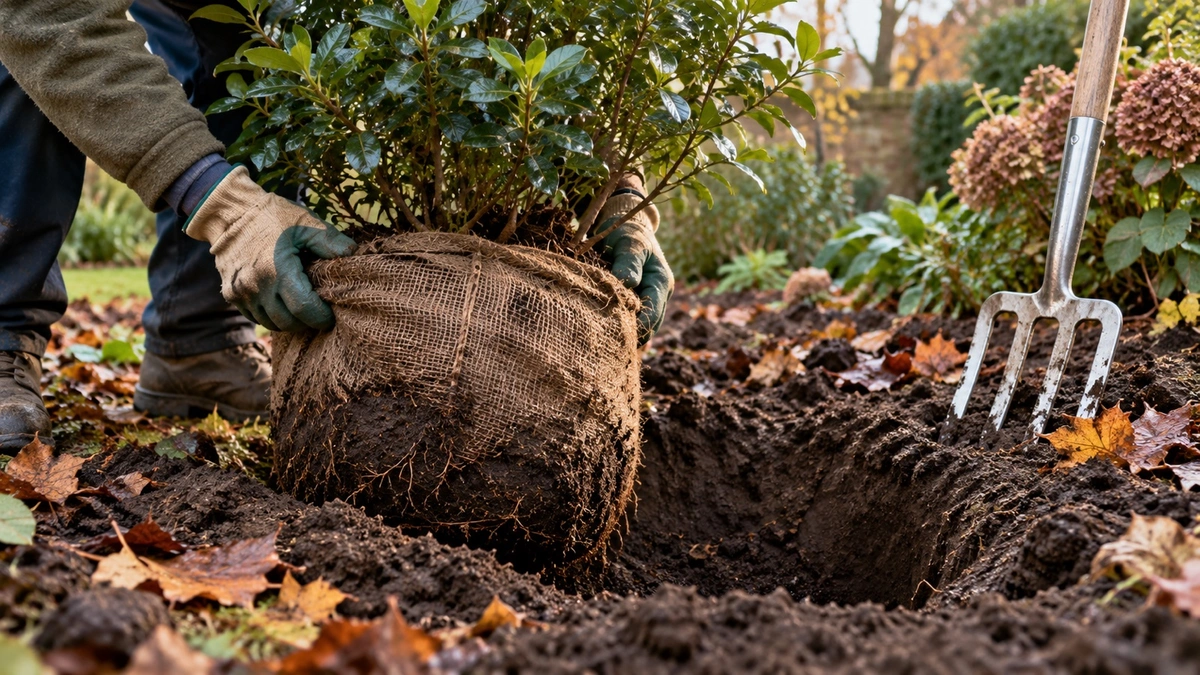
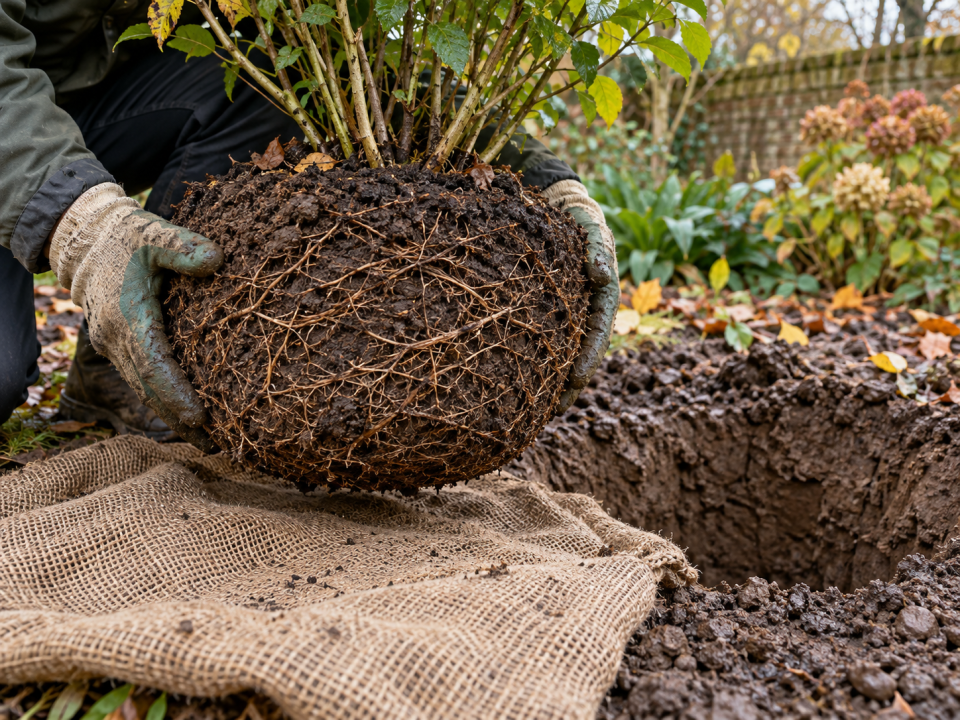
Large or established shrubs move far more successfully when their roots are pruned a year before the move. Between November and February, dig a circular trench one spade's depth and about 30cm wide around the plant, roughly in line with the spread of the branches, and backfill it with sharp sand. The cut roots produce a mass of fine feeding roots inside the trench, which you then lift with the root ball the following dormant season.
Moving Day, Step by Step
- Water the plant thoroughly the day before, so the root ball holds together.
- Dig the new hole first: mark out the expected root spread plus 30 to 60cm, dig to at least 30cm deep and fork the base and sides.
- Tie in loose branches with soft twine to protect stems and give you room to dig.
- Cut a circle around the plant with a sharp digging spade, keeping the edge of the root ball at least a spade's width from the stems, and slice cleanly through thicker roots.
- Gently lever the root ball free with a border fork, rocking it rather than levering against the stems.
- Slide the root ball onto a plastic sheet or damp hessian. Drag large plants on the sheet rather than carrying them, and wrap it, as roots exposed to wind or strong sun dry quickly.
- Inspect the root ball for pests such as vine weevil larvae before it goes into the new hole.
- Set the plant at the same depth, using the old soil mark on the stem as your guide, then backfill, firming as you go to remove air pockets.
- Water in thoroughly, then mulch around the plant, keeping mulch clear of the stems.
Check the planting level twice before you backfill: the RHS calls planting too deep one of the biggest killers of all plants.
Moving Garden Plants to a New Home
Garden plants moving house need the same root protection as a move within the garden, plus a cool, upright journey. Prune dead or overlong growth that could snap in transit, wrap each root ball in breathable hessian rather than plastic, which traps heat, and pack pots in sturdy crates so the soil doesn't spill. Keep plants out of hot vehicles, unpack them immediately and replant on arrival.
Should You Prune Before Moving?
Prune lightly before moving: remove dead, weak or crossing stems, but don't prune hard. The RHS recommends only light thinning for trees and shrubs, because the leaves that remain feed the new roots. Reshape the plant after its first full growing season.
Aftercare: Replanting Flowers and Shrubs
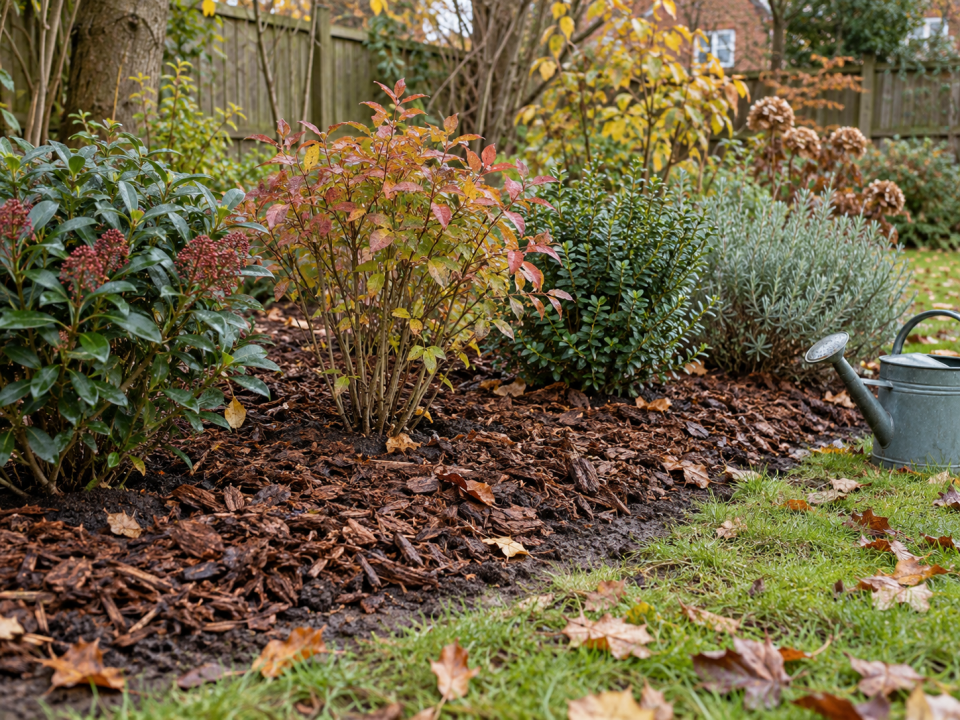
To settle into their new spot, replanted flowers and shrubs need consistent watering through their first growing season, a mulch to hold moisture and, for taller shrubs, a stake for a year or two. The RHS singles out the year after moving as the period that needs most care, particularly through dry spells.
- Water deeply during dry spells for the first 12 months. Newly moved evergreens also need water in dry winters, but never water frozen ground.
- Mulch at least 5cm thick between November and February. Our SylvaGrow Farmyard Organic Matter works well here.
- Improve the backfill with organic matter from our compost range where the soil is poor, but don't create a rich pocket in heavy clay that collects water.
- Stake larger shrubs or any plant on a windy site for one to two years, so wind rock doesn't tear new roots.
- Feed with a general fertiliser in spring once growth starts, not at planting.
Wilting in the first few weeks is a normal sign of stress, not failure. Monitor the plant, keep the soil moist rather than wet to avoid root rot, shade it from strong sun if you can, and judge recovery by new growth the following spring.
Do Mycorrhizal Fungi Help Transplants?
Mycorrhizal fungi products such as Rootgrow are most useful when replanting roses or other members of the rose family into soil where a similar plant has grown before, since that situation risks replant disease. The RHS notes manufacturers' claims that these products counteract it, but its main advice is to replace the old soil with new soil from elsewhere in the garden, in a hole about 60cm across and at least 30cm deep. Sprinkle the granules directly onto the roots as you replant.
How to Move and Replant Peonies
Move herbaceous peonies in autumn and replant them with the buds no more than 2.5cm below the soil surface. Planting too deep is a leading cause of peonies failing to flower. The RHS peony growing guide also notes that a moved or divided plant typically takes a year or two to flower again, so move a peony only when its position is wrong, not to tidy a border.
- Cut the foliage back once it has yellowed in late autumn.
- Lift the whole crown with a fork, keeping as much of the fleshy root as possible.
- If the clump is old and flowering has declined, divide it with a sharp knife into sections with several healthy buds each.
- Replant in sun or light shade, in well-drained soil improved with organic matter, with the buds at 2.5cm depth or less.
Browse herbaceous peonies and companion plants in our perennials range. Tree peonies are woody shrubs and follow the shrub timings above.
Replanting Wild Flowers: What You Can and Can't Move
You can move wild flowers that have self-seeded in your own garden, but uprooting a wild plant growing elsewhere without the right permission is an offence in England and Wales. Section 13 of the Wildlife and Countryside Act 1981 makes it an offence for anyone who isn't an authorised person to intentionally uproot a wild plant. "Authorised person" is defined in the Act and covers the owner or occupier of the land, and anyone they've authorised, so moving a self-seeded plant on someone else's land still needs their agreement first.
Within your own boundaries, move self-sown wild flowers while they are young. Foxglove (Digitalis purpurea) seedlings transplant easily as small rosettes in early autumn or spring, and primroses (Primula vulgaris) can be lifted and divided after flowering. Buy plug plants or sow seed rather than lifting from verges. Our guide to designing a wildflower garden in London covers seed mixes, plugs and soil fertility.
Moving a Garden Plant Into a Pot
To move a garden plant into a pot, choose a new pot only slightly wider than the root ball, with drainage holes, and fill around the roots with a loam-based compost. A loam-based mix such as SylvaGrow John Innes No. 3 holds water and nutrients longer than a light multipurpose compost, which matters for shrubs that stay in the same pot for several years.
- Set the plant at the same depth it grew in the ground, leaving a 3 to 5cm gap below the rim for watering.
- Firm the soil mix around the root ball to remove air pockets, then water thoroughly until it drains.
- Check for root crowding to judge when repotting is due, then move up to a pot one size larger than the current one. Avoid repotting in midwinter; spring suits most container shrubs.
Explore our pots and planters range. For terraces and courtyards planted entirely in containers, our Courtyard & Roof Terrace Container Planting service designs, supplies and installs the planting.
North London gardens sit largely on London clay, which turns moving plants into a question of soil timing as much as plant timing. In a dry autumn, clay lifts in firm, cohesive root balls that travel well. After weeks of winter rain, the same soil smears and compacts under a spade, and a planting hole dug into it fills with water like a sump. The practical rule on clay is to finish moving trees and shrubs by late autumn, and to wait for the soil to dry in spring rather than forcing a February move.
If you're rethinking a whole border rather than relocating one shrub, Boma's Garden Planting Service covers a site consultation with a horticultural specialist, a planting scheme for established beds and borders, clearance of existing soft planting, supply and installation, and aftercare guidance, within a five-mile radius of Kentish Town. Full garden design projects run through our Garden Design and Landscaping service. Further afield — Chelsea, Fulham and South East London included — our tools, compost and plants are available for delivery to all M25 postcodes.
Moving Plants FAQs
What Is the Best Month to Move Plants?
October is the best month to move most garden plants in the UK. Soil is still warm enough for roots to grow, autumn rain reduces watering, and deciduous trees and shrubs are going dormant. For evergreens, October and late March are equally suitable.
Can I Dig Up Flowers and Replant Them?
Yes, most garden flowers can be dug up and replanted if you lift them with plenty of soil and replant at the same depth straight away. Perennials respond best in spring or autumn. Annuals and plants in full flower recover poorly, so wait until they finish.
Is March Too Late to Move Roses?
Early March is not too late to move roses if the plant has not yet broken into leaf. Once new shoots are growing strongly, wait until the following November, or move with a large root ball and water heavily through spring.
How Long Does Transplant Shock Last?
Transplant shock usually shows as wilting for the first few weeks after a move, until the roots can absorb water from the surrounding soil. Shrubs take a full growing season to re-establish.
Move plants in a dry spell of the dormant season, with your tools, mulch and compost ready before you lift. Visit Boma in Kentish Town to see our current range of tools, soil improvers and plants, or order online for delivery to any address within the M25, from Camden to Chelsea, Fulham and South East London. For a border that needs rethinking rather than shuffling, book a consultation with our Garden Planting Service.
Order For Delivery Book A Consultation