

Prune a Japanese maple (Acer palmatum and A. japonicum) after leaf fall and before January, while the tree is fully dormant. For most gardens that means November and December. Cut in late winter or spring and rising sap bleeds from the wound, which weakens the tree and invites dieback at the cut.
Acers need far less pruning than most garden trees. The RHS advises keeping cuts to a minimum, because the most graceful shape forms when the branches develop fairly naturally. The work is mostly corrective: dead or damaged shoots, crossing branches and the odd stem that spoils the outline. The timing and cuts below apply across Boma's Japanese maple range, from 3L 'Orange Dream' to a 65L specimen 'Bloodgood'.
When to Prune Acer Trees in the UK
Prune acer trees in the UK between November and December, once the leaves have dropped and before sap pressure builds in late winter. The RHS gives the window for Japanese maples as after leaf fall but before January, with light corrective work possible into summer once the wood has hardened and sap flow has eased. January to June is the period to avoid structural pruning altogether.
| Month | What the Tree Is Doing | What to Do |
|---|---|---|
| January to March | Sap rising; bleeding risk is highest | Avoid pruning. Cut only branches broken by wind or snow, cleanly back to a side branch. |
| April to June | Leaves expanding; soft new growth | Avoid pruning. Cover young leaves with horticultural fleece when frost is forecast. |
| July to August | Spring growth hardened | Light pruning only: remove dead shoots and shorten a misplaced shoot. |
| September to October | Leaves colouring | Leave the canopy alone. Repot container acers in September. |
| November to December | Fully dormant, leaves down | Main pruning window: crossing shoots, formative cuts and height reduction. |
Choose a dry day above freezing for any acer pruning. Frozen wood tears rather than cuts cleanly, and a ragged wound heals slowly.
Why Does Pruning an Acer at the Wrong Time Cause Bleeding?
Pruning an acer at the wrong time causes bleeding because sap pressure in late winter and early spring forces sap out of fresh cuts. The RHS describes bleeding as usually not harmful, though prolonged bleeding can weaken a tree and, rarely, kill it. The RHS also confirms that wound paints are no longer recommended: they trap moisture against the cut and encourage fungal infection, so every cut is best left open to the air.
Is It Too Late to Prune Acers Once January Arrives?
It is too late for structural pruning of acers once January arrives, so hold off until July for light work or the following November for anything larger. A broken or split branch is the one exception: cut it back to a clean side branch at any time of year, because a torn limb causes more damage than a bleeding cut.
How to Prune an Acer Tree, Step by Step
To prune an acer tree, work in three passes: dead and damaged wood first, crossing shoots second, outline last, cutting each stem back to a side branch or bud. Stop as soon as the tree looks balanced; acers recover slowly from heavy cutting, so the lighter pass is usually the right one.
- Clean and sharpen secateurs, loppers and a pruning saw before you start; sharp, clean blades make precise cuts and avoid spreading disease between plants.
- Remove dead branches, damaged shoots and diseased wood, cutting back into healthy, live wood just above a side branch or bud.
- Remove badly placed shoots and crossing shoots that rub against each other or grow into the centre, to improve air circulation.
- Cut back any strong vertical shoot on a young tree to a side branch in late autumn, as the RHS advises, so it does not compete with the main shoots.
- Reduce height or width by following long branches back to a side branch pointing in the direction you want growth to go.
- Step back after every two or three cuts and check the outline from the house as well as the garden.
Where to Make Pruning Cuts on an Acer
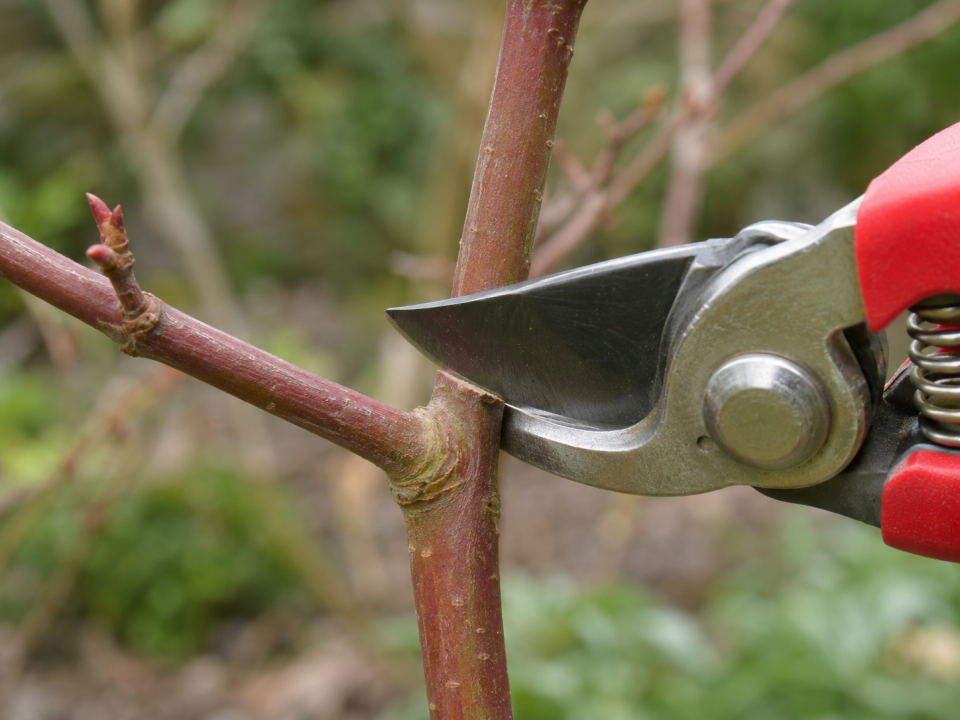
Make every pruning cut just outside the branch collar or immediately above a healthy side branch, and never leave a stub. The RHS warns that stubs are prone to decay and dieback. Use secateurs on small branches up to finger thickness and a pruning saw on anything larger, undercutting heavier limbs first so the bark does not tear as the branch falls.
How Hard Can You Cut Back an Acer?
You cannot cut back an acer hard without losing its character. Excessive pruning provokes a thicket of upright shoots growing from the wound, and that congested regrowth replaces the layered, graceful habit the tree was bought for. For an overgrown tree, spread the reduction over two or three winters rather than taking it all in one go, and keep each year's cut on the light side.
Pruning Acers by Habit: What Each Cultivar Needs
Pruning acers depends on growth habit: mounded laceleaf forms need thinning from beneath, upright forms need a good framework built early, and slow-growing dwarf forms need very little pruning at all. The table groups cultivars from Boma's current range by habit, because the same cut that improves an upright 'Sango-kaku' ruins the dome of a laceleaf.
| Habit | Examples | Pruning Focus | Watch For |
|---|---|---|---|
| Mounded laceleaf (A. palmatum var. dissectum) | 'Garnet', 'Inaba-shidare', 'Viridis' | Thin dead, twiggy growth inside the dome from beneath; lift the lowest skirt clear of the pot rim | Dead twigs hidden under the outer foliage |
| Upright small tree | 'Bloodgood', 'Osakazuki', 'Sango-kaku' | Formative cuts in the first winters to set three to five main branches; crossing shoots only once established | Strong vertical shoots competing with the leader |
| Upright laceleaf | 'Seiryu' | Remove crossing shoots to keep the fine-cut layers distinct | Congestion in the centre of the canopy |
| Dwarf and congested | 'Shishigashira', 'Skeeter's Broom' | Little pruning: dead wood and the occasional shoot growing out of line | Overcrowded inner growth |
| Variegated | 'Butterfly' | Remove all-green reverted shoots as soon as they appear, in any season | Reversion overtaking the variegation |
| Full moon maple (A. shirasawanum) | 'Aureum', 'Moonrise' | Minimal; remove scorched tips in winter | Leaf scorch in afternoon sun or wind |
See the full range of Japanese maples in the Boma acer collection, from compact laceleaf forms for pots to specimen trees.
How to Prune and Repot a Potted Acer
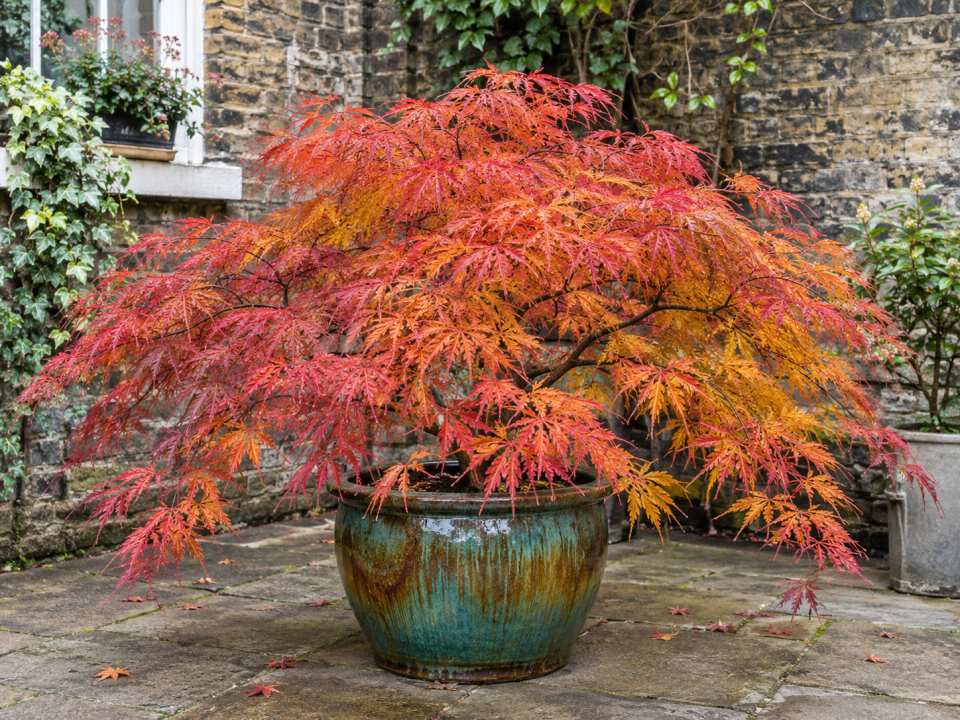
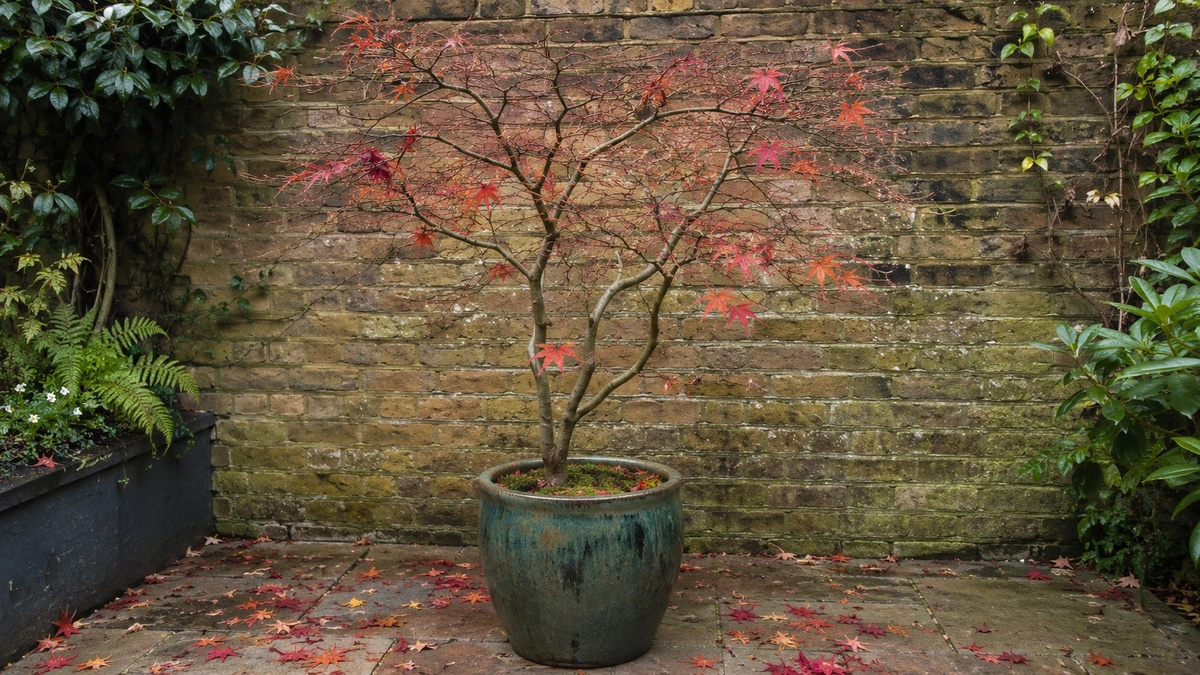
Prune a potted acer in the same November to December window as one in the ground, but more lightly, because a container restricts the roots and slows the tree's recovery. Thin rather than shorten, avoid removing more than one main branch in a winter, and keep the canopy in proportion to the pot so the tree is not top-heavy in winter winds.
Container roots are vulnerable to frost damage, so raise pots on feet, group them in a sheltered spot and wrap them in hessian through the coldest weeks. For courtyards and roof terraces, Boma's Courtyard & Roof Terrace Container Planting service selects, pots and positions acers for exposed, paved spaces.
When to Repot an Acer in the UK
Repot an acer in the UK in April or September, moving it into a container only slightly larger than the last one every couple of years. Both months avoid the dormant season, when roots are slow to establish, and the summer peak, when a disturbed root ball dries out fast. In the years you do not repot, scrape away the top layer of compost and replace it with fresh mix.
Which Compost Suits an Acer in a Pot?
A loam-based, peat-free compost such as SylvaGrow John Innes No. 3 suits an acer in a pot, with a handful of horticultural sharp sand added for drainage. On alkaline tap water or limy soil, a peat-free ericaceous compost is the safer choice, since acers dislike shallow, chalky conditions. Containers that have been in the same pot for over a year benefit from a general granular feed in late spring; acers in the ground need no feeding.
Common Mistakes When Pruning Japanese Maples
The most common mistake when pruning Japanese maples is cutting at the wrong time, closely followed by cutting too much. Each of the errors below costs a slow-growing acer a season or more of recovery.
- Pruning in early spring, when sap is rising and every cut bleeds.
- Topping the tree to control height, which produces a congested crown of upright shoots.
- Taking too much canopy off in one winter, rather than spreading a big reduction over two or three years.
- Leaving stubs, which die back and decay into the main branch.
- Painting cuts with wound sealant, which traps moisture against the wound.
- Pruning to fix scorched or dull foliage: scorched leaves point to too much afternoon sun or wind, and purple leaves turning green point to too little light. Move the tree rather than cut it.
Acers in North London Gardens: Boma's Local Notes
London clay holds water through winter, and acers want slightly acidic, humus-rich, well-drained soil. On clay, dig in plenty of organic matter, keep no more than 2.5cm of soil over the main roots and choose a slightly raised position so water drains away from the trunk. In paved gardens and side returns, wind funnelled between buildings scorches fine-cut leaves; place acers where walls or other plants break the wind and where afternoon sun is filtered.
Where an acer is part of a wider scheme of beds and borders, Boma's Garden Planting Service assesses aspect, soil and microclimate before recommending and planting trees, so the cultivar suits the position from the start.
Choose Your Next Acer With Boma
Prune this winter between leaf fall and the end of December, repot container acers in April or September, and leave the rest of the year to the tree. Visit Boma in Kentish Town to see our current range of Japanese maples, from compact laceleaf forms for pots to specimen trees, along with the sharp sand and compost to repot them.
Book a Planting Consultation Order for DeliveryFrequently Asked Questions
Do Acers Prefer Shade or Sun?
Acers prefer a sheltered spot in partial or dappled shade. Green-leaved forms tolerate more sun, while red and purple cultivars need some sun to develop their dark colour but scorch in strong afternoon light.
Will a Japanese Maple Grow Back if Cut?
A Japanese maple grows back from buds and side branches below a cut, but slowly. Regrowth after heavy cutting is usually upright and crowded, which is why staged, light pruning keeps a better shape.
Should I Prune a Newly Planted Acer?
A newly planted acer needs only dead or damaged shoots removed in its first winter. Container-grown acers from nurseries and garden centres arrive already shaped, so their framework is in place. Begin formative pruning in the second winter, once the roots have established and new growth shows the tree's natural direction.
Do Acers Need Covering in Winter?
Acers in the ground are usually fully hardy and need no covering. Acers in pots need their containers wrapped and raised off cold paving, and young spring leaves benefit from horticultural fleece on frosty nights to guard against late frost scorch.
Written by the Boma team, Kentish Town. Last updated November 2026.