

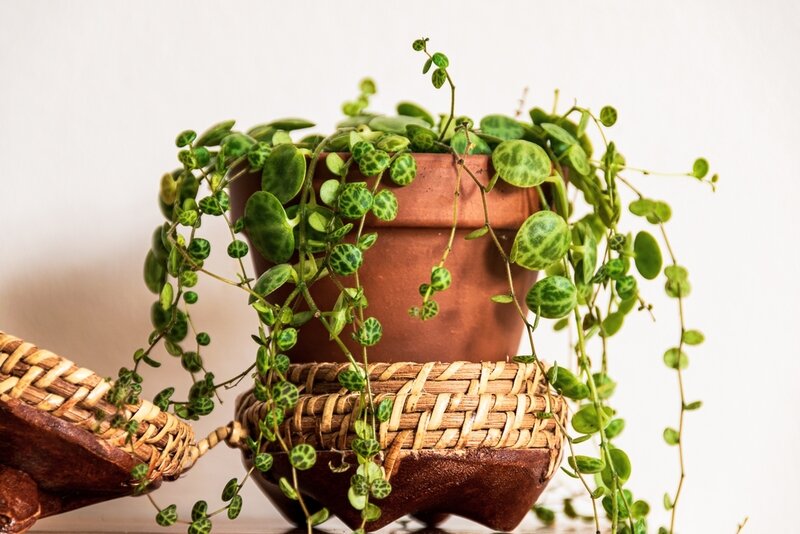
Indoor hanging plants add an extra dimension to a room, with their foliage cascading elegantly from baskets or spilling down from shelves and ledges. And despite their exotic appearance, many hanging plants are straightforward to grow and take care of. Here are five of our favourite indoor hanging plants.
1. Spider plant (Chlorophytum comosum)
The spider plant gets its name from its shape, forming a tuft of slender, arching green and white-striped leaves. In summer, it produces long stems with clusters of white flowers and smaller spidery tufts of leaves at the stem's ends. These stems can be left to cascade from a hanging basket, or the tufts can be cut off and planted and will grow into new plants.
Spider plants like bright, indirect light and a temperature between 13-27°C (55-80°F). Water your spider plant regularly, keeping the compost just moist, and feed monthly with a liquid houseplant feed.
2. Tradescantia
One of the most popular Tradescantia varieties for growing indoors is Tradescantia zebrina, with long stems bearing silver and green-striped leaves with deep purple undersides. It looks beautiful trailing from a pot, showing off the gorgeous leaf colours as the stems bend and twist.
Tradescantias like bright but indirect light and will do well near an east- or west-facing window. Water regularly to keep the compost evenly moist but don’t over-water, or the roots will rot.
3. Orchid cactus (Epiphyllum)
Orchid cacti are spectacular, with long segmented leaf-like stems and clusters of fragrant, brightly coloured flowers in spring and summer. They like bright, indirect light, and it’s essential to plant them in a well-drained medium, such as cactus compost mixed with perlite or horticultural grit.
- In spring and summer, water your orchid cactus when the compost starts to dry out, using bottled water or rainwater. Feed fortnightly with a cactus fertiliser.
- In winter, move it to a cooler spot and reduce watering to allow it to rest. Once new flower buds have formed, move it back to its original position.
4. String of hearts (Ceropegia woodii)
The heart plant's string (also known as the rosary plant) has beautiful trailing wiry stems with dainty silver-marbled heart-shaped leaves. It’s semi-succulent, so don’t overwater it. Let the compost dry out between waterings and reduce watering in winter. It does best in bright but indirect light, with a temperature between 18-24°C (64-75°F).
5. Devil’s ivy (Epipremnum aureum)
This attractive trailing plant has heart-shaped green leaves splashed with yellow. It prefers bright, indirect light and can be allowed to cascade from a hanging basket or trained up a framework.
- Water regularly, allowing the compost to dry out between waterings.
- Reduce watering in winter.
- Wipe the leaves occasionally to remove dust.
Add something special to your home today with a beautiful hanging plant. Visit our centre to see our exciting range of house plants.