

What Makes a Small Garden Feel Private Without Feeling Closed In?
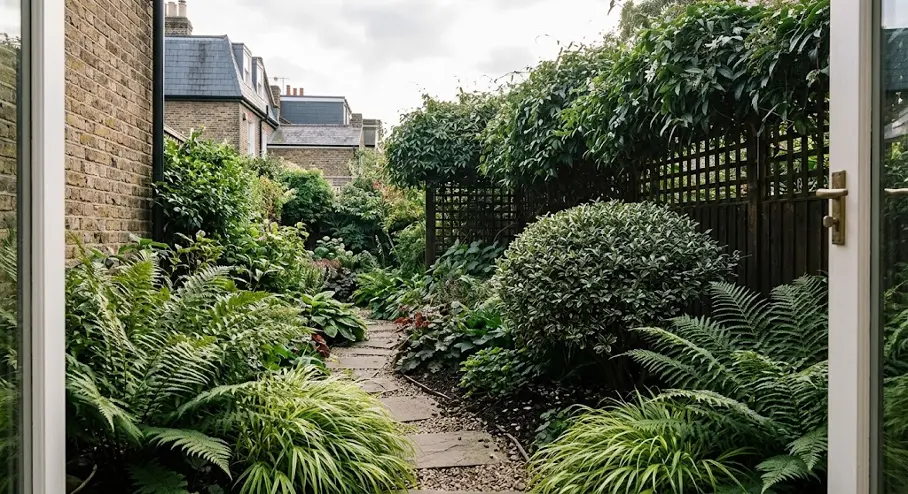
Privacy and enclosure are not the same thing. A garden that interrupts sightlines at several different heights, while varying the texture of its foliage, reads as private without acquiring the shut-in quality that makes small spaces feel oppressive. The distinction matters most in plots of 20 to 40 square metres, where a solid screen on every boundary quickly becomes a box.
The deciding variable is the relationship between canopy height and boundary position. A climber trained to around 3 metres on a rear fence breaks the overlooking angle from above; keeping the mid-storey relatively open at eye level, rather than running a continuous 1.8-metre hedge, preserves depth and lets light reach the body of the garden.
- Screen at height, not at eye level. The overlooking usually comes from above, so that is where the density needs to be.
- Break the boundary line. Planting flush against the fence emphasises where the garden ends; staggered, off-centre planting hides it.
- Vary the texture. Large leaves near the house and fine foliage further away exaggerate distance.
- Keep one sightline open. A single clear diagonal does more for perceived size than more planting.
- Plan for winter. A scheme that screens in July and disappears in January has not solved the problem.
The Three-Layer Planting Matrix
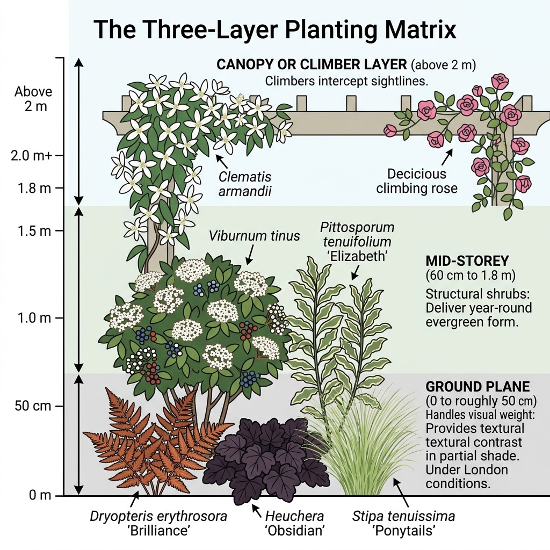
Layering in a small garden means using three zones at the same time rather than choosing between them. Each does a different job, and each reads to the eye at a different apparent distance.
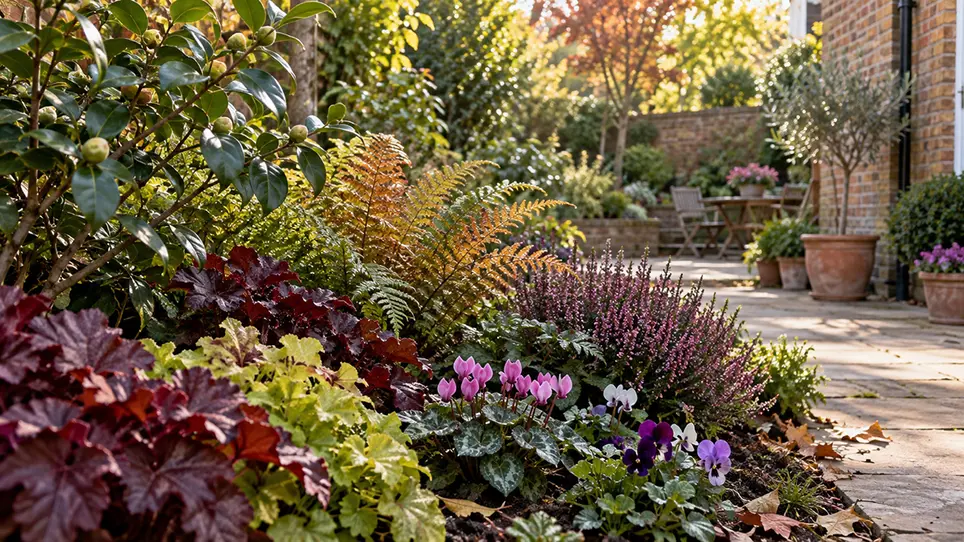
- The ground plane runs from 0 to roughly 50cm and carries the visual weight at foot level. Dryopteris erythrosora 'Brilliance' (autumn fern), whose fronds open coppery and mature to deep green, and Heuchera 'Obsidian' both perform well in the partial shade typical of a walled or overlooked plot.
- The mid-storey occupies 60cm to 1.8m and is where structural evergreens do their work. Viburnum tinus (laurustinus) and Pittosporum tenuifolium 'Elizabeth' hold form and density through winter.
- The canopy or climber layer takes the scheme above 2 metres. Clematis armandii (Armand clematis) or a climbing rose on trellis intercepts the sightlines a fence cannot reach.
The reason the matrix works is optical as much as horticultural. Standing at the house end of a 9-metre plot, the ground plane registers close to you, the mid-storey sits in the middle distance, and the climber layer at the far boundary reads as background — three planes instead of one flat green wall.
As a worked example for a sheltered south- or west-facing border of around 6 metres: plant Dryopteris erythrosora 'Brilliance' at roughly 45cm centres across the ground plane; set a single Pittosporum tenuifolium 'Elizabeth' about 90cm in from the rear fence as the mid-storey anchor; and train Clematis armandii on a trellis panel taking the boundary to around 2.7 metres. The pittosporum and the clematis both want sun and shelter; the fern sits in the shade they cast.
How Overlooking Changes the Screening Requirement
In a two-storey Victorian or Edwardian terrace, first-floor windows look down into the garden from well above a standard 1.8-metre fence, and second-floor windows from higher again. A fence alone therefore addresses only the lowest tier of sightlines. Adding a trellis panel above the fence and training a climber up it is the single most effective intervention, because it puts the screening where the overlooking actually is.
For overlooking from higher up, height alone stops being the answer. What works better is positioning the climber or a small tree slightly away from the boundary, so the foliage spreads across the sightline rather than pressing flat against the fence. The RHS gives Clematis armandii a maximum height of 4 to 8 metres, which is ample to cover both tiers on a single well-sited plant trained over several seasons.
Plants That Screen Reliably in a London Garden
The plants that hold up in small London gardens tolerate urban air, root competition, restricted volume and part shade, and keep their structure through winter. Evergreens carry the scheme; deciduous planting adds seasonal interest on top of it, never underneath it.
| Plant | Layer & Height | Why It Works Here | Aspect |
|---|---|---|---|
| Clematis armandii Armand clematis |
Canopy · 4–8m | Evergreen, leathery leaves that hold density all winter; scented white flowers in early spring | Sheltered south or west wall |
| Pittosporum tenuifolium 'Elizabeth' | Mid-storey · to 4m unclipped | Cream-margined foliage lifts a shaded plot; clips well where width is tight | Sun to part shade |
| Pittosporum tenuifolium 'Irene Paterson' | Mid-storey · slower, more compact | Stronger variegation against a dark fence; good where 'Elizabeth' would outgrow the space | Sun to part shade |
| Viburnum tinus Laurustinus |
Mid-storey · 1.5–3m | Dependable evergreen bulk with winter flower; tolerates shade and city conditions | Sun to shade |
| Euonymus japonicus 'Green Spire' Spindle tree |
Mid-storey · to 2m | Upright and columnar, dense to the base; the best choice for a row in a rectangular trough | Sun to part shade |
| Fargesia Clumping bamboo |
Screen · 2–4m | Vertical screening without the running roots of Phyllostachys; suits exposed terraces | Sun to part shade |
| Dryopteris erythrosora 'Brilliance' Autumn fern |
Ground plane · to 60cm | Coppery new fronds, evergreen presence, thrives in the shade cast by the layers above | Part to full shade |
| Heuchera 'Obsidian' | Ground plane · to 45cm | Near-black foliage anchors the ground plane and reads well against pale paving | Part shade |
| Stipa tenuissima 'Ponytails' Mexican feather grass |
Ground plane · to 60cm | Thread-fine texture for the far end of a border — but needs sun and sharp drainage | Full sun |
Pittosporum tenuifolium as a City-Hardy Evergreen Screen
Pittosporum tenuifolium is among the most dependable evergreen screening shrubs for London conditions, tolerating urban air, a range of soils and moderate shade better than most alternatives in the 1.5 to 3-metre band. It gives structure within a few seasons and clips well, which matters when the available border width is measured in centimetres rather than metres.
'Elizabeth' carries cream-margined foliage that flushes pink in cold weather and lifts a shaded plot considerably. Where space is tighter, 'Irene Paterson' stays more compact and gives stronger variegation against a dark fence. Both want reasonable drainage — a fair caution in London, where garden soil is frequently heavy clay overlaid with made ground from decades of building work.
Clematis armandii for Wall and Fence Coverage
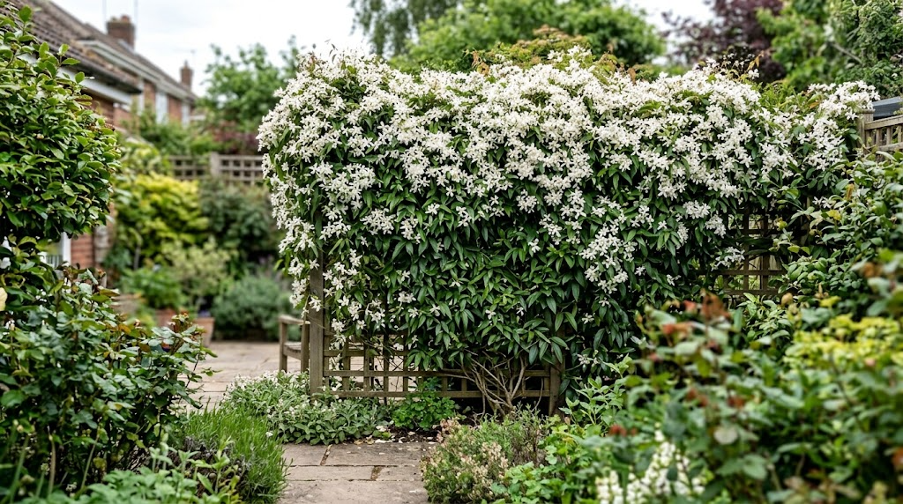
Clematis armandii is a vigorous evergreen climber that will cover a substantial trellis panel within a few growing seasons and, per the RHS, reaches 4 to 8 metres given room and time. It produces scented creamy-white flowers in early to mid spring — generally March into April, occasionally earlier on a sheltered London wall — at a point in the year when most other climbers are still bare.
The RHS recommends a warm south or south-west facing wall with shelter from cold winds, which suits the rear aspect of a great many London terraces. The leaves are long, dark and leathery, and reach a density that meaningfully interrupts sightlines from the second season. It does need properly fixed support — horizontal wire runs or trellis secured at 30 to 40cm intervals — because a mature plant carries real weight.
Is a Climbing Rose a Practical Privacy Screen?
A climbing rose gives excellent screening through summer and leaves the fence visible from November to April. For a brief that has to hold year-round, that makes it a companion plant rather than the backbone — best paired with an evergreen mid-storey shrub that carries the sightline through winter, with the rose adding flower and scent above it.
Boma's David Austin climbing rose range changes through the season and heights vary considerably between cultivars, so it is worth seeing what is on the benches. The team in store can tell you which of the current climbers will take a semi-shaded London wall.
How to Create Depth in a Small Garden
Depth in a small garden is created by giving the eye a reason to travel. Three techniques do most of the work: contrasting foliage scale between foreground and distance, arranging the layout on a diagonal rather than square to the boundaries, and using reflected light to extend a view. None of them requires more space — only a different arrangement of the space you have.
Foliage Contrast and Atmospheric Recession
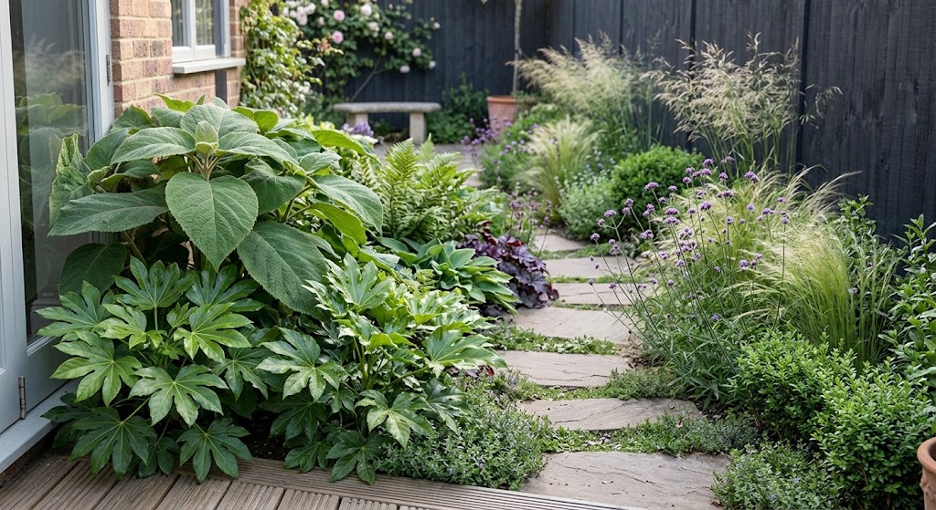
Bold foliage contrast between the near and far ends of a plot creates the optical impression of more distance than the garden physically contains. The eye reads detail as nearness: place large-leaved plants close to the house and fine-textured ones at the far boundary, and the far boundary appears further away than it is.
At the house end, a large-leaved anchor such as Fatsia polycarpa 'Green Fingers' or a Hydrangea aspera gives the foreground real presence. At the far end, fine texture takes over — but match it to the light you actually have. Stipa tenuissima 'Ponytails' gives that thread-fine quality beautifully against a dark fence, though it needs full sun and sharp drainage to stay upright through a wet London winter. Where the far end of the garden is shaded, a fine-textured fern or a narrow-leaved sedge achieves the same recession without asking the plant to do something it cannot.
Does Planting on the Diagonal Make a Garden Look Bigger?
Yes. A diagonal path or border edge extends the perceived length of a rectangular plot compared with lines running parallel to the boundaries, because the longest dimension of a rectangle is its diagonal and the eye follows it to the corner rather than stopping at the end wall. Designers use this specifically to counter the foreshortening that square, axis-based layouts produce in plots under 10 metres.
In planting terms, that means arranging the taller screening shrubs as a diagonal cluster rather than a straight line along the back. Moving a pittosporum or viburnum off-centre so that it screens one corner, rather than sitting flush against the rear fence, opens a diagonal view across the longest axis of the plot. The garden then appears to continue past the planting instead of ending at it.
Mirrors and Reflected Light in a Small Garden
A garden mirror at the end of a shaded path doubles the apparent depth of the section it reflects, but placement decides whether it reads as considered design or an afterthought. The most effective position is on a north or east-facing boundary within a south-facing garden, where the reflection captures the lit side of the border. A mirror taking direct midday sun produces glare rather than reflection and loses the effect entirely.
The frame matters as much as the glass. A mirror set within a wall-fixed trellis panel, or clad on three sides with climbing foliage, reads as an opening into a further garden rather than an object on a wall.
Privacy planting is one of the jobs where getting the geometry right at the outset matters most — which sightlines actually need breaking, from what height, and whether the scheme still holds in January. Our Garden Planting Service covers exactly this: on-site consultation and assessment, planting schemes for established beds and borders, clearance of existing planting, and supply and installation of plants, planters and irrigation, with aftercare guidance to follow.
Where the space is a courtyard, roof terrace or balcony and the whole scheme sits in containers, our Courtyard & Roof Terrace Container Planting service does the same at that scale. Where a garden needs new paving, levels or boundary work first, that is a full redesign — covered by our Garden Design & Landscaping Service, with Boma leading the design and planting and the hard landscaping delivered through a recommended landscaper. All three operate within five miles of Kentish Town, by recommendation and appointment.
Screening in Containers, Troughs and Window Boxes
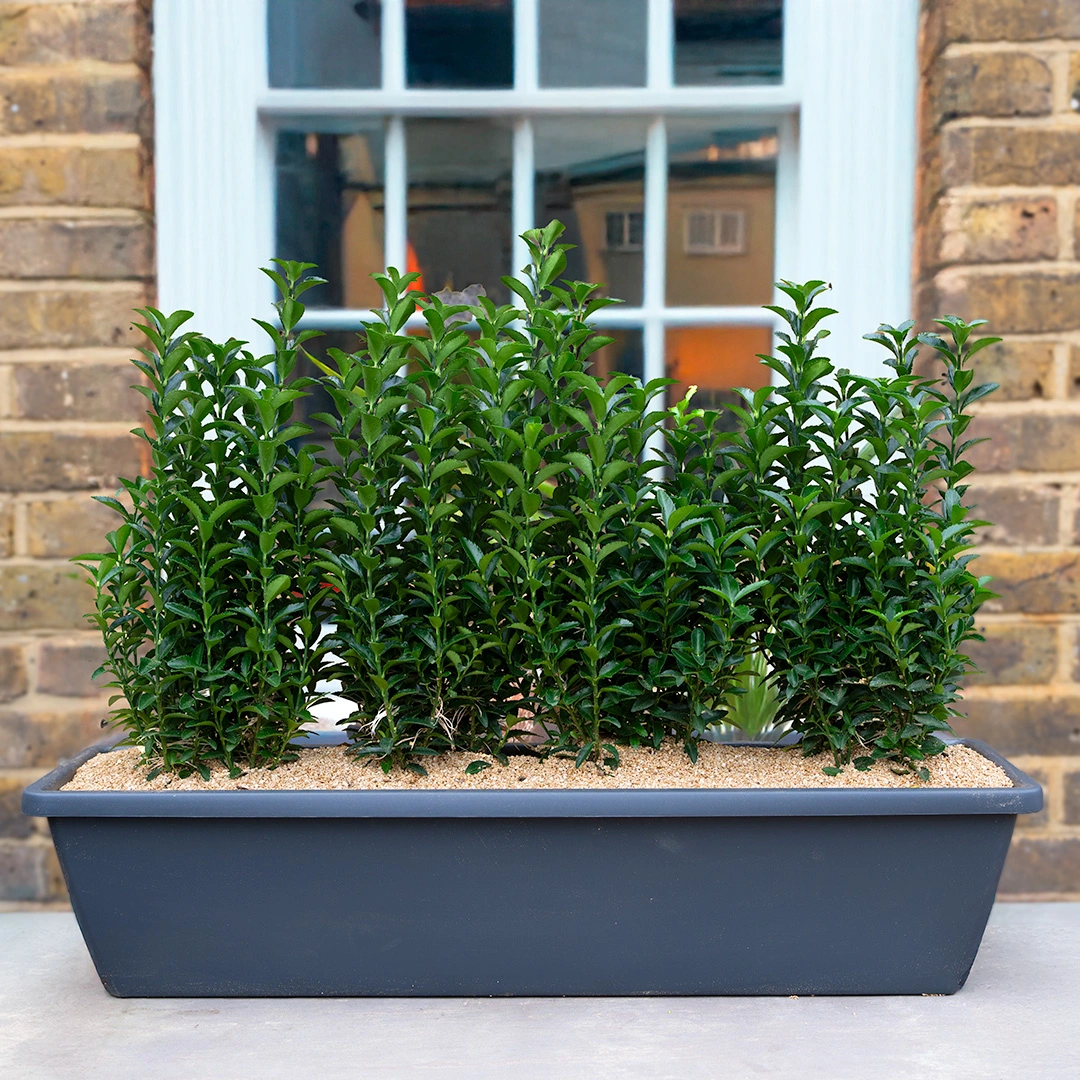
For screening in containers, a rectangular trough planted with a closely spaced row of upright evergreens works considerably better than the same plants in individual round pots. The trough gives a continuous line of foliage with no gaps at eye level, which is the whole point of a screen. Round containers, however handsome, screen in patches.
Euonymus japonicus 'Green Spire' is the most useful plant for this. It is naturally upright and columnar, holds dense glossy foliage right down to the base rather than going bare-legged, takes full sun through to partial shade, and clips readily — the qualities that make it a common replacement for box. Planted at close spacing along a trough, a row of it reads as a low hedge within the first season rather than as a set of separate shrubs.
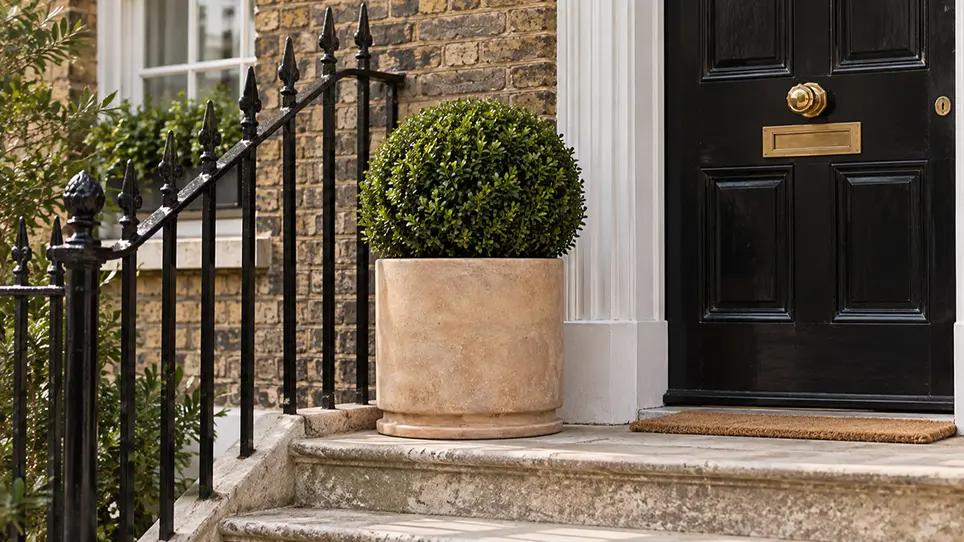
Polystone is the practical material for a screening trough: light enough to move on a terrace or lift onto a sill bracket, frost-resistant, and available in long rectangular formats that terracotta rarely comes in at any sensible weight. Large round terracotta pots — the 65cm diameter size is the workhorse — do a different job. They are specimen containers, best used for a single anchoring plant at a corner or beside a doorway, and they are not the right shape for a run of screening.
At sill and balcony-rail height, the same logic applies at smaller scale. A window box of clipped evergreen gives privacy at the exact height a passer-by looks in, which matters on the ground floor of a terrace where the front room sits close to the pavement. Clumping bamboos in the Fargesia genus remain the option where you need 2 to 4 metres of height in a container, and they cope with rooftop wind better than most broad-leaved evergreens.
Two things to plan from the outset. Raising a trough on a low plinth or bracket buys screening height without needing a taller plant, and without fixings into the building fabric — useful on a leasehold flat or a listed terrace. And any screening container dries out far faster than a border, so irrigation is worth designing in rather than retrofitting; on a roof, the loaded weight needs checking too.
We hold a wide range of evergreen screening shrubs, climbers, ferns, grasses and structural specimens at our garden centre at 51–53 Islip Street, Kentish Town NW5 2DL — stock chosen for small London gardens specifically. Bring photographs and a rough idea of where the overlooking comes from, and the team can work through the layers with you in person. We deliver to all postcodes within the M25, and our three planting services operate within five miles of the shop. Check delivery zones and charges.
Frequently Asked Questions
What Is the Best Plant for Privacy in a Small London Garden?
For most small London gardens, an evergreen climber trained on trellis above the existing fence gives the best return, because it screens at the height the overlooking actually comes from without taking up border width. Clematis armandii is the usual choice on a sheltered south or west-facing wall. Pair it with an evergreen mid-storey shrub such as Pittosporum tenuifolium or Viburnum tinus so the scheme still works in winter.
How Do I Screen a Garden That Is Overlooked From Upstairs Windows?
Raise the screening above fence height and move it off the boundary. A trellis extension bringing a 1.8-metre fence to roughly 2.7 metres, with a climber trained across it, addresses first-floor sightlines. For higher windows, position a climber or small multi-stem tree a little away from the fence so the canopy spreads across the sightline rather than pressing flat against the boundary.
Which Plants Give Privacy in Pots on a London Roof Terrace?
Euonymus japonicus 'Green Spire' is the most reliable choice, planted as a close row in a rectangular polystone trough rather than in separate round pots — the trough gives an unbroken line of foliage where individual pots leave gaps. It is upright, dense to the base, and takes sun or part shade. Where you need 2 to 4 metres of height, clumping bamboos in the Fargesia genus stand up to rooftop wind well.
Do I Need Ericaceous or Special Compost for Screening Plants in London Clay?
No — the plants above all suit neutral to slightly alkaline conditions, which is what most London gardens have. London garden soil is typically heavy clay, often overlaid with made ground containing brick, mortar and chalk rubble from past building work, which tends to push the pH upwards. It varies street by street, so a simple pH test is worth doing before you plant. Improving drainage generally matters more than adjusting pH.
How Long Before a Privacy Planting Scheme Actually Screens?
Expect meaningful screening from the second growing season and a properly dense scheme by the third, assuming the plants go in at a reasonable size and are watered through their first two summers. Evergreens establish more slowly than deciduous planting but hold their gains. Buying larger specimens shortens the wait at the mid-storey layer; climbers usually catch up quickly regardless of starting size.
If you are working out how to screen a small London garden — or want to see the evergreens, climbers and structural specimens side by side before committing — come and see us at 51–53 Islip Street, Kentish Town NW5 2DL. The team can work through the layers with you, and we deliver to all postcodes within the M25.
Visit Us Order For Delivery Book a Consultation