

What Does Compost Do to the Soil in an Established Border?
Compost improves soil at three levels: physical structure, chemistry, and biology. Organic matter opens up clay particles, improving drainage and aeration while reducing compaction. It also releases nutrients slowly as it breaks down, with nitrogen, phosphorus and potassium available to plant roots over roughly a 12-month period, while feeding the earthworm populations and fungal networks that move nutrients through the soil profile.
| Compost Type | Best Use in Established Border | Why Choose This for London Gardens |
|---|---|---|
| General Compost | Soil structure and nutrients | Essential baseline for clay improvement |
| Composted Fine Bark | Surface mulch and weed suppression | Deters cats and retains moisture |
| Ericaceous Compost | Acid-loving plants | Corrects micronutrient lockout for specific plants |
Does Compost Improve Clay Soil in an Already Established Garden?
Yes, compost significantly improves clay soil, increasing its drainage capacity and workability. London clay, a heavy, poorly structured soil common across much of North and Central London, compacts readily under foot traffic and becomes waterlogged in wet winters. Annual compost applications break up clay aggregates over time, with measurable improvement in soil structure typically visible within two to three seasons of consistent application. Earthworm populations, which process organic matter and aerate soil through burrowing, increase markedly in clay soils treated with compost.
Does Compost Feed Soil Organisms?
Yes, compost directly feeds soil organisms, including bacteria, fungi and earthworms. One gram of healthy garden soil contains an estimated 100 million to 1 billion bacteria (10⁸ to 10⁹ colony-forming units, per Metting, 1993). Compost provides the carbon-rich food source these organisms need to thrive. The mycorrhizal networks that connect plant roots across a border rely on organic matter in the soil profile; depleted, compacted soils break these networks down.
When Is the Best Time to Apply Compost to Established Beds?
The best time to apply compost to established beds is late winter to early spring, between November and February. At this point the soil retains moisture from winter rainfall, which helps the compost settle and begin breaking down before the growing season, and herbaceous perennials have died back, clearing access to the soil surface without smothering emerging growth. Autumn is a useful secondary window, applied as plants die back after the first frosts.
Is Spring or Autumn Better for Applying Compost to Borders?
Spring application, specifically between January and March, gives compost the most time to break down before active root growth begins. Soil temperature data for south-east England shows readings typically around 5–6°C in January, rising to 7–8°C by March. Microbial decomposition accelerates meaningfully once soil exceeds 5°C, so spring-applied compost enters its most productive breakdown period within weeks.
Autumn application is a sound alternative for borders where perennial foliage persists late into the season, or where soil improvement is the primary aim rather than weed suppression. London clay is also a shrink-swell soil: during dry summers it contracts and develops deep cracks, then swells again as it re-absorbs moisture through autumn and winter rain. Compost applied to cracked summer clay simply falls into the fissures rather than forming an even mulch layer, which is why late winter or early spring — once the clay has closed back up — is the more reliable window.
Should I Apply Compost to Frozen or Waterlogged Ground?
No. Apply compost only when the soil surface is unfrozen and excess moisture has drained. Compost applied to frozen ground cannot integrate with the soil and is vulnerable to being washed away by rainfall or snowmelt. On waterlogged soil, the lack of oxygen inhibits the microbial activity that drives decomposition. If the border is persistently waterlogged, address the underlying drainage issue before applying any organic matter.
How Deep Should Compost Be Applied to an Established Border?
Apply compost to a minimum depth of 5cm, with 7.5cm the target for effective weed suppression and soil improvement. A layer below 5cm breaks down before it has time to act as an effective mulch, particularly in dry springs where moisture loss is rapid. Layers above 10cm restrict oxygen and moisture penetration to the soil surface.
How Much Compost Do I Need Per Square Metre for Healthy Plant Growth?
One square metre of border requires around 70 litres of compost — roughly two full bucketfuls — to reach a 7.5cm depth. A 40-litre bag covers about half a square metre at that depth, so a 10-square-metre border requires approximately 700 litres, or 17–18 bags of 40 litres each. At a shallower 5cm depth, a cubic metre of compost (1,000 litres) covers around 20m²; at the fuller 7.5cm depth for established borders, that same cubic metre covers closer to 13–14m². Measure your border area before buying so you're not caught short or left with unused bags.
How to Apply Compost Without Disturbing Established Plant Roots
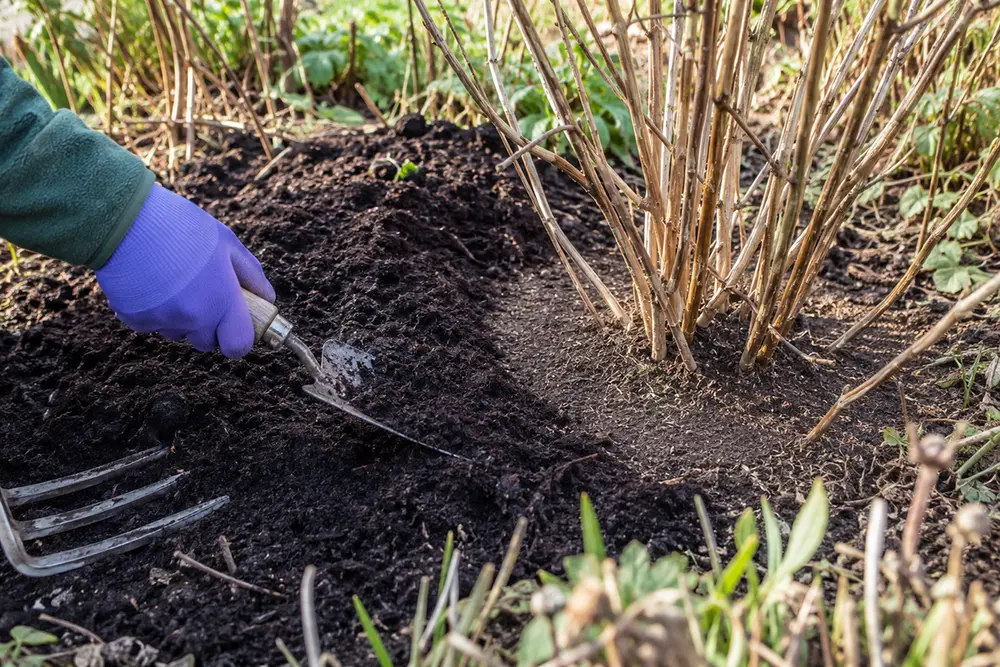
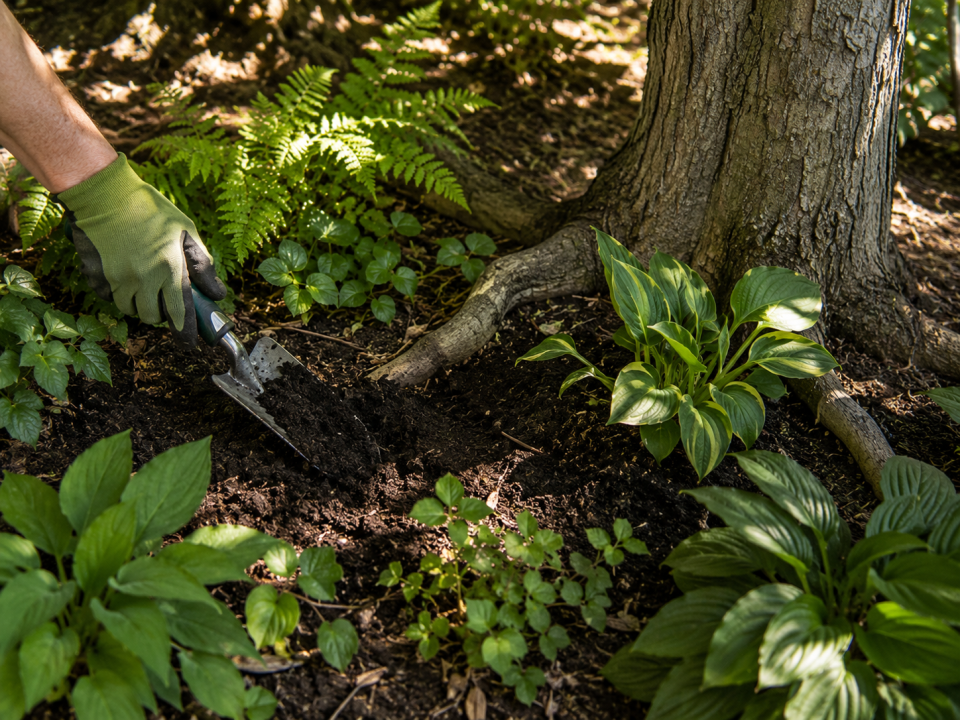
The defining principle for established borders is surface application, not incorporation. The reason this works is biological: Lumbricus terrestris and other earthworm species actively pull surface organic matter down into their burrows, processing it into the soil profile without any mechanical assistance. A healthy border with a functioning earthworm population incorporates a 7.5cm compost mulch within a single growing season. Digging compost in around established plants does not speed this process — it severs the feeder roots and fungal networks the earthworms move through.
- Step 1. Remove perennial weeds by hand, including roots where possible. Compost applied over bindweed (Calystegia sepium) or couch grass (Elymus repens) will not suppress them.
- Step 2. Water the border thoroughly if the soil surface is dry. Compost beds down more effectively on moist soil, and earthworm activity increases sharply when moisture is present.
- Step 3. Spread compost evenly across the soil surface using a narrow border fork or hand trowel around established plants. Aim for an even 7.5cm depth across the full area.
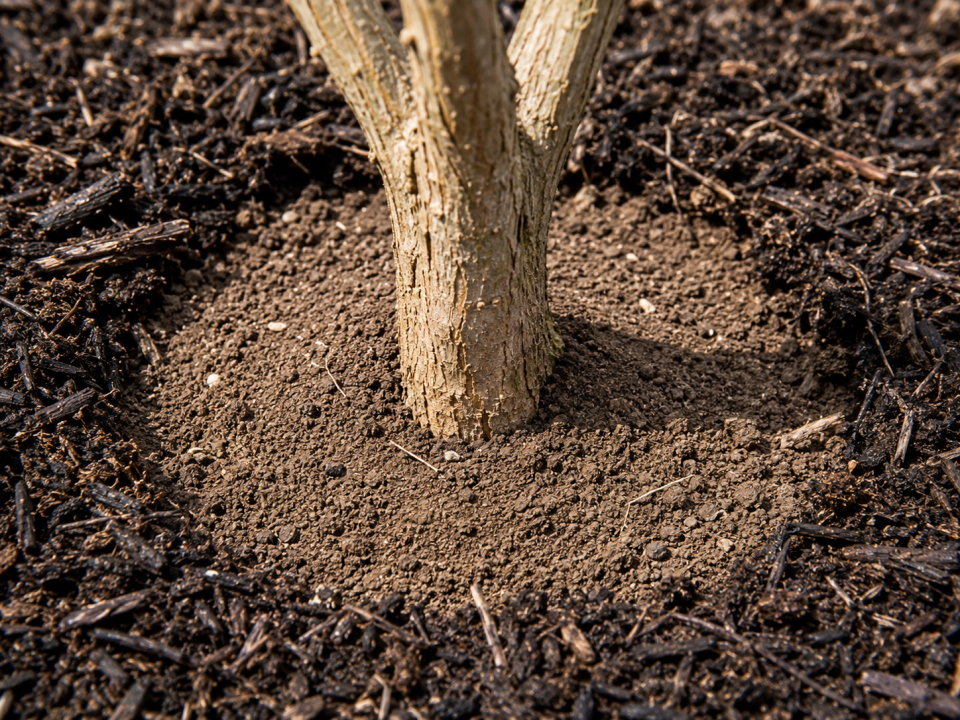
- Step 4. Maintain a 10cm clearance around all woody stems, including roses (Rosa), shrubs such as Viburnum, and ornamental trees. Contact between compost and woody tissue creates conditions for fungal disease and stem rot.
- Step 5. Leave low-growing ground cover plants such as Alchemilla mollis, Epimedium, or Ajuga uncovered, or apply compost carefully between clumps rather than over them.
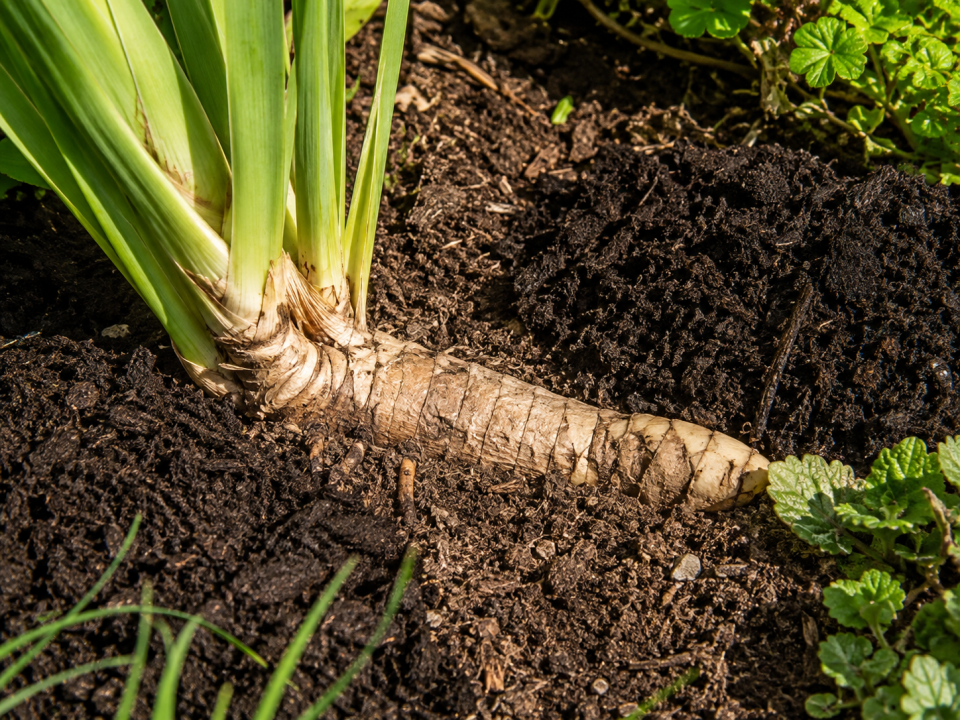
One exception worth noting: bearded iris (Iris germanica) develops its rhizomes at the soil surface and requires direct light and airflow across them to initiate flower buds. Apply compost between clumps, keeping the rhizomes themselves entirely clear. A rhizome buried or shaded by accumulated mulch produces leaf growth but rarely flowers.
Can I Dig Compost Into an Established Border?
Only in areas where permanent plants are absent. Digging compost into the root zone of established shrubs and herbaceous perennials damages fine feeder roots, which sit in the top 15–30cm of the soil profile. For empty patches between plants, light incorporation to 15cm depth is appropriate. For beds with dense planting, surface application is always the correct method.
Should I Keep Compost Away From Plant Stems?
Yes. Keep compost at least 10cm clear of all woody stems and herbaceous crowns. Mounding compost against stems creates warm, moist conditions that favour fungal pathogens including Botrytis cinerea (grey mould) and Phytophthora species — a particular risk for roses, clematis, and newly planted shrubs where stem tissue is still establishing. The RHS specifies a 10cm mulch-free circle around woody stems as standard practice.
Which Compost Works Best for Established Garden Borders?
Well-rotted, peat-free compost is the standard for established borders. Fresh or immature compost, identifiable by a sharp, ammoniac smell and visible undecomposed plant material, draws nitrogen from the soil as it continues to break down, temporarily reducing fertility.
SylvaGrow Organic Peat Free Compost is fully matured and suitable for direct surface application to established beds. For borders where weed suppression is the main priority, Melcourt Composted Fine Bark applied as a top layer over compost extends suppression for a full growing season. For borders on heavy clay, SylvaGrow Farmyard Organic Matter, a composted manure blend, accelerates structural improvement more effectively than compost alone, with higher levels of the organic acids that help break apart clay aggregates.
Bark Mulch as a Complement to Compost in Established Borders
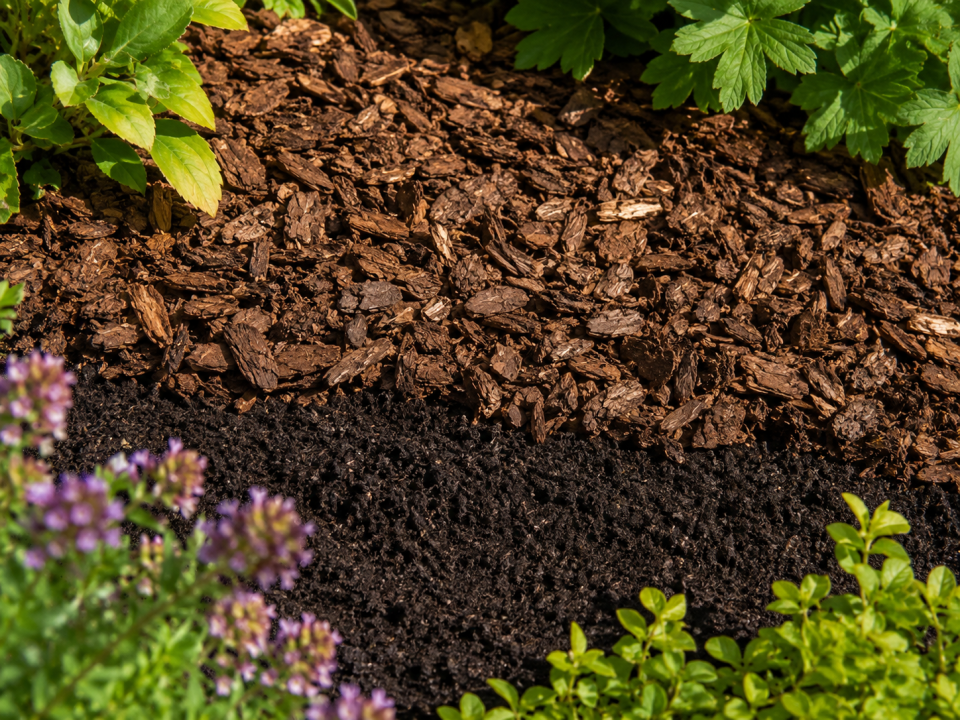
A layer of composted bark applied over a compost mulch in late spring extends weed suppression through the summer. Apply compost first, then add a 5cm layer of Melcourt Composted Fine Bark or Spruce Ornamental Bark on top.
The bark acts as a physical barrier against light, preventing annual weed seed germination, and it also reduces soil moisture loss during dry spells: Met Office long-term averages for London (Heathrow, 1991–2020) show rainfall of 47mm in June, 46mm in July and 53mm in August, making sustained moisture retention a genuine priority through summer. Bark provides little nutritional benefit applied alone; it works best as a surface layer over an established compost mulch.
Composting Your Established London Garden: Specifics to Consider
Composting Under London's Mature Tree Canopy
In gardens under the heavy canopy influence of mature trees — London planes, limes and horse chestnuts among them — dense root systems deplete organic matter faster than standard garden guidance typically assumes. A second, lighter top-up of 3–4cm of compost in late summer helps keep soil biology active and gives understorey plants enough resources to see out the growing season.
Compost and Cat Deterrence
A common concern for London gardeners is that fresh, loose compost can attract neighbourhood cats as a potential toilet area. A finishing layer of Melcourt Composted Fine Bark or ornamental bark on top of your compost creates a textured surface that acts as an effective physical deterrent, keeping the border undisturbed while the compost improves the soil underneath.
Peat-Free Compost and London Clay Gardens
London clay presents specific challenges that make the choice of compost material consequential. Clay soils have naturally high cation exchange capacity, meaning they hold nutrients well but release them slowly to plant roots. Peat-free composts based on composted wood, bark or green waste add organic acids that chelate soil minerals, making iron, manganese and phosphorus more accessible to plants growing in alkaline, clay-heavy conditions.
London clay typically sits at a pH of 7.2 to 8, which is mildly to moderately alkaline. This alkalinity often causes micronutrient lockout for acid-loving (ericaceous) plants such as camellias, rhododendrons or pieris, as they cannot access essential minerals in high-pH soil. Standard peat-free compost is excellent for general improvement but will not meaningfully shift this pH — for these specific plants, use the Melcourt Ericaceous range to meet their specialised nutritional requirements.
We stock a full range of peat-free composts, farmyard organic matter, composted bark and ericaceous formulations at our garden centre at 51–53 Islip Street, Kentish Town NW5 2DL — everything you need to work with London's heavy clay across an established border, whatever its age or planting density. The team in store can help you work out quantities and the right product for your soil before you buy. If a border is showing signs of depleted organic matter — compaction, poor drainage, slow growth — Boma's Garden Planting Service includes soil assessment and organic matter application as standard, ahead of any new planting.
Visit us at 51–53 Islip Street, Kentish Town NW5 2DL to talk through your border, or browse the full range of peat-free composts and soil improvers online. We deliver to all M25 postcodes, and a Boma Garden Planting Service consultation can set out a structured improvement plan if your established beds need more than an annual top-dress.
Shop Compost Book a Consultation Check DeliveryFrequently Asked Questions
Can I Use Compost and Bark Mulch Together on the Same Border?
Yes, and for established borders with high weed pressure it's the most effective combination. Apply your compost layer first, at 5–7.5cm, then top it with a further 5cm of composted bark once the compost has settled. The compost feeds the soil and supports biology; the bark on top blocks light to weed seeds and slows moisture loss, extending suppression through a full London summer without adding further nutrients the border doesn't need.
Does Compost Still Work in Gardens With Mature Tree Roots?
Yes, though mature trees change the maths. Dense root systems from London planes, limes and similar species draw down organic matter faster than open borders, so a single annual application may not be enough. A light 3–4cm top-up in late summer, alongside the main late-winter application, helps keep soil biology active and gives understorey planting the resources it needs through a full growing season.
Does a Thin Layer of Compost Actually Suppress Weed Seeds?
Yes, provided the layer reaches the minimum 5cm depth — anything shallower breaks down before it has time to block light from reaching weed seeds at the soil surface. For established beds with high weed pressure, adding a layer of composted bark on top extends suppression through summer. The compost itself also introduces beneficial soil organisms that compete with weed seedlings for resources.
How Do I Stop Compost Attracting Cats to a Freshly Mulched Border?
Top the compost with a finishing layer of composted or ornamental bark once it's spread. The coarser, textured surface is far less appealing to cats looking for loose, diggable ground than exposed compost, and it doubles as an additional weed-suppressant layer — so the deterrent step also does useful work for the border itself.