

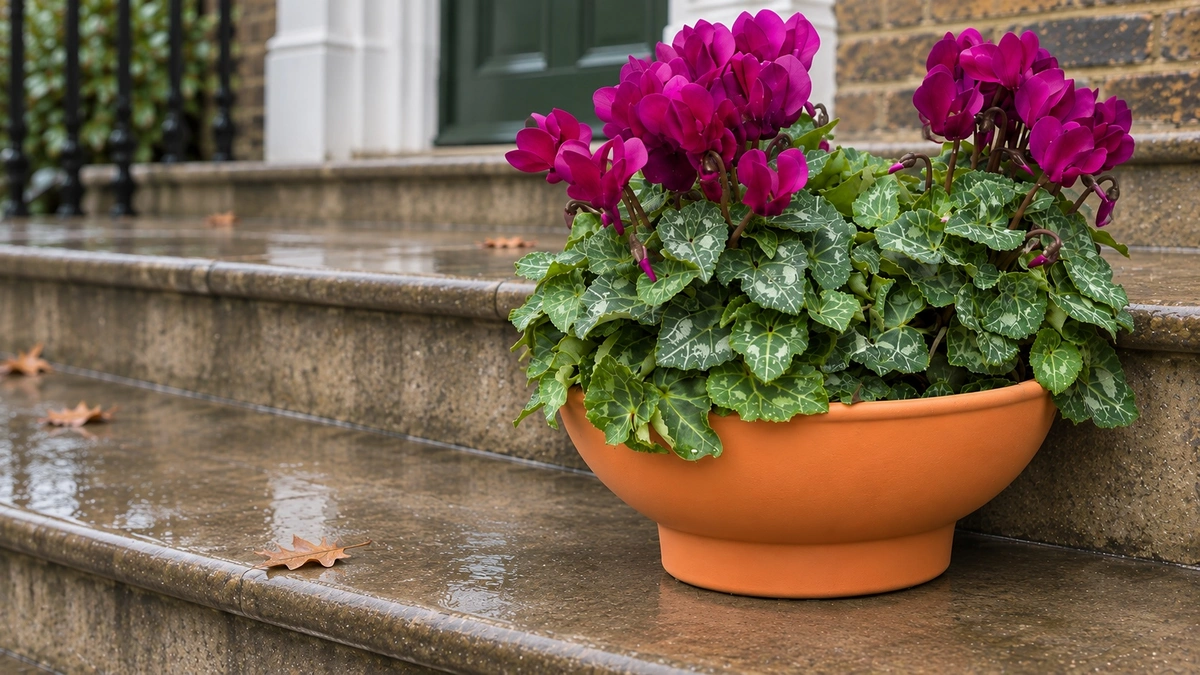
Cyclamen is the main flower in most of our ready-planted winter containers at Boma Garden Centre in Kentish Town, and whether it will last outside through the winter is the question customers ask most when they buy one. The answer depends on the species, and the two sold in Britain behave very differently in a London December.
Will Cyclamen Survive Outside in Winter?
Hardy cyclamen survive outside all winter. A florist cyclamen survives only where it is sheltered and kept clear of frost. The RHS places the two groups far apart on its hardiness scale, and that single difference governs everything else on this page.
- Hardy cyclamen. The RHS rates Cyclamen coum and Cyclamen hederifolium H5: hardy in most places throughout the UK even in severe winters, down to between −15 and −10°C. Both hold the RHS Award of Garden Merit.
- Florist cyclamen. The RHS rates Cyclamen persicum H1C, a plant that can go outside in summer, with a minimum of 5 to 10°C. The popular Metis Series is rated H2, which the RHS describes as tolerant of low temperatures but not surviving being frozen.
On winter containers, the RHS says Cyclamen persicum is not hardy but will usually last until the new year in a sheltered location. That is the sensible way to think about a florist cyclamen standing outdoors: a seasonal plant that will give you several good weeks, and longer if you look after it.
Florist Cyclamen and Hardy Cyclamen Compared
Florist cyclamen are the large-flowered plants sold in bud for Christmas, and they are not rated to survive freezing. The hardy species are smaller, flower later or earlier, and live outdoors permanently. The table sets the three side by side. Hardiness ratings are from the RHS.
| Feature | Florist Cyclamen | Eastern Cyclamen | Ivy-Leaved Cyclamen |
|---|---|---|---|
| Latin name | Cyclamen persicum cultivars | Cyclamen coum | Cyclamen hederifolium |
| RHS hardiness | H1C (5 to 10°C minimum); Metis Series H2 (1 to 5°C) | H5 (−15 to −10°C) | H5 (−15 to −10°C) |
| Flowering | Winter and spring | Late winter, through February and March | Early autumn, before the leaves |
| Height | 10 to 20cm | Up to 10cm | Up to 10cm |
| In a frost | Not rated to survive freezing | Flowers through the severest weather | Hardy, with leaves in place all winter |
| In winter wet | Rots readily if the compost stays saturated | Needs free drainage; dislikes sitting wet | Needs free drainage; dislikes sitting wet |
| Role in a winter pot | Colour from purchase into the new year | A permanent late-winter flower | Marbled foliage from autumn to spring |
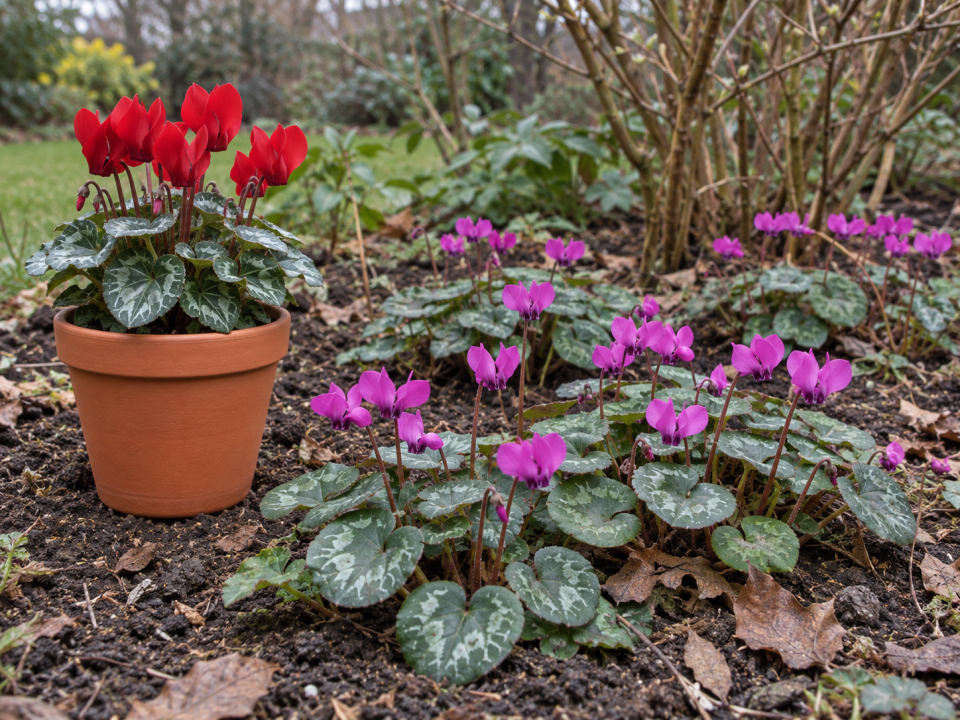
Florist Cyclamen (Cyclamen persicum)
Florist cyclamen is the one sold in flower for Christmas: cultivars of Cyclamen persicum, which the RHS gives as 10 to 20cm tall against up to 10cm for the hardy species. The RHS lists it as flowering in winter and spring and advises growing it indoors or under glass. Compact forms are sold as mini cyclamen and widely used as winter bedding in outdoor pots, where they do well in a sheltered position. Hillier describes these as suitable for growing outdoors but not frost tolerant, which matches the RHS rating.
Colour is a useful clue. The RHS lists C. coum in white through pink to deep red with a purple blotch, and C. hederifolium in pink and white, but neither produces the scarlet of a Christmas cyclamen. A strong red points to a florist plant.
Hardy Cyclamen (Cyclamen coum and Cyclamen hederifolium)
The hardy cyclamen are small tuberous perennials that live outdoors all year. The RHS describes them as ideal for naturalising under trees, on banks or in a shady border, and they do the same job in a pot left in one place.
- Cyclamen coum carries pink or magenta flowers in the depths of winter, from January onwards, and the RHS notes it surviving the severest weather. We list a white-flowered Cyclamen coum in a 9cm pot.
- Cyclamen hederifolium flowers in early autumn, before the leaves appear. Its ivy-shaped, silver-marbled foliage then covers the ground from winter into spring, and it self-seeds freely once settled. Our ivy-leaved cyclamen also comes in a 9cm pot.
Both are small enough that a dozen in a wide, shallow bowl look better than three in a deep one.
Where To Stand Cyclamen in Pots Outdoors
Stand a florist cyclamen in good light, out of cold wind and out of the heaviest rain. The RHS advises placing winter containers where they get as much light as possible, and expects Cyclamen persicum to last until the new year in a sheltered location. Three positions suit it in a London terrace:
- A covered porch or a recessed doorstep, where the plants stay dry and out of the wind.
- A window sill under the eaves, with the box sitting securely.
- A table or step against a house wall, which holds warmth overnight.
Our ready-planted festive winter planters are built for exactly these spots. The Cottage Grove Bowl is a 26cm terracotta bowl of three cyclamen that sits well on a step or a garden table. Wilma's Heritage Box is a 30cm terracotta window box pairing two cyclamen with a golden conifer, Cupressus macrocarpa 'Goldcrest', which stays on after the flowers finish. The Tudor Trio is three separate 16cm pots, which makes it the easiest of the three to carry into a porch on a frosty night.
Hardy cyclamen want the opposite of a bright doorstep. The RHS gives both species partial shade and a sheltered exposure, and a site that is not overly dry or sunny. A pot under a deciduous shrub, or against a north or east wall, suits them better than anywhere the winter sun reaches.
How To Water Cyclamen in Pots in Winter
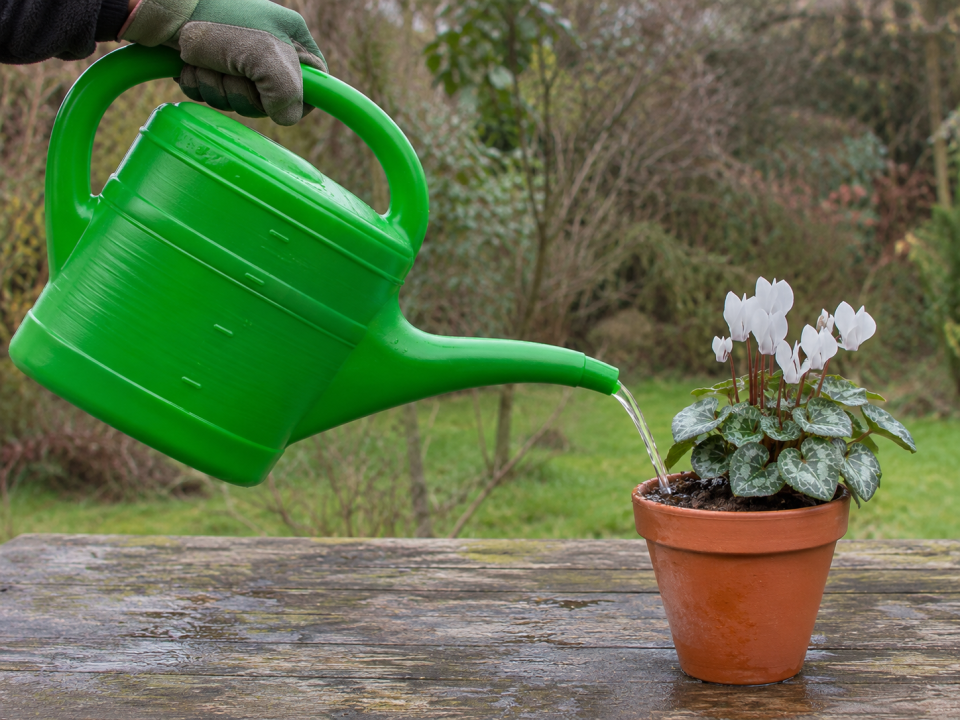
Water cyclamen in pots only when the surface of the compost feels dry, and pour the water around the edge of the plant rather than into its centre. The RHS advises watering moderately and avoiding the crown, which is where rot starts. Standing outdoors in winter rain makes that advice more important, not less.
- Check the compost with a finger first. Containers under a porch or an overhang dry out faster than people expect, even in a wet fortnight.
- Water around the edge of the plant until the compost is just moist, never saturated.
- Tip out any water collecting in a saucer or an outer pot.
- Raise the container on pot feet or a couple of bricks so water runs straight out. The RHS recommends this to aid drainage, and it is the single most useful thing you can do for a pot standing out all winter.
Let the surface dry between waterings. For Christmas houseplants, cyclamen among them, the RHS is clear that occasional drying out does less harm than overwatering, and that drooping or yellowing leaves usually point to too much water rather than too little.
Feeding and Deadheading Winter Cyclamen
Cyclamen in winter pots need little or no feeding, but they do need regular deadheading. General RHS advice is that container plants do not need feeding over winter, so treat feed as optional. If you do feed, a weak low-nitrogen liquid feed every few weeks while the plants are in flower is enough, and it is worth stopping in freezing weather when nothing is growing.
Deadheading matters more. Remove the whole stalk rather than just the flower: twist the faded stem and give it a sharp pull so it comes away cleanly at the base. The RHS recommends this because pieces of stem left behind tend to rot. Wear gloves, as the RHS advises for handling cyclamen.
Clearing spent flowers and leaves promptly is also one of the three defences the RHS gives against cyclamen grey mould, along with good air circulation and not crowding the plants. Cyclamen are particularly susceptible to this fungus, which lives on dead plant material, and a crowded planter standing in still, damp air is where it takes hold.
What To Do When Frost Is Forecast
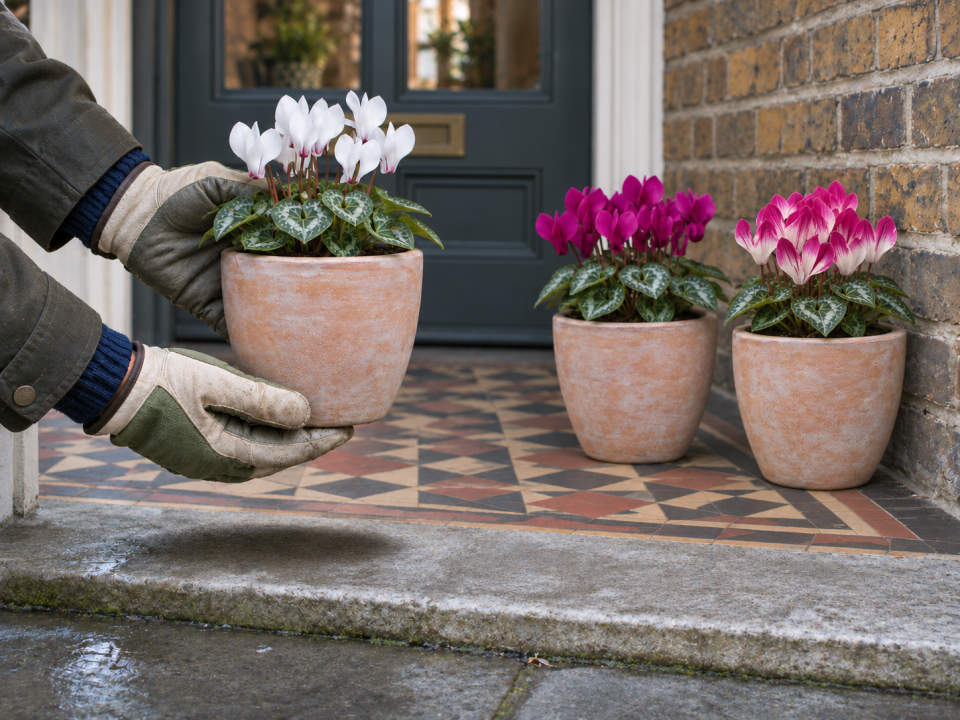
When frost is forecast, bring a florist cyclamen under cover and leave a hardy cyclamen where it is. The table below is deliberately cautious for florist cyclamen, because neither RHS rating allows for freezing. Above freezing it leaves the plants outside, since the RHS still expects them to last until the new year in a sheltered spot.
| Forecast | Florist Cyclamen | Hardy Cyclamen |
|---|---|---|
| Mild, above 5°C | Leave in place. Check the compost and water if dry. | Leave in place. |
| Cold, 1 to 5°C | Move close to the house wall and keep the compost on the dry side. | Leave in place. |
| Frost overnight | Move into a porch or an unheated room. Cover planters too heavy to move with horticultural fleece overnight. | Leave in place. |
| Several days of hard frost | Keep under cover until it passes. | Leave in place. Wrapping the pot protects the roots, which have less insulation than they would in open ground. |
| Days of heavy rain | Move under the eaves or into a porch. | Leave in place, raised on pot feet. |
A porch or an unheated room is the right sort of shelter. Indoors, the RHS recommends bright, cool conditions of around 10 to 15°C, away from direct sun and heat sources, so a warm sitting room beside a radiator is the one place not to put it.
Why Cyclamen Collapse, Yellow or Rot Outdoors
Cyclamen in outdoor pots go wrong for four common reasons: overwatering, grey mould, frost and vine weevil. Each looks slightly different.
| What You See | Likely Cause | What To Do |
|---|---|---|
| Drooping or yellow leaves in wet compost, or softness at the base | Overwatering | Let the surface dry out and move the pot out of the rain. Raise it on pot feet. |
| Flower and leaf stalks collapsing, with fuzzy grey mould | Cyclamen grey mould (Botrytis cinerea) | Remove dead flowers and leaves promptly and give the plants more air. The RHS states that no chemical controls are available to gardeners. |
| A florist cyclamen flattened after a freezing night | Frost | Move it somewhere cool and under cover, and let it thaw before removing any stalks. Some plants recover; a hard freeze is usually final. |
| White, legless, C-shaped grubs in the compost or in the tuber | Vine weevil larvae | Remove the grubs and repot in fresh compost. |
Vine weevil is worth checking for in any pot kept from one year to the next. The RHS notes that the grubs bore into cyclamen tubers, that container plants are the most likely to be badly damaged, and that most losses happen between September and March. Nematodes watered into the compost in August or early September are the usual preventive treatment, which makes it a job to note for next summer rather than one for December.
What To Do With Cyclamen After Flowering
After flowering, a florist cyclamen either goes into a dry summer rest or is replaced, and a hardy cyclamen stays in its pot or moves into the garden. The RHS method for keeping a florist cyclamen is straightforward:
- Carry on watering carefully, and feeding if you have been feeding, until the leaves yellow.
- Reduce watering as the plant goes dormant, and keep the compost dry through the summer.
- Start watering again when new growth appears.
- Replace the top few centimetres with fresh peat-free compost. If the plant needs repotting, set the tuber with its top just above the surface.
For a pot that has stood outdoors, add two steps: stand it somewhere shaded and out of the rain for the summer, and bring it under cover before the first frost. Treating it as winter bedding and replacing it in spring is an equally reasonable choice, and it is the one Wilma's Heritage Box is designed around: when the cyclamen finish, keep the conifer and replant around it.
Hardy cyclamen are long-term plants. If the leaves die off in May or June, growth begins again in autumn. To move one into the garden, the RHS advises planting the tuber 3 to 5cm deep in partial shade, in humus-rich, well-drained soil, with a leafmould mulch each year as the leaves die down. For a permanent pot, the RHS mix is peat-free John Innes No 2 with extra horticultural grit and leafmould or fine composted bark. The grit matters as much as the compost: it is what keeps the tuber from sitting wet.
In most London gardens, winter wet does more damage to a potted cyclamen than cold does. The built-up warmth across Kentish Town, Camden and Highgate holds off the hardest frosts for weeks at a time, while the heavy clay and the long grey spells keep compost saturated from December to March. Get drainage right first and frost protection second.
Two positions are worth planning for. A doorstep under a porch is sheltered from rain, so the risk there is the compost drying out unnoticed. A balcony or roof terrace gets far more wind, so keep planters against the building and move small pots into an unheated room when a hard frost is forecast. Our November guide covers protecting pots more broadly, and the winter perennials guide covers what else flowers alongside cyclamen between December and February.
If you would rather have a winter scheme designed and planted for you, our Courtyard & Roof Terrace Container Planting service covers window boxes through to large troughs within a five-mile radius of Kentish Town. For beds and borders, the Garden Planting Service handles planting schemes for established gardens.
Frequently Asked Questions
Do Cyclamen Flower All Winter?
Not continuously. The RHS says cyclamen in winter containers flower intermittently during mild spells, and that Cyclamen persicum will usually last until the new year in a sheltered location. Cyclamen coum then takes over from January into March, so a pot of each gives flowers across the whole winter.
Can Cyclamen Survive Frost?
Hardy cyclamen survive frost; florist cyclamen do not reliably survive it. Cyclamen coum and Cyclamen hederifolium are rated H5 by the RHS, hardy to between −15 and −10°C. Cyclamen persicum is rated H1C, with H2 for the Metis Series, and neither rating allows for the plant being frozen.
Are Cyclamen Hardy in Pots?
The hardy species are, provided the pot drains freely. A tuber in a container has less insulation than one in open ground, so free drainage and a position out of the worst wet matter more than they would in a border. Raise the pot on pot feet and use a gritty, loam-based mix.
Do Cyclamen Come Back Every Year?
Hardy cyclamen come back every year, in a pot or in the ground, and spread slowly as they settle. A florist cyclamen returns only if it is kept clear of frost in winter and dry while dormant through the summer. Many people treat it as winter bedding and replace it each year, which is a perfectly reasonable approach.
Why Are My Cyclamen Leaves Turning Yellow?
Usually too much water. Yellowing leaves on a plant in wet compost point to overwatering rather than underwatering, and a pot left standing in winter rain is an easy way to get there. Let the surface dry out, move the pot under cover and raise it on pot feet. Yellowing at the end of the flowering season is different, and normal: the plant is going dormant.
Are Cyclamen Poisonous to Cats and Dogs?
Yes. The RHS lists cyclamen, including C. persicum, C. coum and C. hederifolium, as ornamental bulbs that are not to be eaten, and advises wearing gloves when handling them. Keep planters out of reach of pets that chew plants, and contact a vet if one eats any part of the plant. Our Christmas cactus guide covers the safer options for a house with animals.
Come and see the ready-planted winter containers at 51–53 Islip Street, Kentish Town NW5 2DL, where you can pick the colour and the size in person. You can also order online for collection or delivery to all M25 postcodes. If you are not sure which cyclamen suits your doorstep, balcony or shaded border, bring us a photograph and the team will help you choose.
Shop Festive Winter Planters Shop Cyclamen