

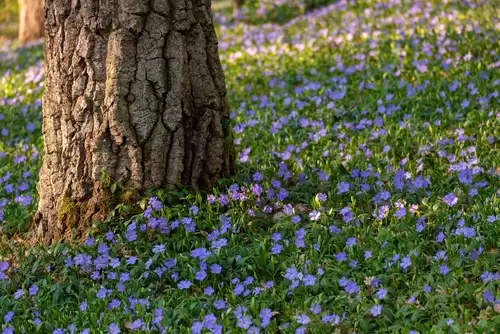
It’s a quintessential image, a beautiful woodland in dappled sunlight with trees surrounded by a sea of bobbing bluebells. But the truth is, it can be a real challenge to get anything to grow under a tree. The tree takes most of the soil’s moisture and nutrients, and the canopy blocks out much of the sunlight for plants underneath. Despite all this, some plants will grow and even thrive under trees, given the proper care and attention.
Underplanting deciduous and evergreen trees
It’s much easier to get plants to establish under deciduous trees than under evergreens, as the plants benefit from early spring sunshine before the trees put on leaves. Even once the leaves appear, a deciduous tree’s canopy tends to be less dense than that of an evergreen. It can be tough getting anything to establish under conifers, as the ground under them is in the shade all year round. To improve your chances of success when underplanting trees, follow these tips.
Tips for successful planting under trees
- Choose plants that can cope with shade and dry soil.
- Add extra organic matter such as garden compost or well-rotted farmyard manure to planting holes to compensate for the poor soil.
- Water your plants regularly in the first year while getting established, and mulch them in spring.
- The southwest side is likely to get more rain, driven by westerly winds, than the northeast side.
Six plants to plant under trees
Given a bit of encouragement, these plants will grow successfully under trees, providing colour as well as ground cover.
-
Lamium maculatum (deadnettle) – a beautiful groundcover plant with variegated silver and green leaves and spires of pink or white flowers in spring that are a good early nectar source for bees.
-
Cyclamen coum – these winter-flowering perennials have attractive marbled silver-green leaves and delicate-looking pink or white flowers with back-swept petals. Once established, they will gradually spread to form a carpet of colour in the coldest months of the year.
-
Pulmonaria (lungwort) – another shade-loving perennial with silver-spotted green leaves and blue or pink flowers that appear in spring. A favourite with bees.
-
Epimedium – one of the best perennials for planting under trees, forming low mounds of heart-shaped green leaves that often have good colour in winter. Cut the foliage back in early spring to see the delicate early flowers.
-
Vinca minor – this low-growing evergreen shrub spreads by underground runners and can be invasive in good soil, but the difficult conditions under trees will keep it in check. This is a good groundcover plant producing pretty blue flowers over a long period from spring to autumn. Trim it in spring to keep it from spreading too far.
-
Ivy – if all else fails, ivy will grow almost anywhere, even in deep shade.
Struggling to find the right plants for underplanting your trees? Visit our centre and take a look at our wide selection of plants for all conditions. Our friendly staff are always happy to help!