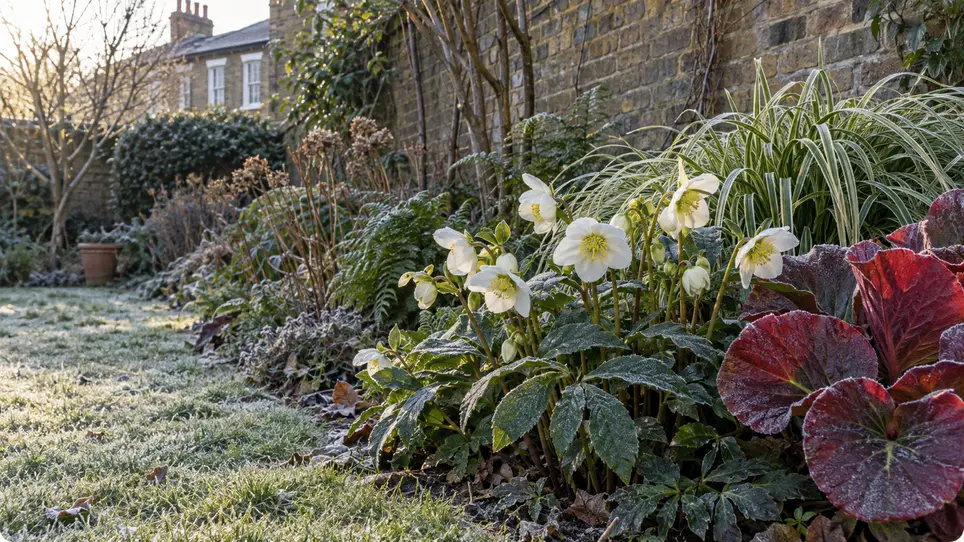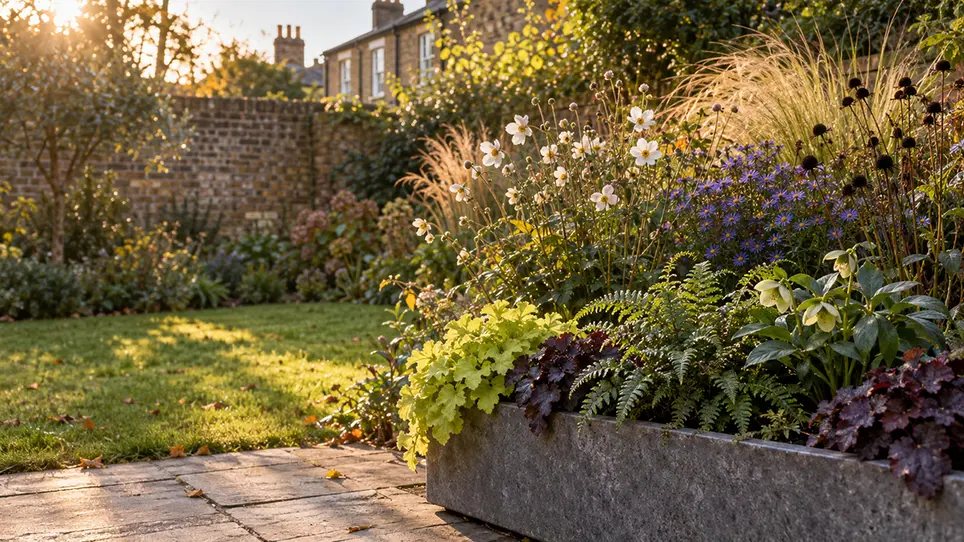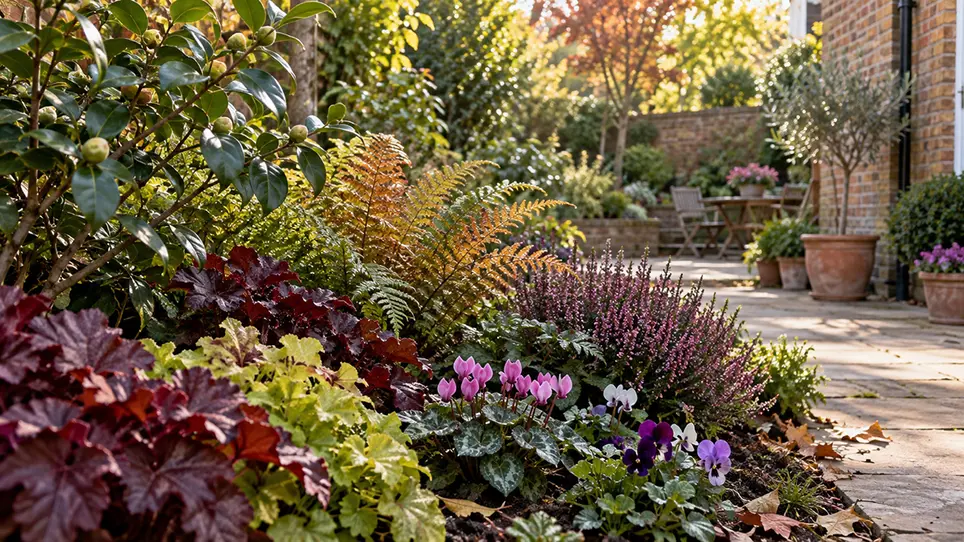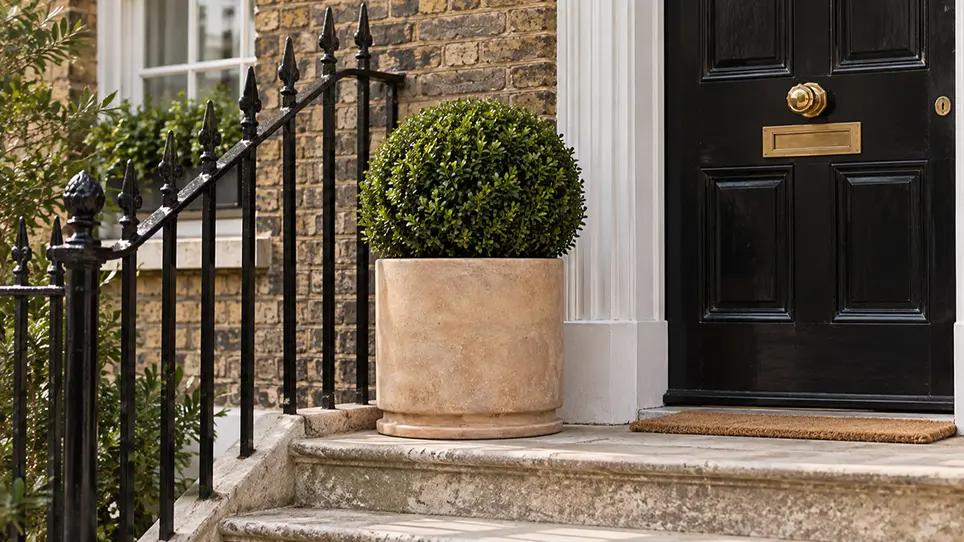


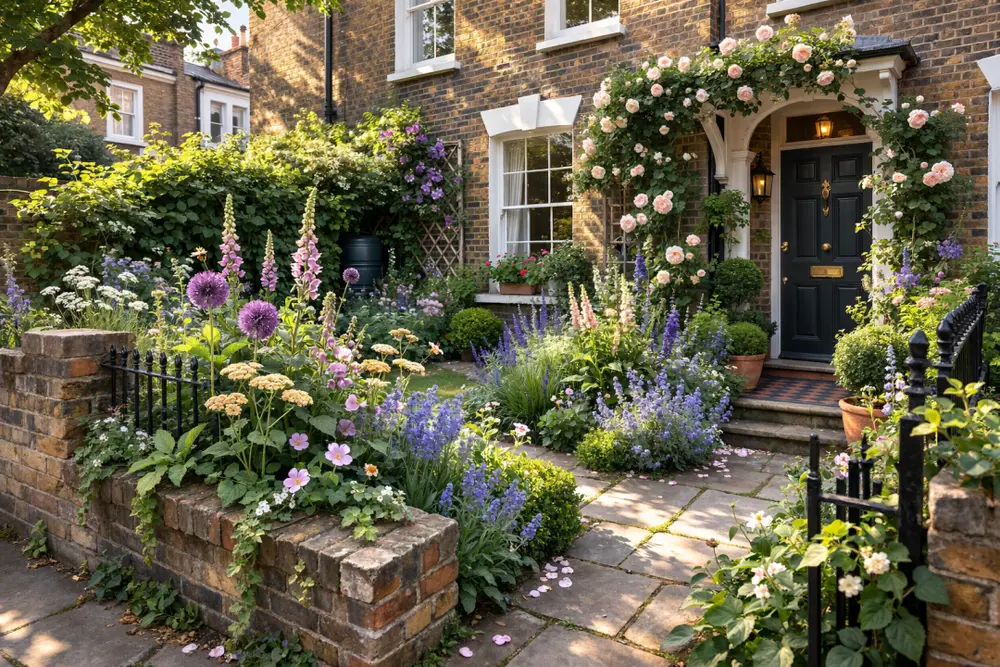
The style was born in the English countryside, where a cottage's small plot did double duty as kitchen garden and flower border. Translating it into a London garden means keeping that same density and structure while working within a narrower walled or fenced rectangle, often overlooked by neighbouring houses on two or three sides. None of the principles below change; what changes is how tightly they need to be applied. A well-built cottage border carries flower from the first roses in May through to the October frosts.
What Defines the Cottage Garden Style?
A cottage garden is not simply lots of flowers. It is a specific set of design decisions drawn from centuries of English domestic gardening, where ornamental planting sat alongside productive herbs, vegetables and fruit out of necessity rather than taste. That blend of the beautiful and the useful is the foundation of the style.
The defining features are informality, density and verticality. Beds are curved rather than geometric. Plants are allowed to lean into paths and into each other. Height comes from climbers on arches and obelisks rather than from trees, and colour comes from a considered set of reliable perennials repeated through the scheme rather than a wide, unrelated mix. Old-fashioned shrub roses and clematis provide the woody, permanent framework; salvia, nepeta, geranium and digitalis fill in around them and change through the season.
Crucially, the look reads as unplanned. It isn't. Every drift, gap and self-sown foxglove is doing a job.
Start With Structure, Not Flowers
The instinct when planning a cottage garden is to start buying perennials. Resist it. Structure comes first, because it is the framework everything else grows against — and it matters more, not less, in a city garden, where a typical London rear plot is a walled or fenced rectangle just 5 to 10 metres deep. Every structural decision carries proportionally more weight than it would across a larger rural plot.
Before any planting goes in, decide on:
- Paths and edges. A cottage garden reads as generous because the paths are narrow and the borders are allowed to spill over them. Brick, stone or gravel all work; what matters is fixing the hard edge early, so the planting has something to soften.
- Vertical points. Arches, obelisks and a wall or fence for climbers. These carry the roses and clematis that hold the garden's shape through winter, when the herbaceous layer has died back.
- Anchor plants. A clipped box ball, a bay standard, or a repeated evergreen at intervals along the border gives the eye somewhere to rest and stops the abundance tipping into chaos.
If the garden needs new paving, raised beds or boundary work before any planting can go in, that is a hard-landscaping job rather than a planting one. Boma's Garden Design & Landscaping Service covers that kind of full redesign, coordinating the structural work — delivered through a recommended landscaper — with the planting plan that follows it.
How To Train Roses and Clematis Together
Once the hard structure is fixed, the framework planting goes in: the permanent, woody layer of roses and clematis trained up the arches, obelisks and walls. Grown together on a single support, a repeat-flowering shrub rose and a group-two clematis give colour and structure across a longer stretch of the season than either delivers alone.
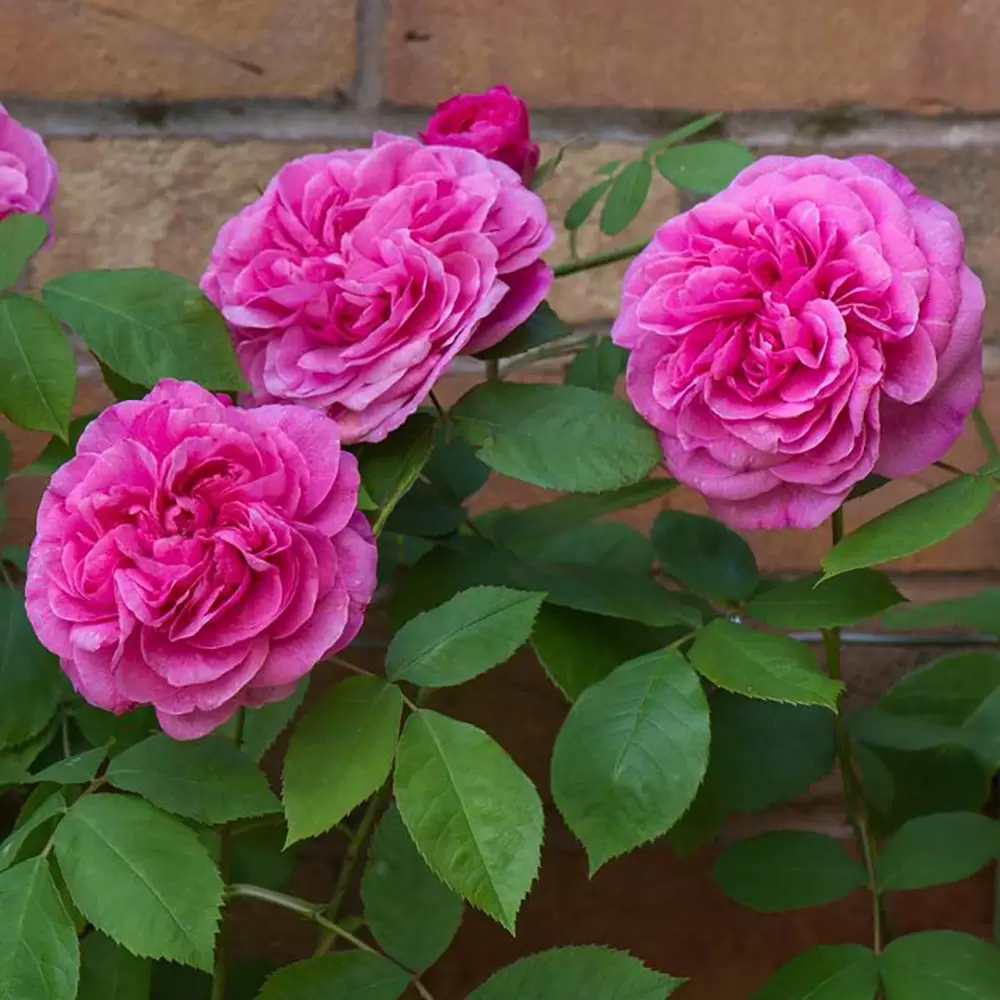
A repeat-flowering shrub rose is the single most useful plant in a cottage garden. Rosa 'Gertrude Jekyll' is a strong example: dense, rich pink blooms, one of the truest old-rose fragrances in cultivation, and flowers that continue from early summer until the first frosts. It is a tall, upright shrub — reaching around 1.5m — and can grow a little bare and leggy at the base, which is exactly where the perennial layer below earns its place, clothing its feet while it flowers overhead.
Pair it with a clematis on the same support rather than treating them as separate features. Clematis 'Elsa Späth' carries large mauve-blue flowers in an early-summer flush and a lighter repeat into late summer and autumn, sitting well against a pink rose without competing for the same weeks of interest. It falls into pruning group two, so a light cut back in February or March, just above a strong pair of buds, is all it needs. Grow the two up the same obelisk or arch and the support carries flower and structure from late spring right through to the first frosts.
Five Reliable Cottage Garden Perennials
With the framework in place, the perennial layer fills the space around and beneath it. This is where the density of a cottage garden actually comes from, and where most of the seasonal change happens. Five plants can do most of the work in a well-run cottage border:
- Nepeta 'Six Hills Giant' — a large, billowing catmint of around 75–90cm for the middle of the border, its aromatic grey-green foliage and lavender-blue flowers flopping generously over a path edge rather than sitting stiffly behind it. Shear it back after the first flush for a second wave of flowers.
- Salvia nemorosa 'Caradonna' — upright violet-blue spikes against grey-green foliage through the middle of the border, from late spring to early autumn.
- Digitalis purpurea 'Dalmatian White' — a compact foxglove of around 50–60cm giving clean white spikes freckled at the throat, useful for vertical accents through the centre of the scheme. As an F1 strain it flowers fast and reliably in its first year, but won't come back true from its own seed, so treat it as a dependable planted accent rather than a self-seeder.
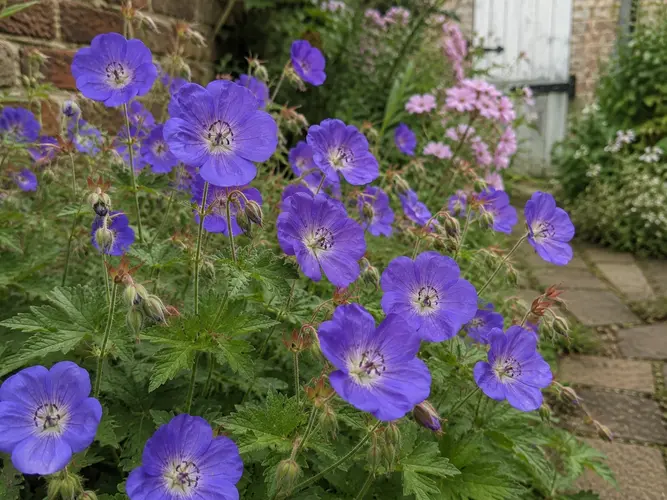
- Geranium 'Rozanne' — front-of-border ground cover that weaves between the taller plants and flowers without pause from early summer to the first frost, suppressing weeds as it goes.
- Alchemilla mollis — worth adding wherever a border meets a hard edge, its chartreuse flower froth and soft, dew-catching leaves softening a path or step line that would otherwise look abrupt.
Layering for Depth and Abundance
The density that defines the cottage garden style comes from deliberate layering, not from cramming plants in at random. Work in three rough height bands — the rose-and-clematis framework tallest, mid-height perennials through the centre, ground cover and edging at the front — and repeat each plant in groups of three or five rather than dotting single specimens about.
A single Salvia 'Caradonna' reads as a spot of colour. Five, worked through a border in a loose drift, read as a wave. That repetition is what makes an abundant border look considered rather than cluttered, and it is the detail that separates a designed scheme from a bed that simply has a lot of different plants in it.
Leave room for self-seeders. Aquilegia and alchemilla will both drop seed into gaps if allowed, and the slightly unpredictable positioning is part of what makes the style read as unplanned. Deadhead selectively rather than everywhere — leave a portion of spent flower heads through late summer so this can happen. Hardy annuals such as nigella, calendula and cornflower can be sown straight into any remaining gaps to keep the beds full through the season.

Cottage Garden Perennials at a Glance
| Plant | Height | Border Position | Bloom Period | Light |
|---|---|---|---|---|
| Rosa 'Gertrude Jekyll' | ~1.5m (taller trained) | Framework / climber | Early summer to first frost | Full sun |
| Clematis 'Elsa Späth' | Climbing to 2.5–3m | Framework, trained with rose | Early summer, repeat into autumn | Sun to part shade |
| Nepeta 'Six Hills Giant' | 75–90cm | Middle, spilling forward | Early summer; repeats if sheared | Full sun |
| Salvia nemorosa 'Caradonna' | 45–60cm | Middle | Late spring–early autumn | Full sun |
| Digitalis purpurea 'Dalmatian White' | 50–60cm | Middle | Early–mid summer | Part shade to full sun |
| Geranium 'Rozanne' | 40–60cm | Front / ground cover | Early summer–first frost | Full sun to part shade |
| Alchemilla mollis | 45–50cm | Front / edge | June–September | Full sun to part shade |
Working With London Clay and Urban Conditions
Most North London gardens sit on clay-heavy ground: it holds nutrients and moisture well but compacts easily and drains slowly in winter. Before planting, fork a generous layer of well-rotted organic matter or peat-free compost into the top 20–30cm, where roots establish, then finish with a mulch to hold moisture and suppress weeds. On the heaviest clay that organic matter matters twice over — it opens the structure as well as feeding it — and it does more for a cottage border's long-term performance than any amount of later feeding.
Urban gardens also bring shade cast by surrounding buildings that a rural cottage garden never has to plan around. Digitalis and geranium both take part shade well, which makes them useful where a wall or a neighbour's return cuts the direct sun for part of the day. Beyond shade, the dense, nectar-rich planting of a cottage scheme is good for city wildlife, supporting bees and butterflies right through the growing season.
When To Call In a Specialist
If the structure is already there and the job is choosing and installing the right plants within it — the most common starting point — that is the work Boma's in-house planting team handles directly.
The Garden Planting Service covers planting schemes for established beds and borders, including plant selection, sourcing and installation. For a courtyard, roof terrace or balcony where the whole scheme sits in containers, the Courtyard & Roof Terrace Container Planting service does the same at that scale. And where a garden is being built from scratch — new paths, beds or boundaries as well as planting — the Garden Design & Landscaping Service covers full redesigns from concept through installation, coordinating the hard landscaping (delivered through a recommended landscaper) with the planting scheme. All three operate within about five miles of the Kentish Town shop.
We're an independent garden centre at 51–53 Islip Street, Kentish Town NW5 2DL, growing and selling for London gardens — from Victorian terrace borders and courtyards in Kentish Town, Tufnell Park and Primrose Hill to the larger mature gardens of Hampstead and Highgate. Our shrub roses, clematis and cottage-garden perennials are chosen with London conditions in mind, and the team can help you match a scheme to your own soil, light and space. We deliver to all postcodes within the M25 — check delivery zones and charges.
Frequently Asked Questions
What Is a Cottage Garden?
A cottage garden is an informal planting style built on a restricted, repeated palette of traditional perennials, shrub roses and clematis, arranged in dense, soft-edged drifts around a simple framework of paths, arches and obelisks. Rooted in the English tradition of the productive cottage plot, it blends beauty and usefulness in equal measure. The RHS guide to cottage garden plants is a useful reference for the wider plant range.
Can a Cottage Garden Work in a Small London Space?
Yes. The style scales down well because it relies on density and a vertical framework rather than square footage. A single obelisk carrying a rose and clematis, underplanted with two or three repeated perennials and some lavender at the edge, gives the same layered effect in a small city bed or courtyard that a larger garden achieves across a full border.
What's the Difference Between a Cottage Garden and a Naturalistic Garden?
A cottage garden uses a restricted, repeated palette of traditional perennials — roses, digitalis, nepeta, salvia — within a defined structure of paths and climbing frameworks. A naturalistic garden draws more from wild plant communities and grasses, with looser, less structured groupings and a more muted palette. The cottage style is the more contained and more floral of the two.
What Roses Work Best for a Cottage Garden?
Repeat-flowering shrub roses with an old-fashioned flower form and strong scent suit the style best. Rosa 'Gertrude Jekyll' is a reliable, widely grown example, flowering from early summer to the first frosts with one of the truest old-rose fragrances in cultivation. Grow it as a shrub in a border or train it up a wall or arch.
How Do You Keep a Cottage Garden Looking Full Through the Season?
Layer plants by height and bloom time so something is always coming into flower as something else fades, and allow controlled self-seeding from aquilegia and alchemilla to fill gaps naturally rather than replanting bare patches each year. Repeating a few reliable perennials in drifts, rather than planting many single specimens, does more for a full look than sheer plant count.
Is a Cottage Garden High Maintenance?
Not especially. Choose hardy perennials, let the self-seeders fill gaps, mulch each spring to suppress weeds and hold moisture, and group plants with similar water needs. Once established, a cottage border largely looks after itself — the layered planting and succession of flowers do most of the work.
Come and see the roses, clematis and perennials in person at 51–53 Islip Street, Kentish Town NW5 2DL, or browse David Austin shrub roses and climbing plants in the webshop to start your framework layer — we deliver across the M25. For a considered planting scheme in an existing border, the Garden Planting Service team can help; for a garden being built from scratch, ask about the Garden Design & Landscaping Service.
Visit Us in Kentish Town Shop Roses & Climbers Book a Consultation