

Why Trailing Plants Work Indoors
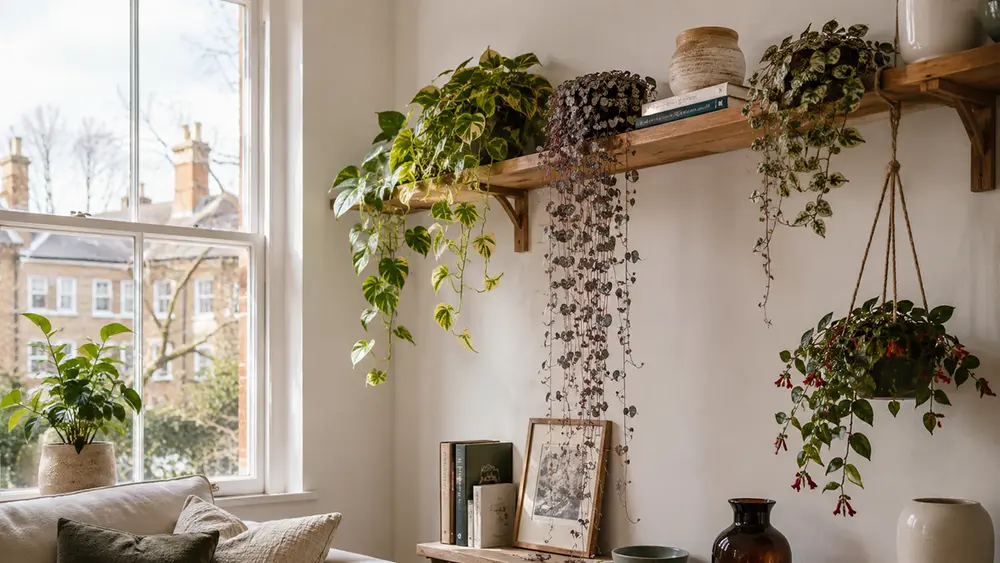
Trailing plants do something no upright plant can: they use the vertical space a room already has. A pot on a high shelf, a plant hung in a bright corner, a length of stem spilling down the side of a bookcase — all of it draws the eye up and softens hard edges, and none of it costs floor space. In a London flat where floor area is the scarcest thing of all, that makes trailing plants some of the most useful greenery you can own.
They are also a year-round category, which sets them apart from seasonal colour. A well-grown trailing houseplant is not a temporary display; it lengthens and fills out over years, and many of the plants below will outlast any number of seasonal schemes. The difference between one that thrives and one that merely survives comes down almost entirely to one thing: light.
First, Read Your Light
Indoor plants are chosen by light, not by season. Before buying, spend a moment working out what each spot in your home actually offers across the day — it is the single best predictor of whether a plant will thrive there. Most trailing houseplants fall into one of three broad groups.
- Bright, indirect light: the largest group, and the easiest to place. A spot near an east- or west-facing window, or a little back from a south-facing one, suits Pothos, Satin Pothos, Philodendron, Tradescantia and the Lipstick Plant. Bright light without harsh midday sun directly on the leaves.
- Bright light with some gentle direct sun: the semi-succulents — String of Hearts and String of Pearls — store water in their leaves and are happy with a few hours of soft direct sun, on an east-facing sill or close to a brighter window.
- Lower light, tolerated: a handful, Pothos chief among them, will cope with a shadier spot such as a north-facing room or a hallway away from the window. They survive and stay attractive, though growth slows and variegation fades — so the brightest position the plant will accept is always the better one.
London adds its own complication. Tree-lined streets across Kentish Town, Highgate and Camden filter the light reaching a window, and a north- or basement-facing room in a Victorian terrace can be darker than its aspect suggests. It is always worth watching how light actually moves through a room across a day before deciding where a plant will live.
The Best Trailing Indoor Plants
The plants below are the trailing houseplants we keep coming back to — for reliability, character and the range of light they cover between them. All are part of Boma's indoor hanging plants collection.
Pothos (Epipremnum)
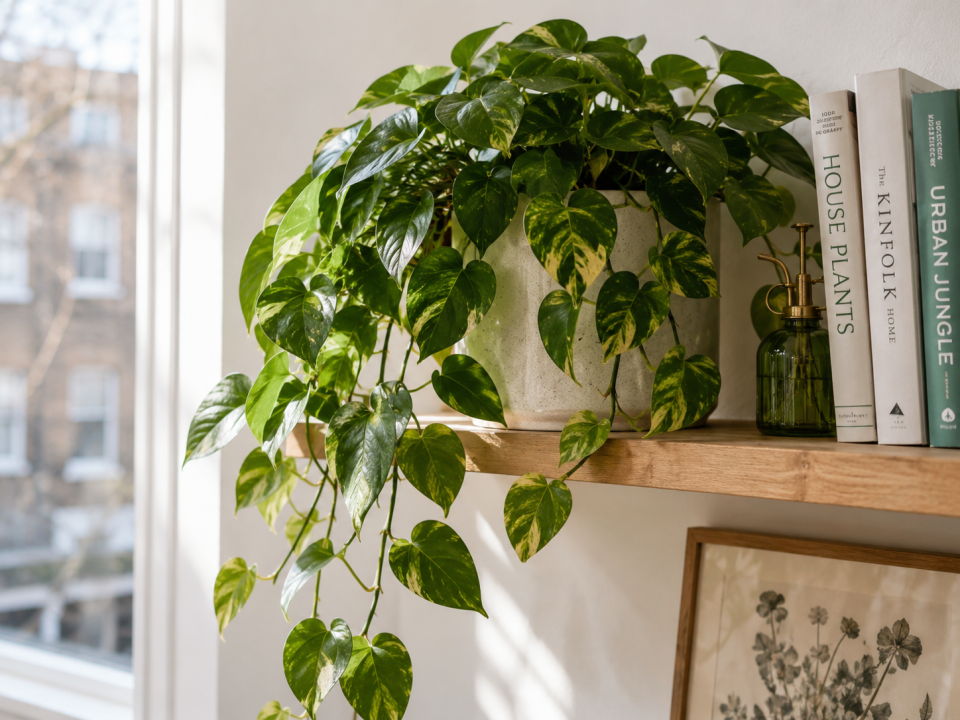
Pothos, also sold as Devil's Ivy, is the plant to start with — the most forgiving and adaptable trailing houseplant there is. Heart-shaped leaves on fast-growing stems trail to a metre or more, and it tolerates a wide range of conditions, from bright rooms to shadier corners. We usually carry several: the classic green-and-gold Golden Pothos, the heavily marbled cream-and-green 'Marble Queen', the silvery-blue 'Cebu Blue', and easy all-greens like 'Global Green' and 'Happy Leaf'. Bright, indirect light keeps the variegation strong; in deep shade it survives but the markings fade and growth slows, so give it the best light you can.
String of Hearts (Ceropegia woodii)
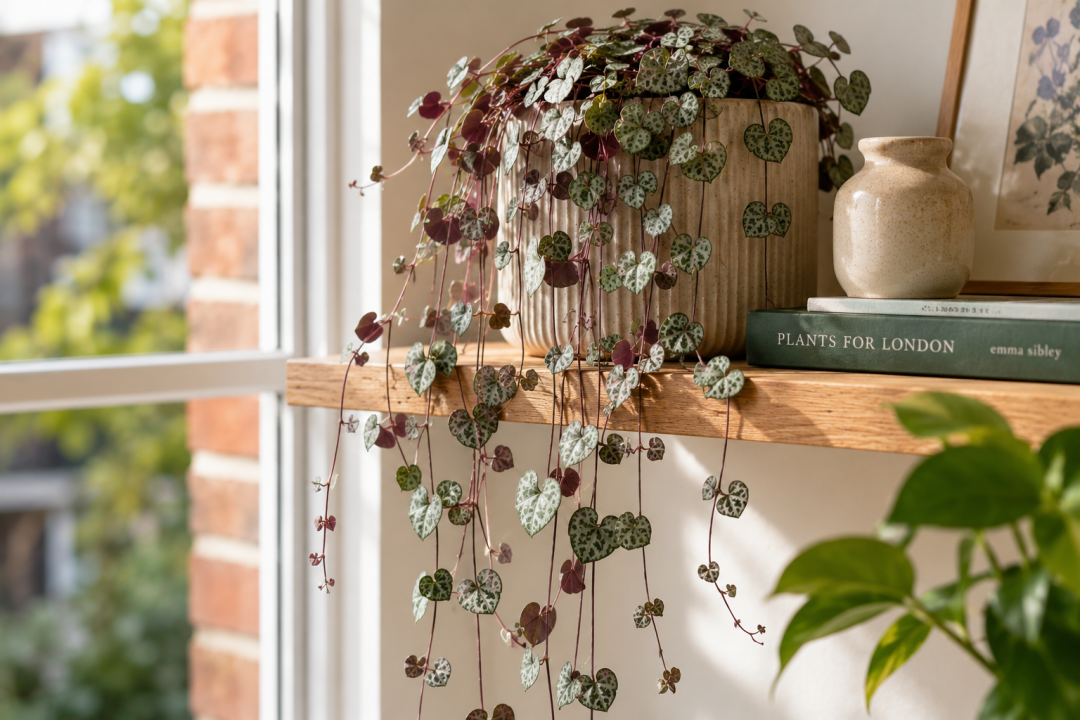
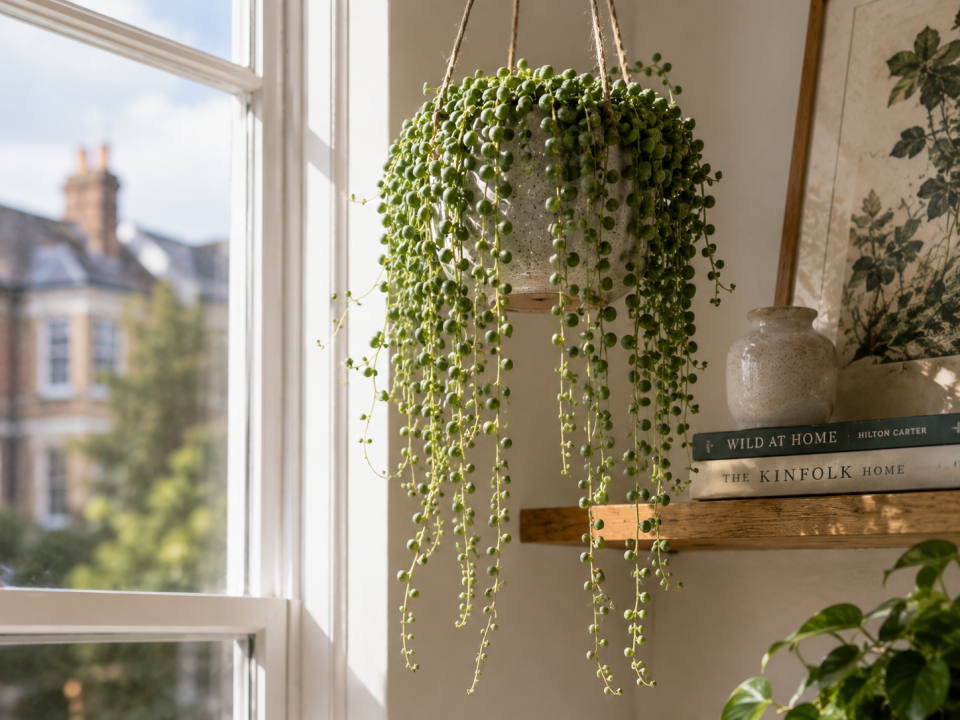
String of Hearts trails fine, wiry stems strung with small, silver-marbled, heart-shaped leaves — one of the most elegant trailers for a bright spot, and forgiving with it. It is semi-succulent, storing water in its leaves and in small tubers along the stems, so it tolerates a few hours of gentle direct sun and copes well with the occasional missed watering. We stock both the silver-green species and the pink-tinged variegated form. Let the compost dry between waterings and ease off in winter; overwatering is the only real way to harm it.
Lipstick Plant (Aeschynanthus)
The Lipstick Plant is grown above all for its flowers, producing showy tubular red or pink blooms that emerge from dark calyxes at the tips of trailing stems — the detail that gives it its name. We carry several, including the classic 'Mona Lisa' and the softer pink 'Pink Polka'. It wants bright, indirect light and a humid spot to flower reliably, which makes a well-lit bathroom or kitchen, or a position grouped with other plants, ideal. The glossy foliage trails well even between flushes of flower.
Hoya (Wax Plant)
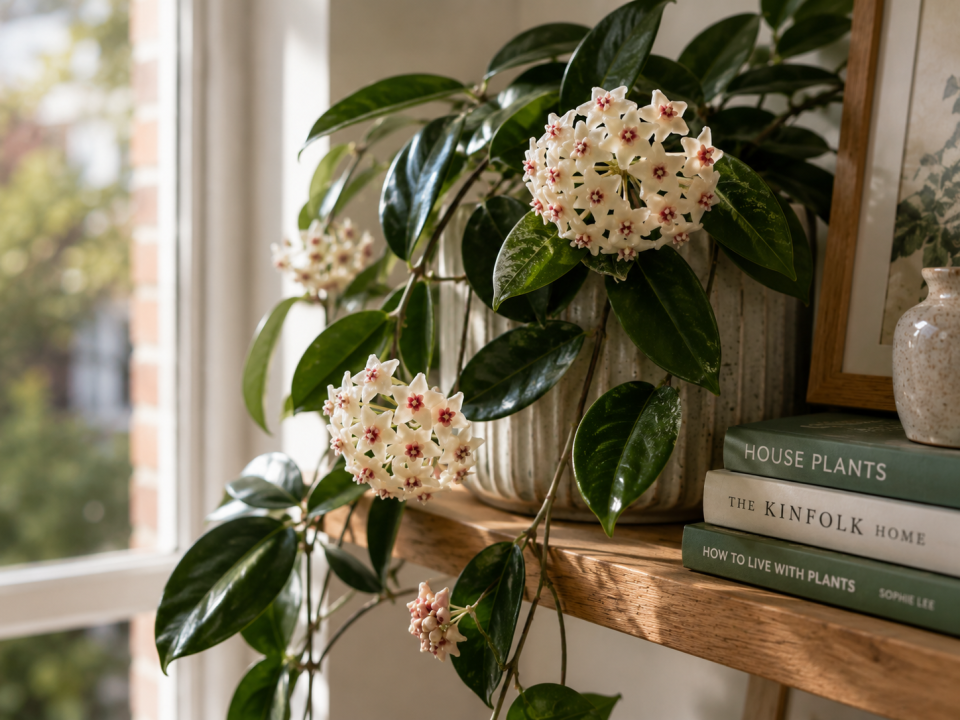
The Hoya, or Wax Plant, is the other flowering trailer worth building a display around — grown as much for its clusters of star-shaped, waxy, richly scented flowers as for its thick, glossy foliage. We usually carry the cream-and-green variegated Burtoniae and the curious heart-leaved Kerrii. It wants bright, indirect light to flower, kept out of harsh direct summer sun, and its semi-succulent leaves store water, so it forgives a missed watering and asks only for a light hand. One tip worth knowing: don't remove the short flower spurs once blooming finishes — Hoyas flower again from the same spurs year after year.
Satin Pothos (Scindapsus pictus)
Despite the name, Satin Pothos is a Scindapsus, distinct from true Pothos and arguably more beautiful — matt, deep-green leaves heavily splashed with silver that catches the light. We stock the silver-spotted 'Argyraeus' and the more heavily silvered 'Silvery Ann'. It is a generous trailer for bright, indirect light, and notably less prone than some variegated plants to reverting to plain green. Keep it out of harsh direct sun, which dulls the silver markings.
Heartleaf Philodendron 'Brasil' (Philodendron scandens)
The trailing Heartleaf Philodendron is a fast, generous grower with a naturally cascading habit. The 'Brasil' form carries vivid lime-green central variegation on glossy, heart-shaped leaves, bringing colour to a shelf or hanging pot without needing the brightest spot in the house. It prefers bright, indirect light and dislikes harsh direct sun. Easy, quick to fill out, and one of the most rewarding trailers for a beginner.
Tradescantia (Spiderwort)
Tradescantia is among the easiest and fastest trailing foliage plants, and bright, indirect light brings out the best of its striped, often purple-flushed leaves. It grows quickly, tolerates fluctuating conditions, and is one of the simplest of all houseplants to propagate — a cutting in water roots in days. A near east- or west-facing window keeps the colour vivid; too little light and the markings fade toward plain green.
String of Pearls (Senecio rowleyanus)
String of Pearls is the most striking of the trailing succulents, cascading strings of spherical, pea-like leaves from a hanging pot. As a true succulent it wants the brightest position of any plant here — a bright sill with some direct sun suits it — and the driest regime: water only when the compost has dried out, and far less in winter. Overwatering is the usual cause of failure. We carry the variegated form, its pearls flecked with cream.
Two Unusual Trailers Worth Seeking Out
Alongside the established favourites, we usually carry a few less-common trailing plants for collectors and anyone wanting something their friends won't have. Two in particular are worth looking out for.
Fishbone Cactus (Epiphyllum anguliger)
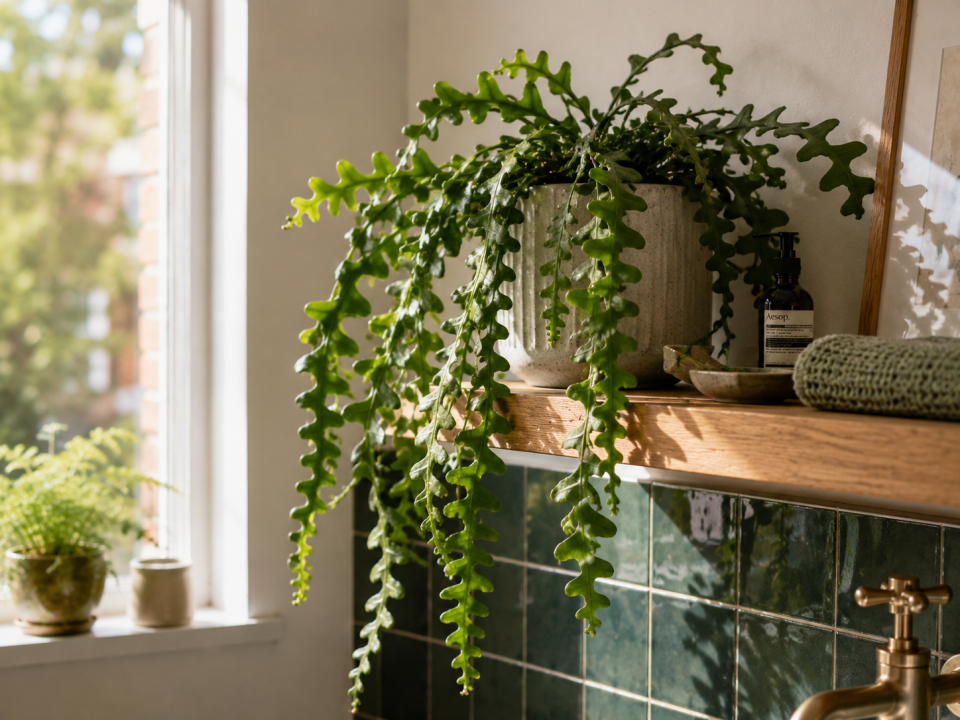
The Fishbone Cactus — also called the Zig Zag or Ric Rac Cactus — is a jungle cactus, not a desert one, with flat green stems notched along their edges like a fishbone. They grow upright at first, then trail handsomely as they lengthen, eventually to a metre or more. As a rainforest epiphyte it wants bright, indirect light (not strong direct sun, which bleaches the stems) and a little more water and humidity than a typical cactus, which makes a bright bathroom or kitchen an excellent home. Mature plants may produce large, intensely fragrant flowers that open at night. Architectural, easy, and a genuine talking point.
Codonanthe
A rare and quietly charming trailer from the Brazilian rainforest, Codonanthe is a relative of the African violet, with small, thick, glossy leaves on slender cascading stems and delicate white-to-pink flowers that appear on and off through the year, sometimes followed by small berries. It asks for bright, indirect light, out of direct sun, and the same light-handed watering as the other epiphytes here. One for the plant lover who already has the classics and wants something few others will recognise.
Choosing by Light: A Quick Reference
The most reliable way to choose a trailing plant is to start from the light a spot actually receives. The table maps each plant to its light needs and the kind of London position that tends to suit it.
| Plant | Light | Typical position | Watering |
|---|---|---|---|
| Pothos (Epipremnum) | Bright indirect; tolerates lower light | Almost anywhere well short of deep shade | Moderate; let top dry |
| String of Hearts | Bright; some gentle direct sun | Bright sill, east-facing ideal | Low; dry between |
| Lipstick Plant | Bright indirect + humidity | Bright bathroom or kitchen | Moderate; keep slightly moist |
| Hoya (Wax Plant) | Bright indirect; no harsh sun | Bright room or shelf; needs light to flower | Low; let dry between |
| Satin Pothos | Bright indirect; no harsh sun | East- or west-facing room | Moderate; let top dry |
| Philodendron 'Brasil' | Bright indirect; no direct sun | East- or west-facing room | Moderate; let top dry |
| Tradescantia | Bright indirect intensifies colour | Near east- or west-facing window | Moderate; keep evenly moist |
| String of Pearls | Brightest spot; some direct sun | Bright south- or west-facing sill | Low; dry out fully between |
| Fishbone Cactus | Bright indirect; avoid strong sun | Bright bathroom or kitchen (likes humidity) | Low–moderate; let top dry |
| Codonanthe | Bright indirect; out of direct sun | East- or west-facing; humid spot | Moderate; don't let sit wet |
Our indoor plant room at 51–53 Islip Street, Kentish Town carries a changing range of trailing and hanging houseplants year-round — from the everyday Pothos and Tradescantia to String of Hearts, Lipstick Plants and the occasional unusual find like the Fishbone Cactus. Because these are indoor plants, they're a good year-round category to buy and to gift, and we deliver to all postcodes within the M25. The team can help you match a plant to the light in your particular room — bring a photo of the spot if it helps — and point you to the right pot and compost to go with it. Check delivery zones and charges.
Caring for Trailing Plants
Most trailing houseplants are easy, and the care they need has more in common across the group than not. Get the light right first (see above), then keep these few principles in mind.
- Water with a light hand. The most common way to lose a trailing plant is overwatering. For the foliage plants, let the top few centimetres of compost dry before watering again; for the succulents — String of Pearls, String of Hearts — let the compost dry out almost completely, and water far less in winter when growth slows.
- Hung plants dry faster. Warm air rises and collects near the ceiling, so a plant in a hanging pot up high dries quicker than the same plant at table height. Check it more often, especially in a centrally heated room in winter.
- Use a pot that drains. Keep the plant in its nursery pot inside a decorative cover pot, or use a pot with a drainage hole, so excess water never collects at the roots. Tip away anything that pools in the cover pot after watering.
- Feed through the growing season. A balanced liquid houseplant feed every few weeks from spring through summer keeps foliage and flowers coming; stop in autumn and winter.
- Humidity helps the jungle plants. Lipstick Plant, Fishbone Cactus and Codonanthe all appreciate more humid air — a bathroom or kitchen, or grouping plants together, raises local humidity through the moisture they release.
- Trim to keep them full. A long, leggy stem can be pinched or cut back, which encourages branching and a fuller plant — and most of these root easily from the cuttings, so a trim is also free new plants.
- Turn them now and then. Plants grow toward the light, so a quarter-turn every week or two keeps growth even rather than one-sided.
Frequently Asked Questions
What Is the Easiest Trailing Indoor Plant?
Pothos (Epipremnum) is the easiest and most forgiving. It grows quickly, trails to a metre or more, tolerates a wide range of light from bright to fairly shady, and bounces back readily from a missed watering. Tradescantia and Heartleaf Philodendron are close behind. All three suit a beginner or a busy household, and all root easily from cuttings if you want more.
Which Trailing Plants Suit Low Light?
Pothos is the most tolerant of lower light and will stay attractive in a north-facing room or a spot well back from the window, though its growth slows and variegated forms fade toward green. Heartleaf Philodendron also copes with less light than many. No trailing plant thrives in genuinely dark conditions — all need usable daylight — but these tolerate shadier corners better than most.
How Often Should I Water a Trailing Houseplant?
It depends on the type. Leafy plants like Pothos, Philodendron and Tradescantia want the top few centimetres of compost to dry out between waterings — typically once a week in summer, less in winter. Succulents such as String of Pearls and String of Hearts want to dry out almost completely and need watering much less often. With all of them, overwatering does more harm than underwatering, and hanging plants dry faster than those lower down.
Why Is My Trailing Plant Going Leggy or Bare at the Top?
Long, sparse stems with widely spaced leaves usually mean too little light — the plant is stretching toward the window. Move it somewhere brighter (indirect for most), and pinch or trim the leggy stems to encourage fuller, branching growth lower down. The cuttings can be rooted and put back into the same pot to thicken it up.
Are Trailing Houseplants Safe Around Pets?
It varies by plant, so it's worth checking each one if you have curious cats or dogs. Some, like Pothos and Philodendron, are mildly toxic if chewed and are best hung or shelved out of reach — which trailing plants lend themselves to anyway. Others, such as the Fishbone Cactus, are pet-safe. If in doubt, ask us in store and we'll point you to the safer options.
Where Can I Buy Trailing Indoor Plants in North London?
Boma Garden Centre at 51–53 Islip Street, Kentish Town NW5 2DL carries a year-round range of trailing and hanging houseplants — Pothos, String of Hearts, Lipstick Plants, Satin Pothos, Philodendron, Tradescantia and more, plus the occasional unusual trailer. Come in to see the current range and get advice matched to your room's light, or order for delivery to any postcode within the M25.
Trailing houseplants are best chosen in person — you can see the plant in growth, judge the trail, and match it to the light in your room. Come and see the current range in our indoor plant room at 51–53 Islip Street, Kentish Town NW5 2DL; the team can help you choose and pair it with the right pot and compost. We're open seven days a week, and we deliver indoor plants to all M25 postcodes if you'd rather order in.
Visit Us in Kentish Town Browse Hanging Plants Check Delivery