

Anyone who’s ever tried to grow a plant will have come up against the question of plant food and fertilizer. With so many different types of fertilizers available, how can you tell which one is best for your plants? We’ve tried to answer some of the most common questions below.
Is plant food the same as fertilizer?
Strictly speaking, plants make their own food, using the elements available in the atmosphere and the soil. Fertilizers are products that we add to the soil to increase nutrient levels. However, in gardening books, websites, and garden centres, you will see the terms ‘plant food’ and ‘fertilizers’ used to mean the same thing, and in this article, when we talk about ‘plant food’ or ‘plant feeds’, we mean a fertilizer.
What do fertilizers do?
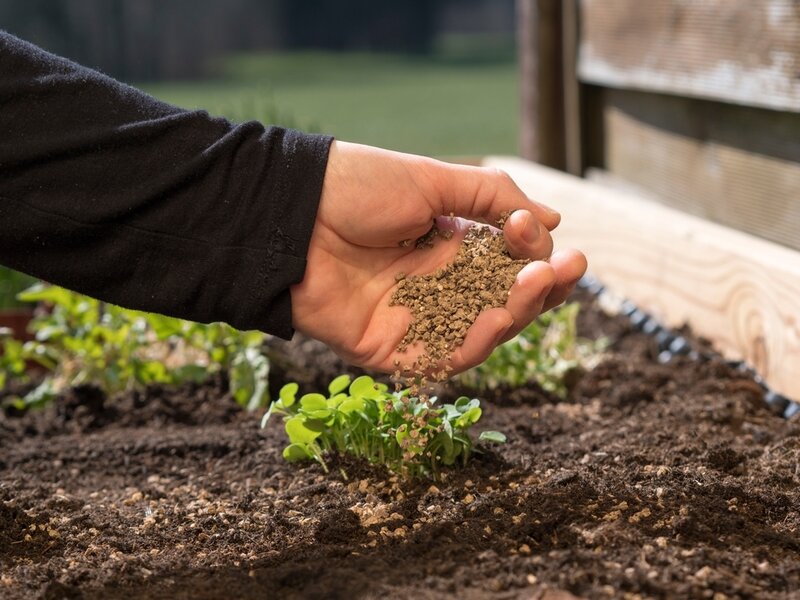
Fertilizers add nutrients to the soil that plants need for healthy growth. They don’t do anything to improve the soil structure. However – for that, you need to add organic material such as compost, leaf mould or well-rotted farmyard manure.
What’s the difference between organic and inorganic fertilizers?
- Inorganic fertilizers are manufactured using chemicals. They are generally faster-acting than inorganic fertilizers. Growmore, Tomorite and Miracle-Gro are all examples of inorganic fertilizers.
- Organic fertilizers are made from plant or animal material. Seaweed feed, bonemeal, and chicken manure pellets are all organic fertilizers. These are usually slower-acting than inorganic fertilizers because they take longer to break down in the soil.
What is an NPK ratio?
Fertilizers contain three key elements: nitrogen, phosphorus and potassium. These three elements are essential for healthy plant growth.
- Nitrogen (chemical symbol N) promotes green leafy growth.
- Phosphorus (chemical symbol P) is important for the development of roots and shoots.
- Potassium (chemical symbol K) promotes the development of flowers and fruit.
Different plants need different amounts of these elements. Leafy vegetables like spinach may need a nitrogen-rich fertilizer to encourage good leaf growth. A high-potassium (usually called high-potash) feed will help plants such as roses and vegetables like tomatoes to produce more flowers and fruit.
The proportion of nitrogen, phosphorus and potassium in fertilizer is called the NPK ratio and is listed on the packaging of each fertilizer. A balanced fertilizer will have roughly the same percentage of each element. In contrast, a high-potash feed such as tomato feed will have a higher potassium percentage than the other two elements.
Top tip: Remember that plant roots can only take up nutrients that have been dissolved in water, so when checking NPK ratios on the packaging, look for the figure that shows the percentage of each element soluble in water.
Advice on applying fertilizers
- Always follow the manufacturer’s instructions.
- Don’t overfeed plants, as this can harm them.
- Water plants well before applying liquid feeds to avoid burning their roots.
Do you need help to decide which fertilizer is best for your plants? Visit our centre, where our staff will be happy to help you.