

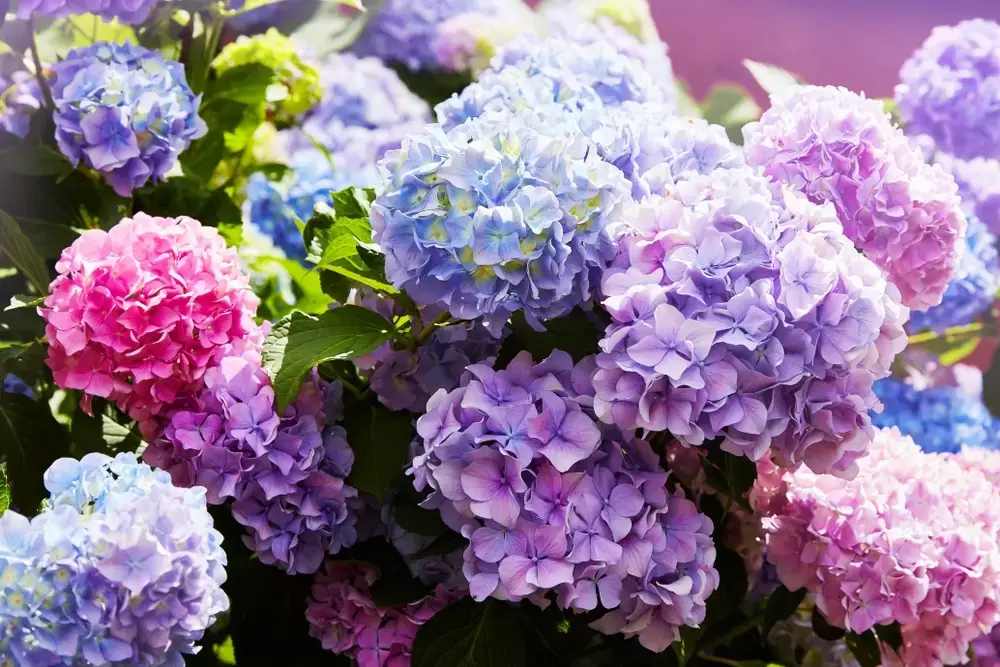
Did you know hydrangeas are perfect for a shady border with bold foliage and big flowerheads? If you’re looking for a plant with a significant impact, you can’t beat a hydrangea. Their rounded shape and bold foliage make an excellent backdrop for other plants, and they have their starring moment in late summer when the eye-catching flowerheads appear. Hydrangeas are easy to care for, and they’re perfect for lighting up a shady corner of the garden. Find out everything about hydrangeas and start growing them yourself.
How to grow hydrangeas
Hydrangeas do best in moist, well-drained soil in dappled shade. Macrophylla hydrangeas (mopheads and lacecaps) have a unique party trick up their sleeves – the flowers change colour depending on soil pH (acidity or alkalinity). When grown in acidic soil, their flowers turn blue, producing pink flowers in alkaline soil. White-flowered hydrangeas are the exception, as their flowers don’t change colour with soil pH.
Types of hydrangea
Whatever your situation, there’s sure to be a hydrangea to suit. Here’s a quick overview of the most common hydrangea types:
-
Hydrangea macrophylla: this includes both mophead and lacecap hydrangeas. Mophead hydrangeas have rounded flowerheads, while lacecaps have flatter flowerheads with a centre of tiny flowers surrounded by an outer ring of open florets. The flowerheads can be red, pink, blue or white.
-
Hydrangea paniculata: These are generally large shrubs with conical flowerheads in late summer. In some varieties, the flowerheads gradually change colour over the season.
-
Hydrangea arborescens: these have huge domed flowerheads and are spectacular in full flower. Hydrangea ‘Annabelle’ is the best-known variety of this species, with enormous rounded white flowerheads.
-
Climbing hydrangeas (Hydrangea anomala ssp. petiolaris and Hydrangea seemannii) are excellent for a shady wall. They can take a couple of years to get going but eventually cover a large area.
Landscaping ideas for hydrangeas
Hydrangeas have a fabulous presence on the border, and they flower for a long time in mid and late summer. Here are a few ideas on where to place your hydrangeas for the best effect:
-
Hydrangeas add both texture and architectural interest to borders with their large round flowers, making a good contrast with more delicate perennials or ornamental grasses.
-
Mophead hydrangeas are compact enough to be grown in a large container. Place a couple in pots on a patio to brighten up a shady seating area.
-
Brightly coloured pink or blue hydrangeas make an excellent focal point in a pot on a patio. They also look good repeated through a mixed border to give a feeling of continuity to the planting.
-
Add white-flowered hydrangeas to a shady corner of the garden to add light and interest all through summer.
-
Hydrangeas are perfect for filling a space in a border, growing quickly into neat, rounded shrubs. The dry flowerheads last a long time and can be left on the plants over winter to add interest. They also make excellent cut flowers.
Our centre has a fantastic selection of hydrangeas and other shade-loving plants. Come in and see our great range!