

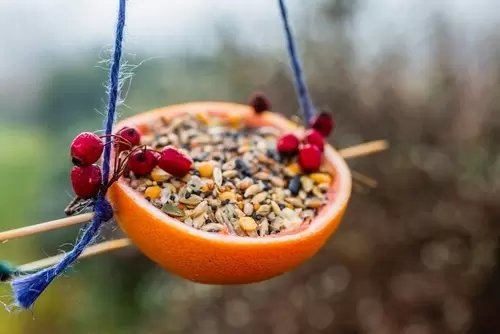
Fat balls are a favourite treat for many birds in winter. Packed with energy-rich fats and seeds, they give birds the extra resources they need to survive cold weather when other food is scarce. Fat balls are fun and easy to make at home, and here’s how it’s done.
What you need to make fat balls for birds
- String
- A yoghurt pot or something similar, to use as a mould
- Lard or suet
- Porridge oats or seeds
- Raisins, currants or sultanas (optional)
- Grated cheese (optional)
- Mealworms (optional)
Tip: Don’t use cooking fats such as turkey fat to make your fat balls, as it doesn’t set as well as lard or suet does. It also tends to smear on birds’ feathers, making them less insulating and affecting birds’ ability to fly.
How to make a fat ball bird feeder
-
Pierce a hole in the base of the yoghurt pot.
-
Tie a knot at one end of the string and feed the other end up through the pot’s base so that you have a long length coming out of the top of the pot, which you can use to hang the finished fat ball from a tree branch. Seal over the hole and the knot with Sellotape to leak-proof the pot.
-
Add the seeds, grated cheese, raisins etc., to the pot so that it is filled to about 1cm below the rim of the pot.
-
Melt the lard or suet in a saucepan on a stove, then carefully pour it into the yoghurt pot to cover all the dry ingredients.
-
Place the pot in the fridge to set.
-
Once set, remove the fat ball from the yoghurt pot mould.
-
Use the string to hang the fat ball from a tree and wait for the birds to find it.
Tits, robins, sparrows, blackbirds, nuthatches and even woodpeckers will love these balls.
Making fat balls with pinecones
If you don’t have any yoghurt pots to hand or don’t want to use plastic, pinecones make a handy alternative base.
- Collect a few fallen pinecones and clean them of soil and leaves. Tie a length of string to the base of each pinecone.
- Melt the lard in a saucepan on a stove, and mix in the oats, seeds and other dry ingredients.
- Using a knife or spoon, spread the mixture onto the pinecone, pushing it between the scales.
- Put the covered pinecones in a fridge to set.
- Use the string to hang the pinecones from a tree branch.
NB: Check your fat balls regularly and watch out for signs of mould in damp weather. If you see any mould, replace the ball with a fresh one.
Do you want to encourage more birds into your garden? We have a fantastic range of feeders, seed and other bird care products in the centre. Visit us soon to see what’s in store.