

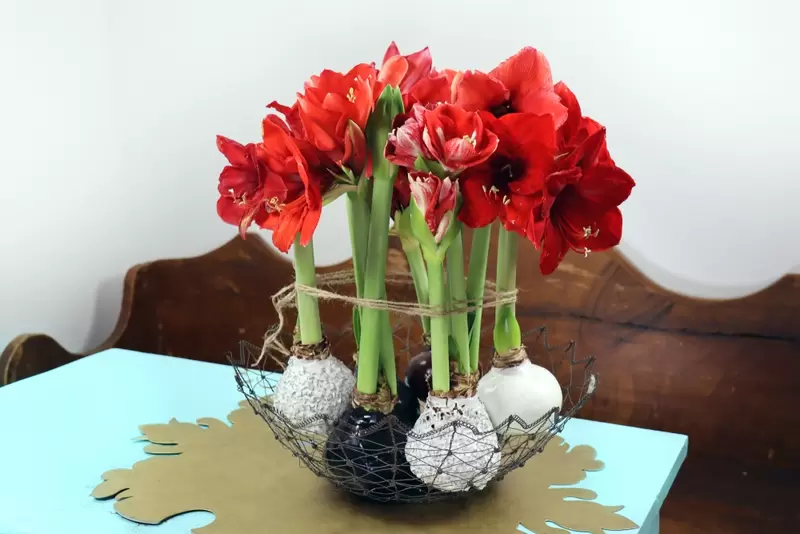
These facts about Amaryllis will help you to understand its origins, myths and how to care for it. Amaryllis are stunning when in bloom with the big, bright and beautiful flowers that light up a room. They can be a real focal point if placed in a prominent position. It’s not just the flowers that look incredible. Even the gigantic bulb the strong stem grows from is incredible as well! It’s an unmistakable plant, that’s for sure, and with the various colours available, there is an Amaryllis for everyone.
- History of the Amaryllis
- Myths about the Amaryllis
- How to care for Amaryllis
- After flowering care
Historical facts about Amaryllis
The Amaryllis is native to Africa, but the name actually derives from the Greek word ‘amarysso’, which aptly means ‘to sparkle’, and sparkle is done! The flowers in all colours have a gentle sparkle when you look closely at them. The big bulbs were introduced to Europe sometime in the 1700s, and in some places, it has been known for them to flower again and again for 75 years.
Myths and facts about Amaryllis
In Greek mythology, Alteo was loved by Amaryllis, who, upon advice from the Oracle of Delphi, stood at Alteo’s house for thirty long nights in a row and pierced her heart with a golden arrow. It turns out it worked because Amaryllis did win Alteo’s heart. Success, determination and strength are all associated with the Amaryllis flower, and you can see why! Amaryllis is the common name for flowers in the genus Hippeastrum. The latter looks similar, but the stems are different.
Facts about Amaryllis care
Firstly, Amaryllis plants are very easy to grow. So even though the big bulb might seem like it will need a lot of care, it really doesn’t at all. Amaryllis bulbs will take about six to eight weeks to flower from planting.
- Pot them up, but not in a pot that's too big,
- Leave the top inch, or more, of the bulb above the compost,
- Keep it in a brightly lit position but not with direct light, and there’s no need for much water until you see the shoot appear,
- Keep the compost moist but not overwatered.
After flower facts about Amaryllis
When the flowers have faded, just cut the flower stalk leaving about 3cm above the top of the bulb. You might even have a second stem growing at this point which you should just leave to enjoy the next flowers coming. When it has completely finished flowering, water and feed the plant as usual, and you will see plenty of leaf growth during the summer. From mid to late summer, stop watering, allow the foliage to die back and the compost to dry out. Move the pot to a cool, dark spot for at least eight weeks. Then report it in some new compost and start the process all over again.
Keep up the patience and strength, just like Alteo, and you will get it your Amaryllis bulbs bloom again.