

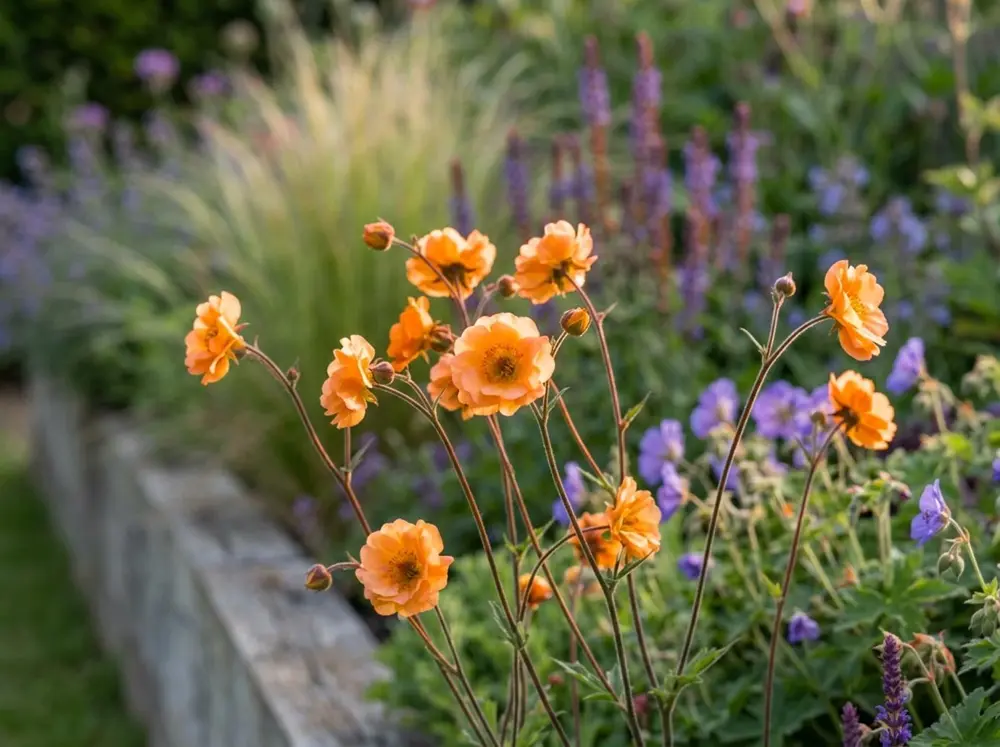
Geum 'Totally Tangerine' in full flower, with hardy geraniums and salvia providing the classic blue-purple contrast behind. This RHS Award of Garden Merit winner flowers from late spring right through to autumn.
If you've ever wondered what those bright, bobbing flowers are on wiry stems in practically every Chelsea show garden, you've been looking at Geums. They turn up year after year at the RHS Chelsea Flower Show, quietly stealing scenes from plants twice their size. And for good reason. Geums deliver months of colour from late spring right through summer, they're tough as old boots, and even slugs can't be bothered with them. For a North London garden, that last point alone is worth the price of admission.
Also known as avens, Geums belong to the rose family and form neat clumps of attractive, semi-evergreen foliage. From those clumps, slender stems rise carrying flowers in shades of orange, red, coral, peach, yellow and pink. Most top out around 45–60cm, making them perfect for the front and middle of a border. They mix brilliantly with grasses, salvias and hardy geraniums, and they're excellent cut flowers too. Pick a few stems, drop them in a jam jar on the kitchen table, and you've got an arrangement that looks like it took effort.
Browse the full Geum collection
Why They Make Sense in North London
Geums are genuinely unfussy plants. They cope with clay soils (which many of us around Kentish Town, Highgate and Hampstead know all too well), they tolerate partial shade, and they're fully hardy through our winters. They do prefer soil that doesn't sit waterlogged, so if your plot holds water in the wet months, work in some organic matter or grit before planting. A south-facing wall that bakes in July isn't ideal either — Geums like cool roots and a drink when it gets dry. That said, most London gardens offer exactly the kind of sheltered, part-sun conditions where Geums thrive.
They're also compact enough for the courtyard and patio container gardens that are so typical of our area. A couple of Geums in a decent-sized pot, underplanted with something trailing, looks smart on a front step from May through to September.
The Ones to Know
Here's where it gets interesting. Modern breeding has transformed Geums from a handful of cottage garden staples into a genuinely diverse group. At Boma, we stock a strong range this spring, and the selection reflects both the best of the old guard and some exciting newer cultivars.
Totally Tangerine
The Geum Totally Tangerine is the one that changed everything. Bred by Tim Crowther and introduced in 2010, it won RHS Chelsea Plant of the Year the same year and hasn't stopped appearing in show gardens since. It holds the RHS Award of Garden Merit and is a certified Plant for Pollinators. The flowers are a soft peachy-orange on tall, airy stems reaching up to 90cm — significantly taller than most Geums. Because it's a sterile hybrid (a cross between Mrs Bradshaw and Geum rivale), it never sets seed, which means it flowers non-stop from late spring into autumn without any deadheading. It combines well with practically everything: blues, purples, whites, yellows. If you buy one Geum this year, this should probably be it.
Mai Tai
Part of the Cocktail Series (yes, several Geums are named after drinks, and we'll get to that), Mai Tai opens with warm vermilion flowers that fade through peach to soft pink as they age. The result is a single plant carrying multiple tones at once, which creates a lovely watercolour effect. The stems are dark burgundy, adding contrast. It's compact at around 35cm, brilliant for the front of a border or a pot, and it's a strong performer in cooler spots — something to remember for those shaded North London courtyard walls.
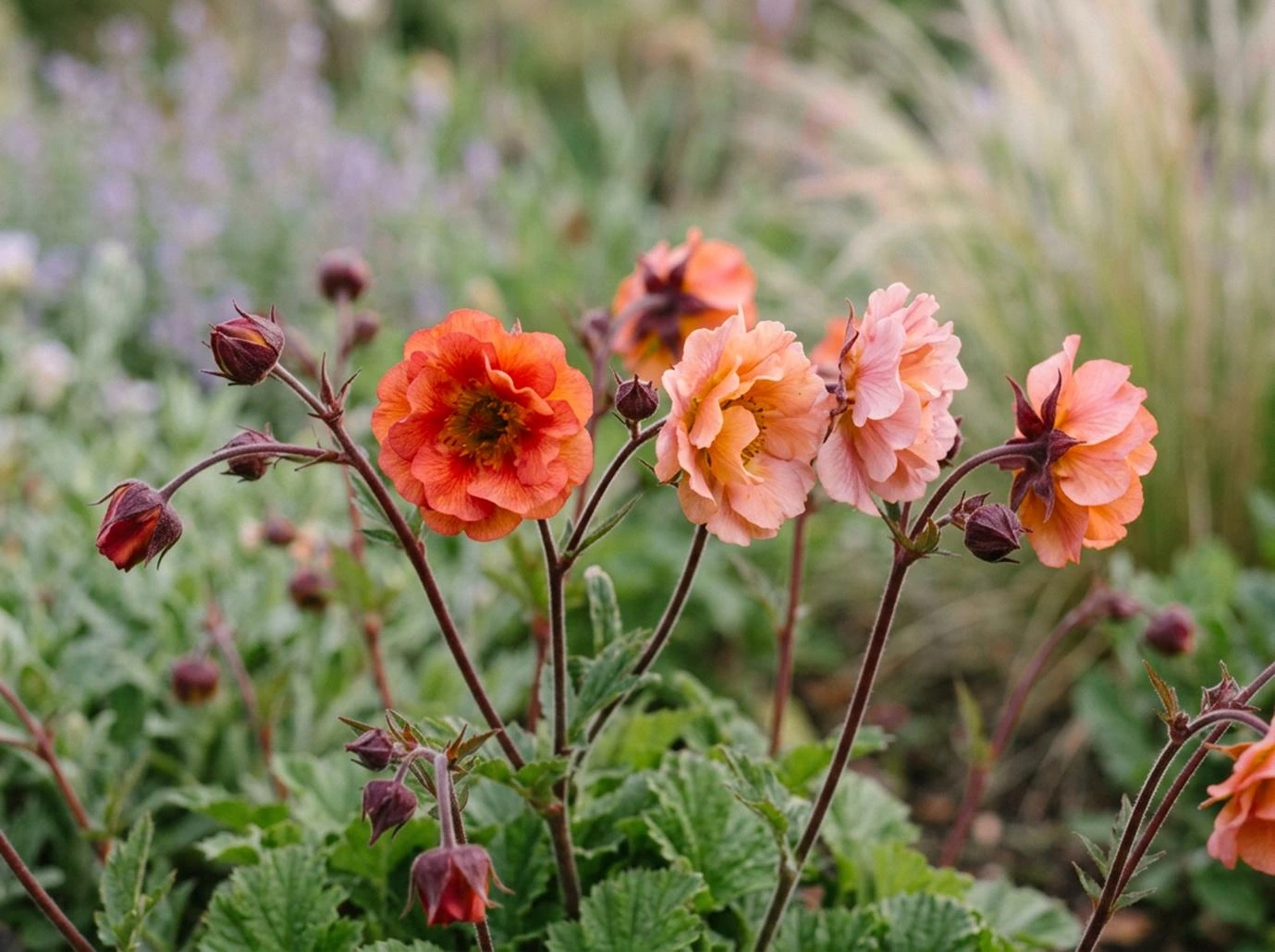
Geum 'Mai Tai' showing its signature colour shift — flowers open a warm vermilion before fading through peach to soft pink, giving a single plant the feel of a watercolour palette. Dark burgundy stems add contrast.
Miss Clementine
Miss Clementine offers up semi-double flowers in a clean clementine-orange, held on wiry stems above dark green, strawberry-like foliage. It flowers for months and the blooms are large enough to make an impact without the plant getting unruly. A proper workhorse in the border and another one that earns its spot in a container.
The Heritage Pair: Lady Stratheden and Mrs Bradshaw
These two have been border staples for decades and still hold up. Lady Stratheden gives you masses of double yellow flowers; Mrs J Bradshaw delivers bright red. Both reach 60–75cm and flower in sun or part shade. They need deadheading to keep flowering (they're not sterile hybrids), but they reward the effort. If you want tried-and-tested, these are it. Mrs Bradshaw is also one of the parents behind Totally Tangerine, so she's arguably the matriarch of the modern Geum renaissance.
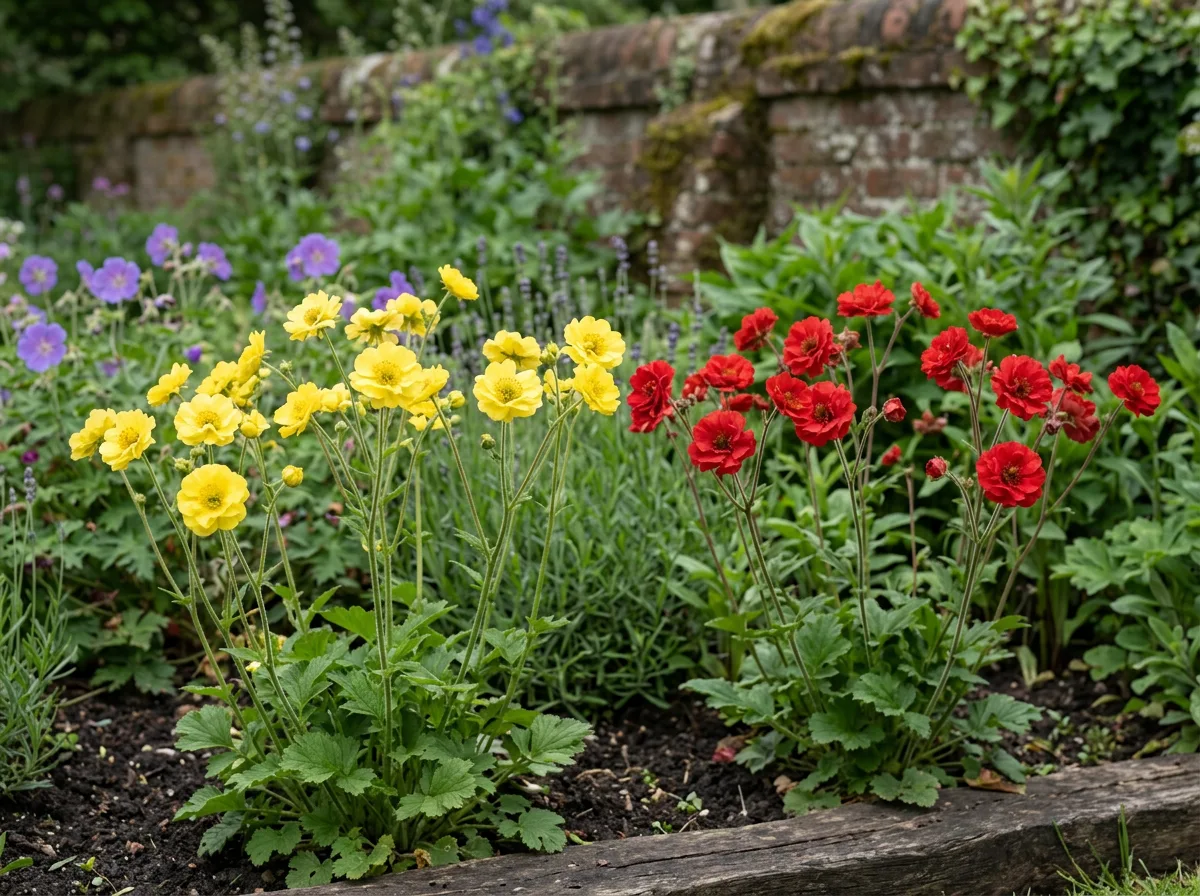
Geum 'Lady Stratheden' and Geum 'Mrs J Bradshaw' — the heritage pair. Double yellow and bright red blooms that have been earning their place in English borders for generations.
The Tempest Series
This is where breeding has really pushed things forward. Developed by Scottish plantswoman Elizabeth MacGregor (who also gave us Anemone Wild Swan), the Tempest series produces large, often double flowers on sturdy plants with impressively long flowering seasons. They're sterile hybrids, so like Totally Tangerine, they keep flowering without fuss.
Scarlet Tempest came second in the RHS Chelsea Plant of the Year competition in 2016. Large, frilly, double scarlet flowers flushed with apricot appear from mid-spring, take a short break, then return from midsummer right through to autumn. It's compact at 45cm and works in both borders and pots.
Coral Tempest followed in 2019, building on Scarlet Tempest's success with rich coral-pink semi-double flowers that are even larger at around 5cm across. Long flowering, dense foliage, and equally at home in a container or a sunny border.
We also stock Fiery Tempest, Foxy Tempest and Tropical Tempest — all variations on the same reliable theme, each with their own colour personality.
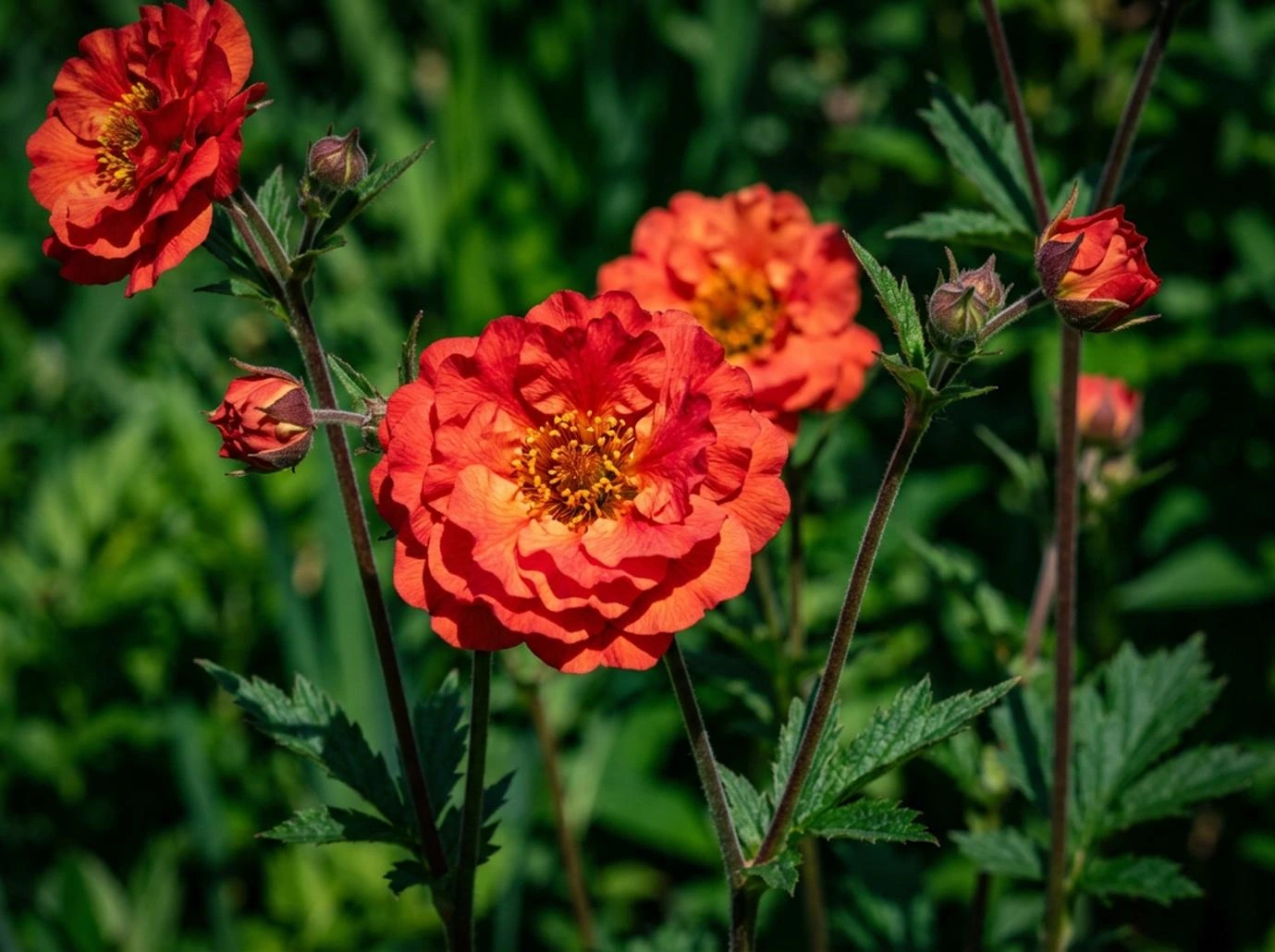
Geum 'Scarlet Tempest' — large, ruffled double flowers in rich scarlet with an apricot flush at the centre. Bred by Elizabeth MacGregor in Scotland, this sterile hybrid flowers from mid-spring through to autumn.
The Cocktail Cabinet
Beyond Mai Tai, several of our cultivars carry cocktail names: Alabama Slammer has ruffled semi-double orange flowers and a compact 30cm height. Banana Daiquiri brings a softer, warmer tone. Tequila Sunrise does exactly what you'd expect with warm red-orange gradients. These tend to be compact, punchy plants ideal for the front of a bed or tucked into a mixed planter.
More to Explore
The full range this season includes Bohema Pink, Borisii, Firestarter, Flames of Passion, Koi (a striking alpine type with shocking orange flowers at just 30cm), Leonard's Variety (a shade-tolerant Geum rivale type with soft, nodding russet flowers), Nonna, Orange Pumpkin, Petticoats Peach, Pink Petticoats, Tempo Rose, and the Tosai series in both orange and yellow.
That's over 25 cultivars. It's one of the strongest Geum selections we've ever put together.
Planting and Care: The Short Version
- When to plant: Spring is ideal — right now, in fact. Plant them while the soil is still cool and moist, and they'll settle in quickly before summer.
- Where: Sun or partial shade. Avoid the hottest, driest spot in the garden. Geums like cool feet and steady moisture, so a border that gets morning sun and afternoon shade is perfect. They also work well in containers.
- Soil: Moist but well-drained. They'll cope with clay if you improve the drainage with compost or organic matter. They tolerate both acid and alkaline soils.
- Watering: Keep them watered through the first summer. Once established, they're reasonably drought-tolerant, but they'll look and flower better with consistent moisture.
- Deadheading: For the sterile hybrids (Totally Tangerine, the Tempest series), you barely need to bother — they just keep going. For seed-setting types like Lady Stratheden and Mrs Bradshaw, regular deadheading extends the season significantly.
- The important bit: Divide your Geums every three years. This is not optional. If you skip it, the clumps turn woody and bare in the centre, and eventually they'll die. Dig them up in spring, split them into healthy sections, replant the best bits, and you'll have fresh, vigorous plants that flower brilliantly. It also gives you free plants for elsewhere in the garden or to pass on to neighbours.
- Pests: Essentially none. Slugs ignore them. Deer ignore them. Rabbits ignore them. The only things to watch for are vine weevil in containers and geum sawfly larvae in spring, neither of which tends to be a serious problem.
Visit Boma
Our Geum range is in stock now and looking good. Come and see us in Kentish Town to pick up a few plants for your borders, pots, or that tricky spot by the front door that never quite performs. Our team can help you choose the right varieties for your garden conditions, and if you'd rather not wrestle with the planting yourself, ask about our planting services.
Shop our full Geum range and seasonal perennials online at bomagardencentre.co.uk, or pop in and browse in person. April is the perfect month to get them in the ground.