

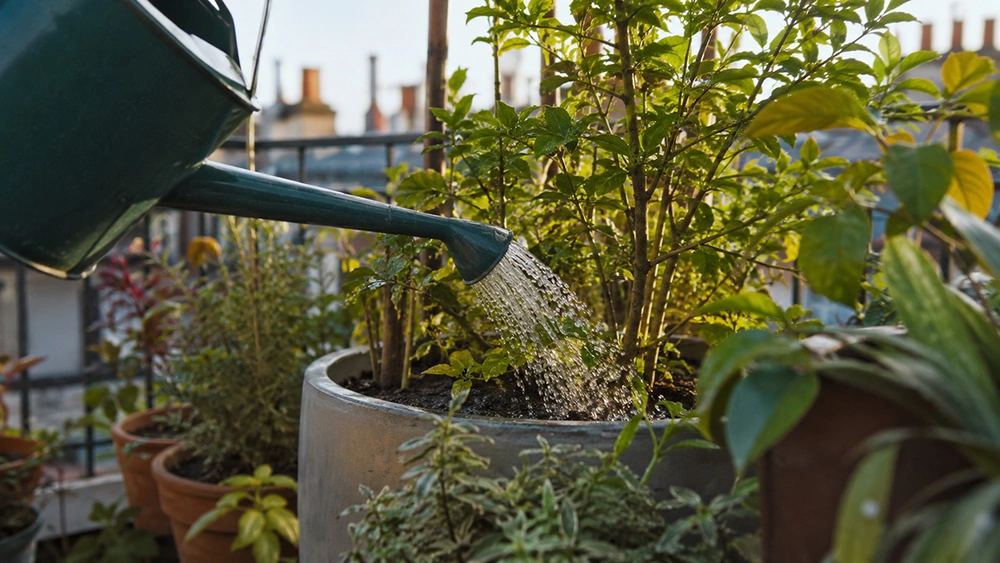
Why Plants Need Water — Beyond the Obvious
Plants need water for three distinct reasons, and understanding which of the three is most urgent at any given moment is what separates good watering practice from guesswork.
The first is photosynthesis. Water is a raw material in the photosynthetic reaction — alongside carbon dioxide, it is split to produce glucose and oxygen. Without it, the process slows or stops. But the water requirement for photosynthesis itself is relatively modest; the much larger demand comes from the second reason.
The second is transpiration. Plants cool themselves and drive the movement of nutrients up from the roots to the leaves by drawing water in through the roots and releasing it as vapour through tiny pores called stomata in the leaf surface. On a hot day in a London garden, a large container-grown shrub may transpire several litres. This is not inefficiency — it is the plant's circulatory system. Nutrients dissolved in the soil water are carried up through the roots along with it. If the soil dries out, nutrient uptake stops even if the nutrients are present. A plant that looks pale or tired in summer drought is often nutritionally deficient, not just thirsty.
The third is cell turgor. Plant cells maintain their shape and structural rigidity through internal water pressure. A well-watered leaf is firm because its cells are fully expanded. When water is lost faster than it is replaced, cells lose pressure and the plant wilts. This is a temporary and recoverable state in mild drought — but once a plant reaches what plant scientists call the permanent wilting point, cell damage occurs that no amount of subsequent watering can fully reverse.
The practical implication is the same in each case: watering is most effective before plants show stress, not in response to it. By the time a plant has wilted visibly, the damage is already underway.
Reading Water Stress Before Damage Occurs
The most useful skill in summer garden management is learning to read the early signs of drought stress, which appear before wilting and before visible damage. These vary by plant type, but the common signals are:
- Loss of leaf gloss. Leaves that normally have a slight sheen become matt before any wilting occurs — this is one of the earliest signs that cell turgor is dropping.
- Slightly less upright leaves. Leaves and stems lose a little of their normal angle before they actually droop. In grasses, the blades begin to fold or roll inward.
- Slowed growth at the tips. New growth at the shoot tips pauses — stems that were extending daily become stationary.
- Flowers dropping or failing to open. Drought stress during the flowering period causes buds to abort or flowers to drop prematurely — one of the most frustrating results of irregular watering in a container garden.
Overwatering produces a different set of signals that are easy to mistake for drought:
- Yellowing leaves, starting with the older (lower) leaves and progressing upward — the plant is dropping foliage it can no longer support in waterlogged conditions.
- Soft, mushy stems at the base, sometimes with a faint sour smell from the compost.
- Soil that remains wet to the touch several days after watering, with no drying at the surface.
- Leaves that feel soft rather than firm, despite the soil appearing wet.
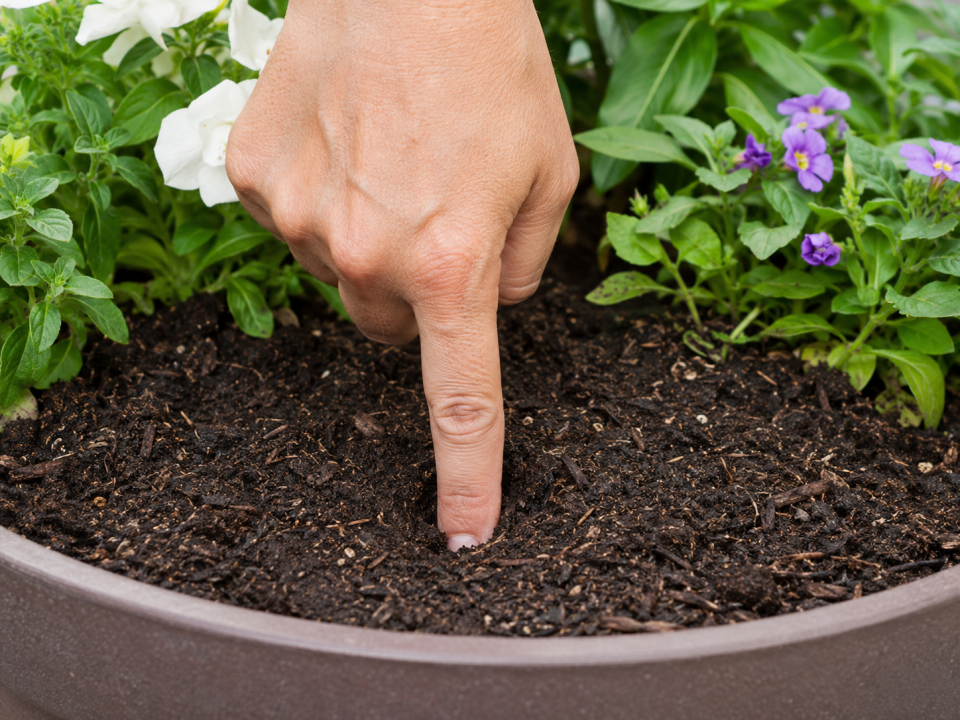
When in doubt, the most reliable diagnostic tool is your finger. Push it 3–4 cm into the compost or soil around the plant. Dry at that depth: water now. Still damp: leave it alone. This applies to containers, borders and houseplants alike. There is no schedule that replaces it.
Watering Cans, Hoses and Spray Guns
The right equipment shapes how you water — and whether you water at the right depth rather than just wetting the surface. The tools below are in rough order of usefulness for a typical North London garden with a mix of containers and open ground.
| Tool | Best Used For | Notes |
|---|---|---|
| Watering can with long reach spout | Seedlings, windowsill plants, individual pots indoors and out | Use a fine rose for seedlings and young plants (soft spray avoids disturbing compost); remove the rose for direct base-watering of established plants |
| Hosepipe | Borders, multiple containers, lawns | An open hose is imprecise and wasteful — always pair with a spray gun or lance attachment to control flow |
| Adjustable spray gun | General garden watering from a hose | [PRODUCT LINK: Gardena spray gun] — adjustable from fine mist (seedlings, foliage washing) to jet (deep-watering pots, reaching under dense planting). Significantly reduces water use vs. free-flow hose |
| Watering lance | Containers and hanging baskets at height, reaching into dense planting | The most underrated tool in a planted terrace. A long-arm lance gets water to the base of a hanging basket or to the soil under a large leafy canopy without disturbing the planting above |
| Trigger nozzle with flow lock | Any hand-watering | A lockable trigger means you can walk between containers without holding the nozzle shut — small thing, large difference on a terrace with twenty pots |
A note on hose quality: cheap hoses kink, restrict flow and fail at the connector within a season. A good hose — reinforced rubber or quality textile-braided — is worth the investment if you have more than a small courtyard. Boma stocks the Gardena hose and watering range, covering connectors, spray guns, lances and reel systems across different garden sizes.
Drip Irrigation and Tap Timers
If you have more than eight to ten containers, a planted terrace, or a garden that goes unwatered during heatwaves because you're away, a drip irrigation system is the most useful tool in this list. Not a luxury — a practical response to the fact that most London gardens are watered by people with full-time jobs.
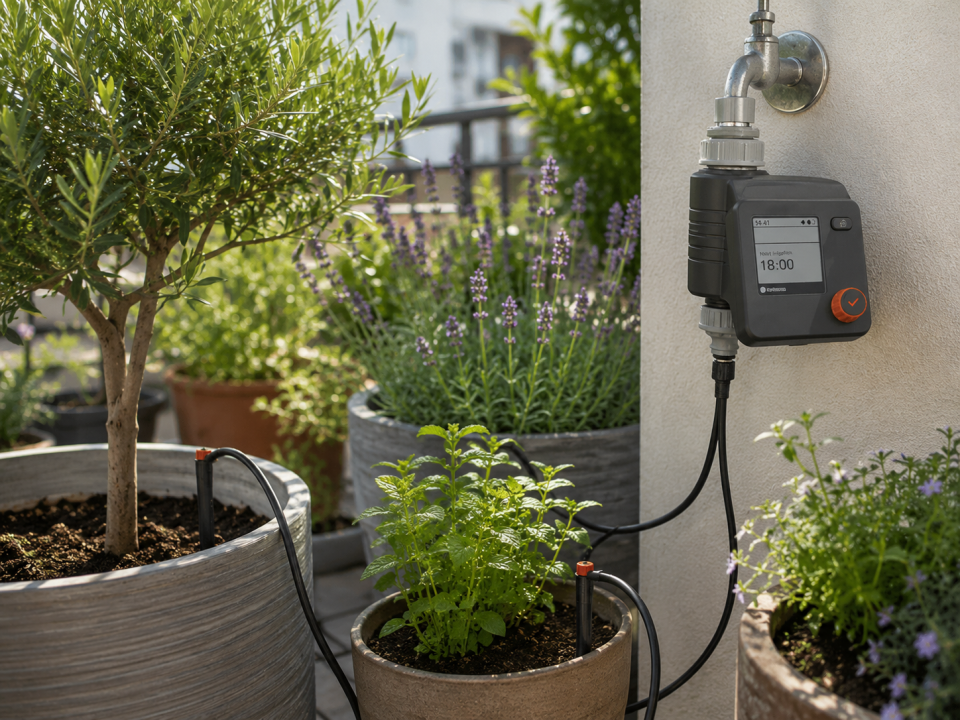
Micro-drip systems run thin tubing from a tap or water butt to individual emitters positioned at the base of each container. Water drips slowly and directly to the roots — no surface evaporation, no wet foliage, no guessing. Connected to a tap timer, they water at a set time each day without any input from you. The Gardena micro-drip range covers systems from three to four containers up to a full planted terrace or raised bed installation.
Setting up a basic drip system
Start at the tap: a tap connector and pressure reducer feed the main supply hose. A distributor splits the flow to individual runs of micro-tubing, each ending in a drip emitter positioned at the base of a container. A tap timer (battery-operated, no wiring needed) sets the watering window — early morning, daily or every two days in hot weather.
The whole system for ten to fifteen containers typically takes two to three hours to install and pays for itself in reduced plant losses within one season. Browse the Gardena irrigation range at Boma — the team can advise on the right components for your space.
Tap timers work independently of a drip system too: attach one to the tap with a hose connected, set it for 20–30 minutes at 6am, and your pots get watered whether or not you remember. Not a substitute for checking moisture levels — but a reliable baseline that prevents the worst outcomes during a prolonged dry spell.
Water Butts and Rainwater Collection
A water butt connects to a downpipe from your guttering and collects the rainwater that runs off the roof. In a typical North London terrace house, a single downpipe can fill a 200-litre butt several times over in a single heavy shower. This matters for two reasons: water cost and water quality.
Collected rainwater has a naturally lower pH than London tap water, which is drawn from chalk aquifers and runs at around pH 7.5 to 8. For acid-loving plants — Rhododendron, Camellia, Pieris, Vaccinium — this distinction is significant. Using tap water on ericaceous plantings in containers gradually raises the compost pH regardless of what they were planted in, reducing the availability of iron and manganese. Collected rainwater, close to neutral, preserves the growing medium. It is also noticeably better for houseplants, where mineral deposits from hard tap water accumulate on leaves and soil over time.
Practically: site the butt on a firm, level surface with a small stand to raise it enough for a watering can to fit underneath. Keep the lid closed to prevent algae and debris accumulation. In summer, a 200-litre butt empties quickly — connecting two in series doubles your storage. Boma stocks a range of water butts and accessories, including slimline models suited to narrow passages and courtyard gardens.
When and How to Water
Timing
Early morning is the best time to water — universally, for any plant type, in any garden. The soil is cool enough to absorb water before the sun warms it, foliage has the full day to dry (reducing fungal disease risk), and evaporation from the soil surface is minimised. If you can water only once, water in the morning.
Evening is acceptable in sustained hot weather when morning watering is not possible. Evaporation is lower than midday, which means more water reaches the roots. The risk is wet foliage through the night — in humid conditions this encourages powdery mildew and other fungal diseases, particularly on roses, courgettes and susceptible bedding plants. Water at the base of plants rather than overhead if watering in the evening.
Midday is the worst time — a significant proportion of water applied at the hottest point of the day evaporates before it reaches root depth, and cold water applied to hot leaves can cause scorch on thin-leaved plants. The only exception is a plant that is visibly wilting in full sun, where an immediate drink is better than waiting. Even then, apply water to the base, not the foliage.
Deep and Infrequent vs Shallow and Frequent
A generous soaking every two to three days is significantly more beneficial than a light watering every day. The reason is root architecture: roots follow moisture. A plant that receives only surface moisture keeps its roots in the top few centimetres of soil — exactly where temperature extremes and surface drying are most severe. A plant watered deeply, less often, develops roots that grow down into cooler, more stable soil layers and is far more resilient when a dry spell extends beyond your usual routine.
The target for containers is water coming out of the drainage holes at the base — that confirms you have reached the full depth of the root ball. For open ground, push a trowel in after watering to check how deep the moisture has penetrated. Aim for at least 15–20 cm in dry conditions.
Where to Direct the Water
Water at the base of plants, not overhead. Overhead watering wets foliage (disease risk), misses the root zone of many container plants where the canopy acts as an umbrella over the pot, and is less efficient. The exception is washing down dusty foliage on houseplants or rinsing pests — but even then, do it in the morning.
For newly planted specimens in open soil, direct the water over the original root ball, not the surrounding ground. The native soil around it may appear moist, but the nursery compost the plant arrived in dries at a completely different rate from the surrounding clay, and this is where the roots currently are. This is one of the most common reasons new plantings fail in a dry first summer.
Containers, Terraces and Roof Gardens
Containers present a fundamentally different watering challenge from open ground. They have no access to groundwater, their growing medium dries faster than any open soil, and the volume available to buffer moisture is limited by the size of the pot. This is compounded in a London context by south-facing terraces, reflected heat from brick and paving, and wind exposure on roof gardens that accelerates moisture loss further.
Pot Material and Drying Rate
| Pot Material | Drying Rate | Watering Notes |
|---|---|---|
| Terracotta (unglazed) | Fast — evaporates through the walls | May need daily watering in a heatwave. Worth lining with polythene (leaving drainage clear) if water retention is a priority; or use a saucer in summer to provide a brief water reserve |
| Glazed ceramic | Moderate — retains moisture longer than terracotta | Check by feel before watering — easier to overwater than terracotta. Good choice for plants that dislike irregular moisture (hostas, ferns) |
| Fibreglass / resin | Moderate to slow | Lightweight, good insulator — the root zone stays cooler than terracotta in full sun. Good for roof terraces where weight is a constraint |
| Plastic | Slow — virtually no evaporation through the walls | Easiest to overwater. In hot sun the black variants can heat the root zone significantly — avoid dark plastic pots in full sun positions |
| Wooden half-barrel or trough | Moderate | Insulates well; tends to dry from the inside out. Push a finger in to the centre to check actual moisture level, not just the surface |
Pot Size
A 40–50 cm diameter pot holds substantially more water, insulates better against temperature swings, and dries more slowly than a 20–25 cm pot. If plants in small containers are struggling through every dry spell, moving to a larger pot is a more durable solution than watering twice as often. The root volume also supports healthier, more vigorous growth.
Saucers in Summer
Saucers under pots are generally removed in winter (where standing water causes waterlogging and root damage) but can be used to advantage in summer. A shallow saucer beneath a terracotta pot provides a short-term water reserve that the pot draws on slowly over a warm day. Empty any saucer that still has standing water after 24 hours — standing water longer than that depletes oxygen around the roots.
Mulching the Container Surface
A 2–3 cm layer of fine gravel or decorative aggregate on the compost surface in a pot reduces surface evaporation measurably — testing consistently shows a meaningful reduction in water loss compared to bare compost in the same conditions. It also gives a clean finish and reduces liverwort growth on compost that stays moist. Boma stocks a range of decorative aggregates and chippings suited to this purpose.
South-Facing and Roof Terraces
An exposed south-facing London terrace on a clear June day can exceed 30°C. At that temperature, a small terracotta pot in full sun may need watering twice daily — early morning and early evening. This is not a maintenance failure; it is the physics of a small volume of compost in a ceramic vessel in radiant heat. The practical responses are: switch to larger containers, move to glazed or resin pots in the most exposed positions, install drip irrigation on a timer, and mulch every pot surface. Even one of these changes reduces the frequency significantly.
Newly Planted Trees and Shrubs
Establishment watering is the single most important watering task in the garden. A plant that fails in its first summer almost always fails because its root ball dried out — not because the soil around it was dry.
When a plant comes out of a container at the nursery, its roots are largely confined to the original growing medium. That compost has different water-retention properties from the surrounding garden soil, and it is where all the active root tips currently are. The surrounding soil — especially the clay-heavy soils of North London — may be moist while the root ball itself is dry. The plant has no way to access the ambient ground moisture until it grows new roots into the surrounding soil, a process that takes weeks to months after planting.
The practical consequence: for the first full growing season after planting, water directly over the root ball of any new plant, every five to seven days in dry weather, with a thorough soaking each time. Do not assume the surrounding moist soil is sustaining the plant. A common and useful technique is to create a small raised ring of soil 30–40 cm out from the stem, forming a shallow basin that concentrates water directly over the root zone and prevents it running off into the surrounding soil.
Trees planted in the ground need the same treatment amplified: a thorough soaking once a week in the first summer, applied slowly enough to penetrate deeply rather than running off. A slow trickle from a hose over 20–30 minutes is more effective than a quick blast.
How long does establishment take?
The rule of thumb is one year of establishment watering per 30 cm of plant height at time of planting — so a 90 cm shrub needs careful attention for roughly three growing seasons before it can genuinely look after itself in a dry spell. For trees and large specimen shrubs, continue first-year watering regardless of how settled the plant appears. Drought stress in the second and third year of a tree's life often doesn't show until the following season.
Established Borders
The good news about established borders in North London is that the heavy clay soils, which make so many other gardening tasks harder, hold water well. An established border with mature root systems reaching 30–60 cm into the soil has genuine drought resilience. In all but the most sustained dry spells, it needs less intervention than most gardeners assume.
The practical approach:
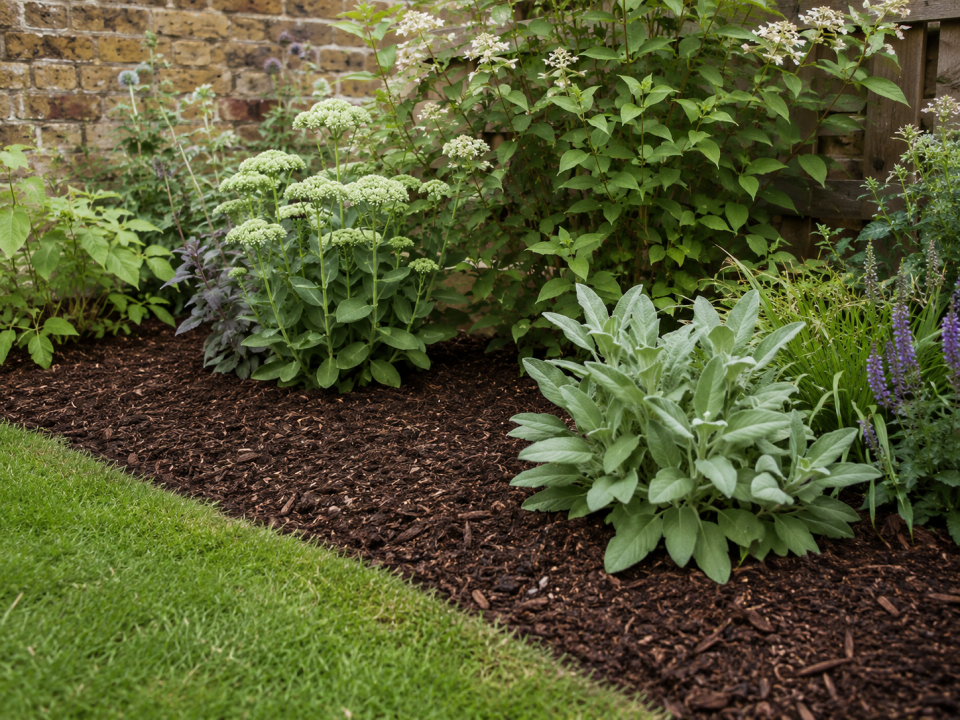
- Mulch in spring. A 5–7 cm layer of compost or bark mulch applied to moist soil in March or April is the single most effective action you can take for a border in summer. It significantly reduces surface evaporation, suppresses weeds that would compete for moisture, and feeds the soil as it breaks down. Applying mulch in summer to a dry border has much less effect — the moisture is already gone. See our compost and bark mulch range.
- Focus intervention on recent plantings. Established shrubs and perennials with deep root systems will manage most normal London summers. Direct your watering attention to anything planted in the last twelve months.
- Watch the soil surface — but not the top layer. North London clay cracks at the surface in a dry spell. This looks alarming but the cracks are a feature of surface clay drying — they do not mean the lower soil is dry throughout. Push a trowel or a finger into the soil beside a plant before watering to check what's actually happening below the surface.
- Act at the first signs of stress. In a genuine extended drought — two or more weeks without significant rain — watch for leaves rolling, early leaf drop on deciduous plants, and buds failing to open. At that point, a thorough soaking of the most vulnerable plants is worthwhile.
Houseplant Watering in Summer
Summer changes indoor plant watering in one important direction: most houseplants are in active growth from May through September, which means they are transpiring more and their compost dries faster than in winter. The frequency of watering increases naturally — but the method remains the same, and overwatering is still the more common mistake.
The Weight Test
The most reliable way to judge whether a houseplant needs water is to lift the pot. A pot that feels light has lost most of its moisture; a pot that feels heavy still has water in the compost. With practice, you develop an intuitive sense for what a given pot should weigh when dry vs. hydrated. This is faster and more accurate than a schedule, and works across plant types.
Watering by Plant Group
- Most foliage houseplants (Monstera, Pothos, Philodendron, Dracaena, Peace Lily): let the top 2–3 cm of compost dry before rewatering. In summer this may mean every five to seven days. Water thoroughly — through until it drains from the base — then stop and wait.
- Succulents and cacti: let dry completely between waterings. In summer, this typically means watering every two to three weeks rather than monthly. More succulents die from overwatering than from drought.
- Orchids (Phalaenopsis): water thoroughly in a sink, allow to drain fully, then wait until the roots visible through the pot appear silver-grey rather than green. In summer this is roughly every seven to ten days.
- Ferns and moisture-loving plants (Calathea, Maranta): these dislike drying out. Check every two to three days in a warm room. Keep the compost consistently moist but never waterlogged — a well-draining mix matters here as much as frequency.
Water Quality Indoors
London tap water at pH 7.5–8 leaves mineral deposits on leaves (a white-grey crust after repeated watering) and can gradually raise the pH of houseplant compost over time, particularly for acid-preferring plants. Where possible, use collected rainwater for acid-sensitive houseplants. Alternatively, letting tap water stand in a open container for 12–24 hours allows chlorine to dissipate, though it does not change the pH or mineral content. For plants that are visibly struggling with hard water — progressive yellowing, mineral crusting on compost — periodic flushing with rainwater helps reset the accumulated mineral load.
Reducing How Much Water Your Garden Needs
The most effective water-saving measures are structural — they change the conditions of the garden so that plants need less intervention, rather than asking you to do the same job more efficiently. These are worth prioritising over any watering technique.
Mulch Every Border, Every Year
A 5–7 cm mulch layer on moist spring soil reduces moisture evaporation from the soil surface by a meaningful margin throughout the summer. It also suppresses annual weeds that compete for water and nutrients, and improves the soil structure as it breaks down. Melcourt Composted Fine Bark and SylvaGrow Farmyard Organic Matter are both effective choices for established beds. Apply to moist soil only — never to dry ground, and keep mulch clear of direct stem contact. Browse the full mulch and compost range at Boma.
Moisture-Retaining Gel in Containers
Miracle-Gro Moisture Control Water Storing Gel mixed into container compost at planting — one to two teaspoons per 10 litres — absorbs water and releases it slowly as the compost dries. It reduces watering frequency noticeably for containers in exposed or south-facing positions and pays for itself in reduced losses through a hot summer. It is most effective when incorporated at planting; adding it to an established container is possible but less so.
Choose Plants That Suit the Conditions
The plants that need least watering once established are those that evolved in dry, sunny conditions — Mediterranean natives and South African species that are well adapted to summer drought. These thrive in North London's summers with minimal intervention once their first year of establishment is behind them:
- Lavandula angustifolia (English lavender) — fully established plants need no supplementary watering in a typical London summer
- Salvia nemorosa, S. microphylla — drought-tolerant once established, and valuable for pollinators across the whole season
- Cistus (rock rose) — one of the most drought-tolerant plants for a sunny border
- Stipa tenuissima, Festuca glauca — ornamental grasses that look best in dry, exposed conditions
- Echinops ritro, Eryngium — architectural plants that thrive on neglect once established
- Sedum / Hylotelephium — late-season flowering, excellent drought tolerance, attractive to butterflies
By contrast, consistently high-water plants in containers — lush bedding mixes, large-leafed tropical foliage — are a legitimate commitment. There is nothing wrong with choosing them, but go in with a clear sense of the watering requirement they carry.
Collect What Falls
A water butt on a downpipe costs relatively little and provides genuinely useful free water across the summer — particularly valuable if you use collected rainwater for acid-loving plants or houseplants where tap water pH is an issue. Boma stocks slimline and standard water butts suited to small courtyard and terrace spaces where a full-size barrel is not practical.
We stock the full Gardena watering and irrigation range — spray guns, lances, micro-drip systems, tap timers and hose reels — alongside water butts, moisture control products, and the mulches, composts and aggregates needed to reduce how much watering your garden requires. The team in store can advise on irrigation for a specific terrace or container setup. We're at 51–53 Islip Street, Kentish Town NW5 2DL, open seven days a week. We deliver to all M25 postcodes — check delivery zones and charges.
Frequently Asked Questions
How Often Should I Water Containers in Summer?
There is no universal answer — it depends on pot size, pot material, plant type, aspect, and the weather. The only reliable guide is the finger test: push 3–4 cm into the compost. Dry at that depth, water; still damp, wait. In practice, a terracotta pot on a south-facing London terrace in a heatwave may need watering daily or twice daily. A large glazed container in a sheltered courtyard may be fine every two to three days. If you want a baseline without constant checking, install a tap timer and drip system — it takes the guesswork out entirely.
My Plant Wilted Even After I Watered It — What's Wrong?
If a plant wilts shortly after watering — or stays wilted despite the soil being wet — the cause is almost certainly overwatering, not drought. Waterlogged roots become oxygen-deprived and lose their ability to take up water. The plant wilts not because there is too little water, but because the roots have been damaged and can no longer absorb it. Check the base of the stem: if it is soft, discoloured or has a sour smell, root rot is likely the issue. Allow the compost to dry out significantly before watering again, and consider repotting into fresh, well-draining compost if the damage is extensive.
Should I Still Water If It Has Rained?
Possibly — particularly for containers. A leafy plant in a pot acts as its own umbrella: rainfall rarely penetrates the canopy to reach the compost below. After rain, always check the compost directly before assuming containers are watered. For open borders with established plants, a good soaking rain of 15–20 mm is usually adequate for several days. A light shower of 5 mm or less has minimal impact on soil moisture at root depth and should not replace any planned watering.
Is Tap Water Bad for Plants?
For most garden plants and most container plantings, London tap water at pH 7.5–8 is fine. It becomes a problem specifically for acid-loving plants in containers — Rhododendrons, Camellias, blueberries — where repeated use gradually raises the compost pH and causes nutrient deficiencies. For these plants, and for sensitive houseplants where mineral deposits are an issue, use collected rainwater where possible. Standing tap water overnight before use allows chlorine to dissipate but does not change the mineral content or pH.
What Is the Best Way to Water a Lawn in Summer?
Most London lawns are better left unwatered. A brown, dormant summer lawn looks alarming but recovers once rain returns — grass is highly resilient and the roots survive underground even when the blades die back. Watering a lawn through a dry summer is expensive, time-consuming, and encourages shallow root growth that makes the lawn less drought-resilient over time. If you want to water a lawn: water deeply and infrequently (once a week, enough to penetrate 10–15 cm), early in the morning, rather than light sprinkles daily. Raise the mowing height in summer — longer grass shades the soil and reduces moisture loss significantly.
What Causes Brown Leaf Tips on Houseplants in Summer?
In summer, brown leaf tips on houseplants are most commonly caused by low humidity — central London homes with hard flooring and direct sun become very dry in a heatwave. The second most common cause is irregular watering: plants that dry out fully between waterings experience brief drought stress that causes tip damage. Third is mineral build-up from hard tap water, which desiccates leaf margins over time. Move sensitive plants (ferns, Calathea, tropical aroids) away from radiators and direct sun, group them together to raise local humidity, and switch to rainwater if tip browning persists despite consistent watering.
My Clay Soil Cracks in Summer — Does This Mean It Needs Water?
Not necessarily. North London clay cracks at the surface in dry weather, but the fissures are a feature of the upper few centimetres drying out — the soil at root depth may still have useful moisture. Before watering a border because the surface is cracking, push a trowel in 15–20 cm beside a plant and check the actual moisture level at that depth. If it is still damp, the established plants do not need intervention yet. When you do water, apply water slowly: dried clay is slow to absorb water and a fast flow will run off down the surface cracks rather than soaking in. A drip or slow trickle over 20–30 minutes is more effective than a quick heavy pour.
How Do I Water Plants When I'm Away?
For containers: a tap timer connected to a drip system is the most reliable solution and keeps working regardless of what the weather does. For a few days, the DIY bottle method (a small hole in the lid of a filled bottle, stood upside down in the compost) provides a slow drip over two to three days. Grouping containers together in a shadier, sheltered spot reduces moisture loss while you are away. For indoor plants: move them out of direct sun, water thoroughly before leaving, and group them together on trays with a small amount of water. Do not leave plants sitting in deep water for more than 24 hours.
Can Boma Help Plan Irrigation for a Terrace?
Yes. The team in store can advise on the right Gardena components for any terrace or container setup — from a basic tap timer for four to five pots up to a full micro-drip installation for a planted roof terrace. If you're considering commissioning a planting scheme alongside irrigation, Boma's Courtyard & Roof Terrace Planting Service covers planting design, installation and irrigation within a 5-mile radius of Kentish Town.
Boma stocks the full Gardena watering and irrigation range — hoses, spray guns, drip systems and tap timers — alongside water butts, moisture control products, and everything needed to set up a container or border for a London summer. Come and see us at 51–53 Islip Street, Kentish Town NW5 2DL. We deliver to all M25 postcodes.
Shop Watering & Irrigation Planting Service Check Delivery