

Start growing mistletoe with this guide, and you’ll be kissing underneath it in no time at all. There is a great deal of conflicting information about growing mistletoe, and as it is a parasitic plant, it is no wonder why many people think it cannot be grown at all. In fact, mistletoe isn’t that hard to develop, and you can even start collecting your own berries to grow on your host tree. Here’s how:
- Collect berries
- Store then rehydrate
- Sow your seeds
- Host tree
- Kiss under the mistletoe
Start growing mistletoe by first collecting berries
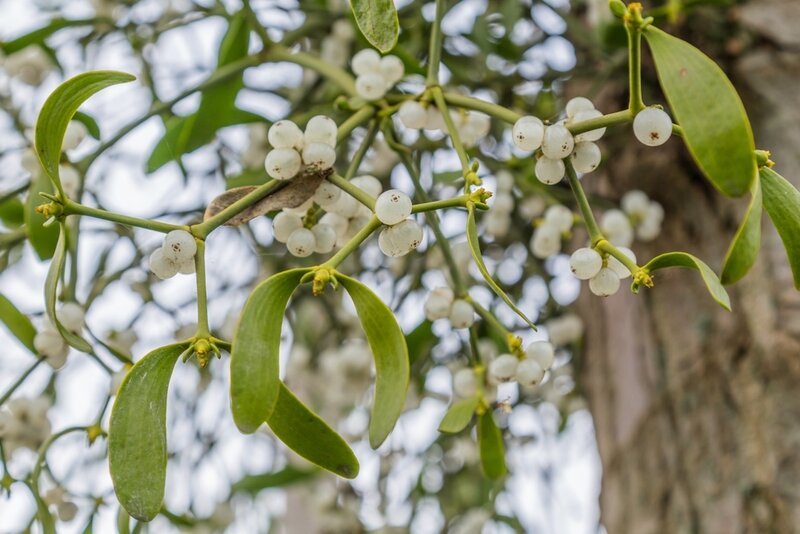
Collecting berries is best between February to March, but some plants will still have berries in April. Collect as many as you can, leaving plenty for the birds. Please make sure they are clean and discard any rotting or damaged berries, so they are ready to be used. You can also buy them online from a reputable store.
Growing mistletoe starts with good storage
If you have collected berries over Christmas, they can be stored in a cool, dry place with light. Don’t place them in the dark. Although using them fresh is by far the best way to grow mistletoe.
Sow your seeds and get ready to start growing mistletoe
This is the exciting bit! If your berries have been stored, pop them into some water to rehydrate them before squishing the seeds out of the berry. The seeds are coated in a gel-like substance, and ideally, if you can clear the seed of as much of that as you can, this will ultimately help germination. The seeds will still be sticky enough to stick to your hands and the host tree.
Growing mistletoe means choosing the host tree
There are many trees mistletoe can grow on, and you don’t need to put the seeds under a ‘flap’ of bark. It’s even more straightforward than that. All mistletoe needs are healthy tree bark and enough light. Choose young branches and stick about six seeds per branch. You’ll need to do this on a few branches to ensure germination, and then later success as not all will fully grow. Germination will be really quick, but full growth and berries will be in a few years time, so you’ll need some patience! It will be well worth it, though.
Growing mistletoe can only result in kissing underneath it
It might be some time, but all good things come to those who wait! So once that mistletoe is full of berries at Christmas, be sure to cut a little and hang it right over the door where the person you’d like a festive kiss with is sure to walk on through!
If you need any help with growing mistletoe tips, our friendly staff can advise you in the store.