

Lawns get a lot of hard use during the summer, so they need a little care and attention in autumn to help them recover. Follow these simple autumn lawn care tips to keep your lawn healthy through the winter and ready for another year.
Autumn lawn care tips
-
Keep mowing the lawn regularly, but as growth starts to slow down, raise the blades of your mower. As lawns are often wet with dew in the mornings at this time of year, it’s better to mow in the afternoons when the grass is dry.
-
Apply a lawn weed killer to eliminate any weeds that germinated over summer, always remembering to follow the manufacturer’s instructions. Alternatively, if you only have a few weeds in your lawn, weed them out by hand, taking care to get as much of the root as possible when dealing with broadleaved weeds like docks and dandelions.
-
Tackle moss by raking it out, or apply moss treatments – again, always follow the manufacturer’s instructions when using moss killer.
-
Scarify your lawn. Scarifying involves raking to remove thatch (dead grass) that builds up over the year and can form a thick layer over the soil, stopping water from reaching the roots of the grass. Scarify small lawns by raking them firmly with a spring-tine rake, or use a mechanical scarifier for larger spaces. As well as getting rid of thatch and moss, this helps to weaken broadleaf weeds like dandelions by damaging their leaves.
-
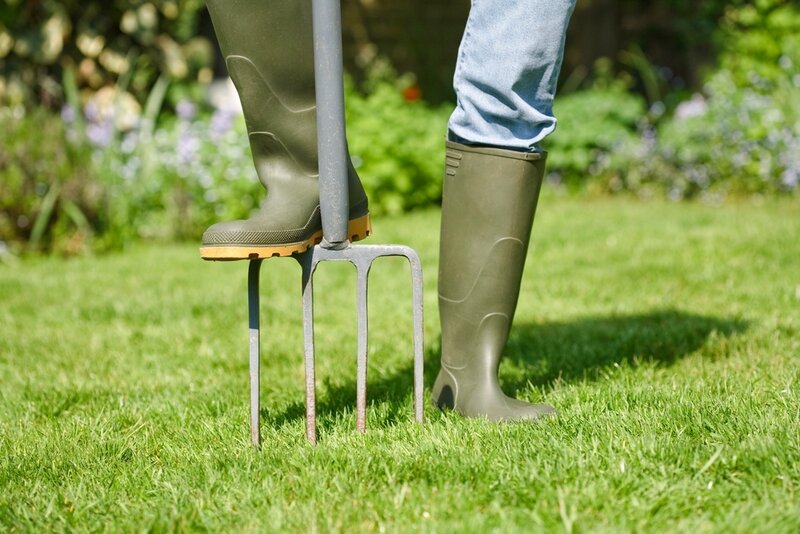
After scarifying, it’s a good idea to aerate your lawn, especially areas that have become compacted through frequent use. You can do this manually on small lawns, spiking holes in the soil at regular intervals with a garden fork or a hollow-tine aerator. However, this can be quite hard work, and for larger areas, it’s best to use a mechanical aerator. Aerating the lawn breaks up compaction, allows air in and improves drainage, helping the grassroots grow strong so they can out-compete weeds.
-
Once you’ve dealt with weeds and moss, and the lawn has been scarified and aerated, give it an autumn feed. Autumn lawn feeds are formulated to promote root growth and ‘harden’ the grass, helping your lawn recover from summer and strengthening it ready for winter.
-
Autumn is a good time to sow new seeds on bare spots in your lawn and also to lay new turf or patch bare areas. Although there is generally enough rain in autumn to keep the soil moist, water regularly if the weather is dry, and don’t let newly-laid turf dry out.
-
Finally, as the autumn leaves start to fall, rake them off the lawn so that the sunlight can reach the grass and cut back any plants that are spilling over onto the lawn.
We have everything you need in the centre to get your lawn into great shape this autumn, so visit us soon!